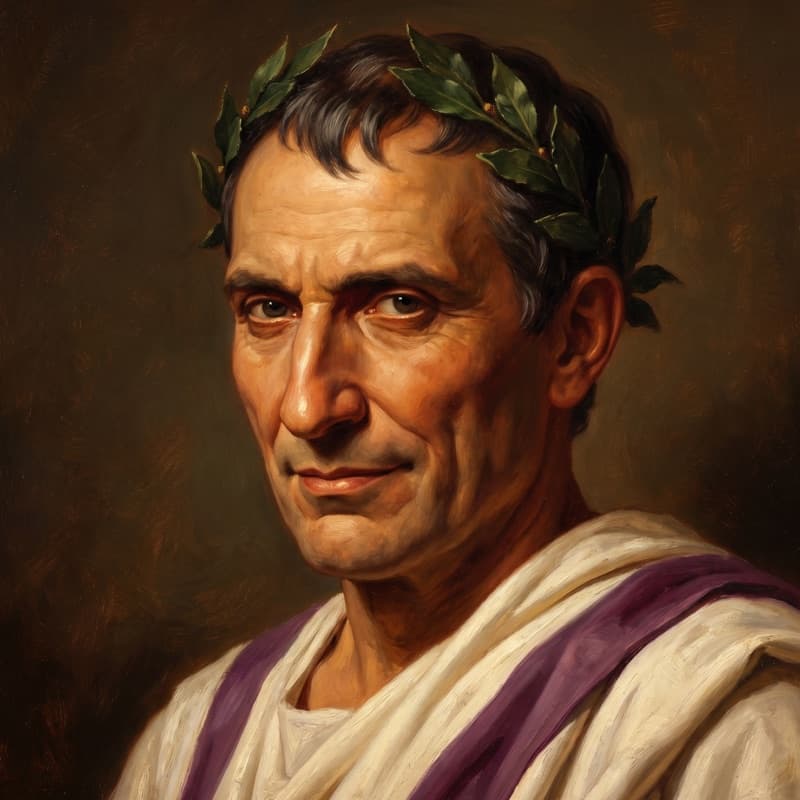
The essential Julius Caesar facts: born July 12, 100 BCE, into a patrician Roman family of ancient name but thin fortune; conquered Gaul over eight years of campaigning; crossed the Rubicon River with his army in January 49 BCE, triggering civil war; defeated Pompey at Pharsalus in 48 BCE; never a Roman emperor, though he ruled Rome as dictator; and assassinated by a group of senators on the Ides of March, 44 BCE, stabbed twenty-three times. All sourced below — plus the popular "facts," including his most famous supposed last words, that don't survive checking.
The core facts, with why they matter
Born July 12, 100 BCE, to a family of the old Julian gens. His father held the office of praetor; the family's politics ran with the Populares, the faction favoring Rome's lower classes over its senatorial elite — a starting position that shaped the coalition Caesar later built.
He allied with Pompey and Crassus around 60 BCE, then won election as consul in 59 BCE. Historians call this informal power-sharing arrangement the First Triumvirate. It was never an official office, just an agreement among Rome's three most powerful men — which is exactly why it eventually broke down.
His conquest of Gaul ran from 58 to 51 BCE. Caesar wrote his own account of the campaign, the Commentaries on the Gallic War, in the third person. National Geographic puts the human cost at more than a million Gauls killed or enslaved over those eight years — worth holding next to the celebrated opening line, "All Gaul is divided into three parts."
He crossed the Rubicon River into Italy in January 49 BCE. Roman law forbade a general from bringing an army into Italy proper; crossing anyway was open rebellion against the Senate and began the civil war against Pompey, whom he defeated at Pharsalus the following year.
Rome later granted him the title of dictator for life — National Geographic dates the declaration to 45 BCE. As sole ruler he expanded the Senate, broadened citizenship, and enacted the calendar reform still underlying the modern Western calendar. That same concentration of power convinced a group of senators that killing him was the only way to stop a monarchy from returning.
He was self-conscious about his baldness — and treasured the laurel crown as a cover for it. Suetonius records rivals needling him over his thinning hair; of every honor the Senate gave him, he prized the right to wear a laurel crown at all times "with greater pleasure" than any other, precisely because it hid what genuinely bothered him.
He was assassinated on the Ides of March, stabbed twenty-three times. Suetonius records that Caesar "uttered a groan only, but no cry, at the first wound" — a detail from an ancient biographical source, not dramatic invention.
Popular "facts" that need correcting
"Caesar's last words were 'Et tu, Brute?'" That line is Shakespeare's, written more than 1,600 years after the assassination. The closest ancient source, Suetonius, instead reports a disputed Greek phrase to Brutus — "kai su, teknon," roughly "you too, my child" — flagged as only one version among several, not a confirmed transcript.
"Caesar declared, 'Cowards die many times before their deaths.'" Also Shakespeare — a line spoken by his fictionalized stage Caesar, not anything preserved in Caesar's own writing or in Suetonius or Plutarch.
"Julius Caesar was a Roman emperor." He wasn't. Caesar ruled as dictator, an office he stretched into an unprecedented grip on power. Rome's first actual emperor was his adopted heir Octavian — later Augustus — who emerged from the civil wars that followed Caesar's death.
The fact pages can't hold him
Facts are the skeleton; the voice is the man. Our Caesar — an AI recreation, built from the sourced record and labeled as what it is — can tell you about weeping before a statue of Alexander at an age he felt he hadn't matched, about writing his own war in the third person, and about the vanity behind that laurel crown. Ask him why he crossed the river anyway. He's ready when you are.
More in this cluster: Caesar hub · his death · verified quotes · biography.