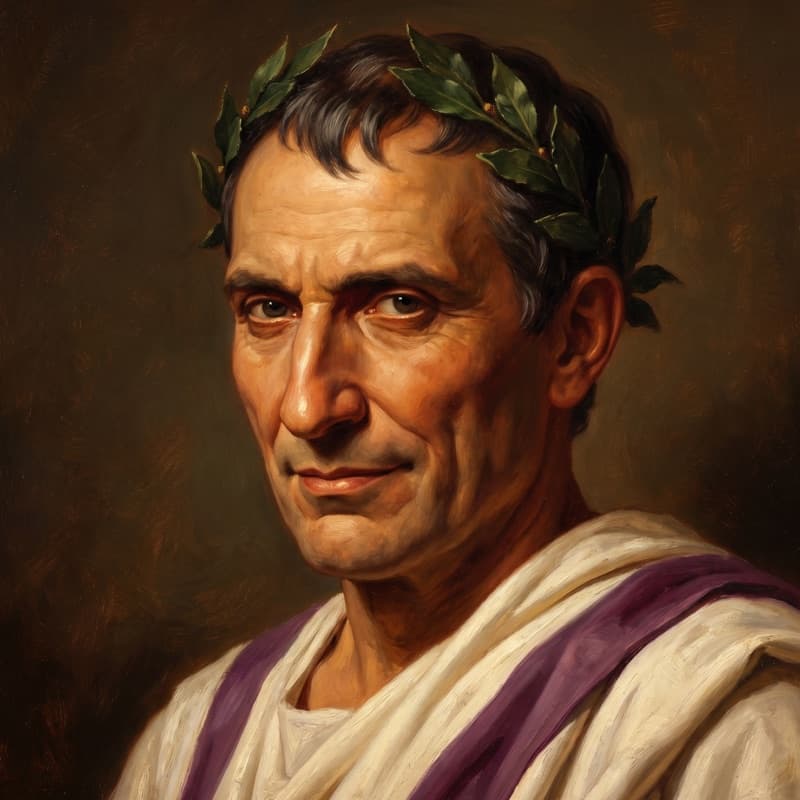
Julius Caesar's most reliably sourced lines survive through two kinds of witness: Caesar himself, in his own terse war commentaries, and the biographers Suetonius and Plutarch, writing generations later. This page keeps the two apart — and covers the line everyone "knows" that Caesar never actually said.
The general's own prose
Caesar wrote his Gallic campaigns in the third person, as if reporting on someone else's war. It opens with a line every Latin student meets:
"All Gaul is divided into three parts, one of which the Belgae inhabit, the Aquitani another, those who in their own language are called Celts, in ours Gauls, the third."
Plain and declarative — Caesar's style in miniature.
The Rubicon: two ancient traditions, not one recording
No one transcribed what Caesar said crossing into Italy in January 49 BCE. Suetonius gives the Latin line most people know:
"The die is now cast."
Plutarch instead reports Caesar spoke Greek at the river. Both are later historians' accounts, not a transcript — treat either as reported speech.
A public inscription, not a private boast
After a swift victory in Pontus, Caesar had a tablet carried in his triumph reading:
"I came, I saw, I conquered."
Suetonius calls this a public formula for the crowd — prized for advertising speed, not for describing the fighting.
Ambition, before the fame
On assignment in Spain, long before Gaul or the Rubicon, Caesar reportedly stood before a statue of Alexander the Great and said:
"Do you think I have not just cause to weep, when I consider that Alexander at my age had conquered so many nations, and I have all this time done nothing that is memorable?"
Plutarch records the same trip producing a colder line, said of a squalid Alpine village:
"For my part, I had rather be the first man among these fellows, than the second man in Rome."
The divorce, and the proverb it became
After the Bona Dea scandal touched his household, Caesar divorced his second wife, Pompeia, giving this reason:
"I wished my wife to be not so much as suspected."
The popular proverb "Caesar's wife must be above suspicion" paraphrases that sentence — useful shorthand, not Plutarch's actual wording.
The assassination
Suetonius's account of the Ides of March, March 15, 44 BCE, is spare:
"He was stabbed with three and twenty wounds, uttering a groan only, but no cry, at the first wound."
He also records a disputed Greek phrase supposedly said to Brutus — one version among several, flagged as uncertain even in the ancient source.
Quotes Caesar never said
- "Et tu, Brute?" Shakespeare's Latin, written for the stage in Julius Caesar (Act 3, Scene 1), sixteen centuries after the event — no ancient source records Caesar saying it (MIT Shakespeare, Act 3, Scene 1).
- "Cowards die many times before their deaths." Also Shakespeare — the character Caesar, arguing with Calpurnia about the morning's bad omens, not a preserved historical remark (MIT Shakespeare, Act 2, Scene 2).
If a "Caesar quote" sounds like a motivational poster, it probably came from the stage.
From a conversation with our Caesar
An excerpt from our AI Caesar persona — a stylized recreation, clearly labeled; not a historical quotation.
Caller: Did you really say "the die is cast"?
Caesar: Some clerk wrote that down years after the river had gone quiet, friend, and it reads well enough. What I remember is colder than any phrase — an army behind me, a law behind the Senate, no way to walk both banks at once. Men want my crossing to sound like a decision. It felt more like arithmetic.
Hear the calculating voice, not the marble bust
Our Caesar — an AI recreation, honestly labeled — argues the way the record suggests he did: precise, competitive, unwilling to let anyone narrate his own campaigns for him. Ask him what he actually weighed at the Rubicon before the historians got to it.
More in this cluster: Caesar hub · his death · biography · facts.