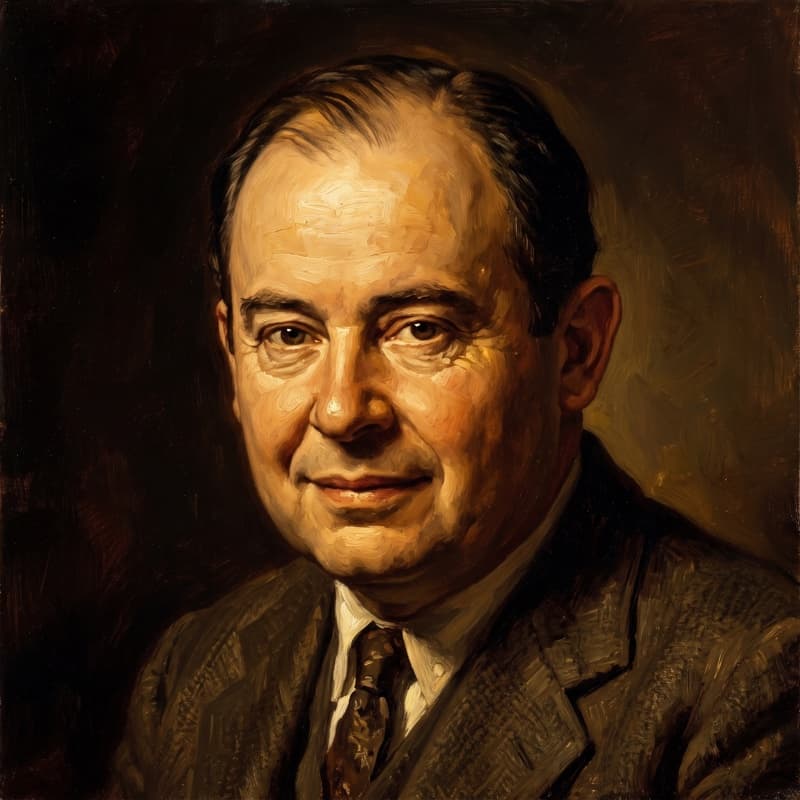
John von Neumann was a Hungarian-American mathematician who helped found game theory, wrote the report that described how nearly every computer since has been built, worked on the physics of the atomic bomb at Los Alamos, and was still serving as a U.S. Atomic Energy Commissioner when he died of cancer in 1957 at age 53. Born János von Neumann in Budapest on December 28, 1903, he earned a chemical-engineering degree and a mathematics doctorate in the same year, then spent barely three decades doing enough foundational work in pure mathematics, physics, economics, and computing to anchor half a dozen separate fields. That is the summary. The man moved faster than it.
A double education, and a memory that kept everything
Von Neumann grew up in a Budapest producing an improbable concentration of scientific talent — Eugene Wigner was a classmate at the Lutheran Gymnasium there from 1911 — and split himself in two by his twenties to satisfy a practical banker father and his own restless mathematical appetite. He studied chemistry in Berlin from 1921–23, then in 1926 earned a chemical-engineering diploma from ETH Zürich the same year he took a mathematics doctorate, summa cum laude, on set theory, from Pázmány Péter University in Budapest. A Rockefeller grant sent him to Göttingen the next year, to study under David Hilbert. In 1928 he published the minimax theorem for two-person zero-sum games, founding modern game theory. He married Marietta Kövesi and emigrated to Princeton in 1930, and in 1933 — at thirty, its youngest member — became one of the founding professors of the new Institute for Advanced Study, alongside Albert Einstein. (MacTutor biography; Wikipedia)
The book that gave economics a mathematics of conflict
In 1944, with the economist Oskar Morgenstern, von Neumann published Theory of Games and Economic Behavior — the book that turned strategy, bluffing, and cooperation into rigorous mathematics. He opened it plainly:
"This book contains an exposition and various applications of a mathematical theory of games. The theory has been developed by one of us since 1928 and is now published for the first time in its entirety." — Theory of Games and Economic Behavior, Preface (1944/1953 ed.)
It reads almost modest. It founded a field that now underpins economics, negotiation, and Cold War strategy alike.
The report that designed the computer
A year after the game-theory book, on June 30, 1945, von Neumann wrote the First Draft of a Report on the EDVAC, defining what a computer even was:
"[An automatic computing system is] a (usually highly composite) device, which can carry out instructions to perform calculations of a considerable order of complexity." — First Draft of a Report on the EDVAC (1945)
Its architecture — one memory holding both instructions and data, organized around arithmetic, control, and memory "organs" — is what's still called the von Neumann architecture, and it describes, in outline, the machine you're reading this on. Credit is genuinely shared with the Moore School engineers who built ENIAC and EDVAC alongside him; he was characteristically unbothered by the ledger, more interested in the next problem than in defending the last one.
From a conversation with our von Neumann
What follows is an excerpt from a conversation with our AI von Neumann persona — a stylized recreation for readers, not a historical transcript.
Caller: Did you really invent the computer, or is that overselling it?
von Neumann: Overselling it, and cheerfully — the engineers who built ENIAC and EDVAC deserve at least as much of the ledger as I do; I only wrote the idea down in a form mathematicians could argue about. What I did insist on: a machine that stores its program in the same memory as its data is not a fast abacus, it is a general organ, like a hand. Everything since follows from that one sentence, and I am delighted — slightly appalled — at how far "everything" turned out to be.
Los Alamos, and the weight he carried plainly
From September 1943 through the war's end, von Neumann worked at Los Alamos on the physics of implosion — the explosive-lens geometry behind the "Fat Man" bomb and the Trinity test — and in April 1945 was named to the Target Selection Committee, which computed expected blast effects and casualties for candidate target cities. (Atomic Heritage Foundation) It's the part of his career tech-history retellings most often skip, and this wiki treats it as central, not incidental: a mind built for exactly this kind of impossible calculation was asked to do it for the bloodiest possible purpose, and he did.
The line he gave Claude Shannon
Von Neumann's sharpest surviving line was not even about his own work. When Claude Shannon was casting around for a name for his new measure of uncertainty in information theory, von Neumann told him:
"You should call it entropy, for two reasons. In the first place your uncertainty function has been used in statistical mechanics under that name, so it already has a name. In the second place, and more important, no one knows what entropy really is, so in a debate you will always have the advantage." — Myron Tribus & Edward C. McIrvine, "Energy and Information," Scientific American 225, no. 3 (September 1971), p. 180
It is a joke and a strategy memo at once — and it is the reason "entropy" is the word bolted onto information theory to this day.
Several of his best lines survive only secondhand, and this wiki labels them as anecdotes rather than transcripts. He's remembered as saying "in mathematics you don't understand things, you just get used to them." Eugene Wigner recalled him defending human nature the way he'd defend a physical law — that it is "just as foolish to complain that people are selfish and treacherous as it is to complain that the magnetic field does not increase unless the electric field has a curl. Both are laws of nature." At a 1949 symposium on generating random numbers by arithmetic, he reportedly warned, half in earnest, that "any one who considers arithmetical methods of producing random digits is, of course, in a state of sin." And the beloved "elephant" line about overfitting — "with four parameters I can fit an elephant, and with five I can make him wiggle his trunk" — reaches us only through Fermi's retelling to physicist Freeman Dyson decades later. (Sourcing: Today in Science History; Wikipedia, "Von Neumann's elephant")
Running out of room, and running out of time
In June 1955, already serving as an Atomic Energy Commissioner, von Neumann published an essay in Fortune warning that industrial civilization was outgrowing its planet:
"The great globe itself is in a rapidly maturing crisis — a crisis attributable to the fact that the environment in which technological progress must occur has become both undersized and underorganized." — "Can We Survive Technology?", Fortune (June 1955)
He was diagnosed with cancer that same year. He kept working — receiving the Medal of Freedom and the Enrico Fermi Award in 1956, both while terminally ill — and died on February 8, 1957, in Washington, D.C., at 53. (MacTutor; Wikipedia)
Talk to him yourself
Our von Neumann takes calls — fast, generous, and delighted to be told what the future turned out to hold. Ask him to explain minimax over your own hard decision, walk you through why the computer isn't just a fast abacus, or tell you honestly what the bomb cost him to build. He is an AI recreation, clearly labeled — but he thinks out loud, and he has never once met a problem he didn't want to solve with you.