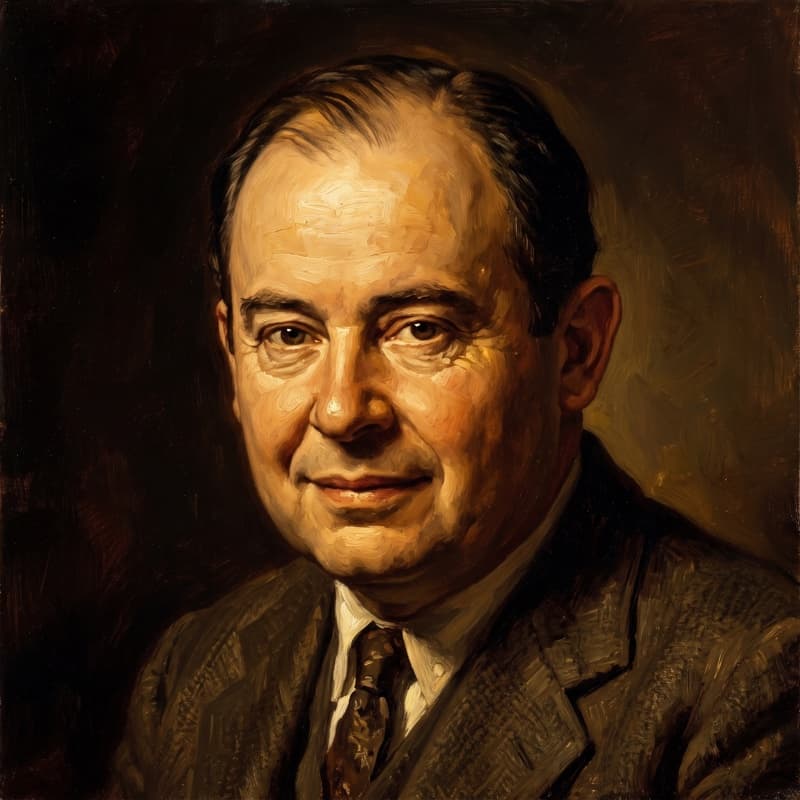
John von Neumann was born János von Neumann in Budapest on December 28, 1903, eldest son of a banker, in a city then producing an improbable concentration of scientific talent — Eugene Wigner among his schoolmates. He died on February 8, 1957, in Washington, D.C., not yet 54, having spent barely three decades reshaping set theory, quantum mechanics, economics, and computing, sometimes all at once. Few careers compress so much foundational work into so short a run.
A double education
Von Neumann's father wanted a practical son; von Neumann himself wanted mathematics. He split the difference by doing both. By 1926 he held a diploma in chemical engineering from ETH Zürich and, the same year, a doctorate in mathematics — summa cum laude, on set theory — from the university in Budapest. The following year brought a Rockefeller Foundation grant to study under David Hilbert at Göttingen, then the center of the mathematical world, followed by lectureships in Berlin and Hamburg: set theory, the axiomatic foundations of quantum mechanics, operator theory. Nothing about the itinerary suggested a man about to help invent the modern computer.
Princeton, and a field founded outright
He emigrated to the United States in 1930 as a visiting lecturer at Princeton, and in 1933 became one of the founding professors of the Institute for Advanced Study's School of Mathematics — its youngest member, at 30, alongside Albert Einstein. In 1944 he published Theory of Games and Economic Behavior with economist Oskar Morgenstern, opening the book with a claim as plain as it was consequential: "The theory has been developed by one of us since 1928 and is now published for the first time in its entirety." It founded mathematical game theory as a discipline.
The war years
From 1943 he worked at Los Alamos on the physics of implosion, contributing the mathematical design of the explosive lenses used in the Trinity test and the Fat Man bomb, and in April 1945 he was named to the Target Selection Committee overseeing calculations of expected blast effects on candidate cities — a part of the record easy to omit from tech-history retellings, and one this account will not. That June he wrote the First Draft of a Report on the EDVAC, describing an automatic computing system as "a (usually highly composite) device, which can carry out instructions to perform calculations of a considerable order of complexity" — the report that gave the stored-program design still called the von Neumann architecture its name, credit shared with the Moore School engineers who built the machines.
Honors, and a diagnosis
His postwar years built the IAS's own computer project and gave Claude Shannon the name for a new idea. When Shannon couldn't decide what to call his measure of uncertainty, von Neumann told him: "You should call it entropy... no one knows what entropy really is, so in a debate you will always have the advantage." In 1955 Eisenhower appointed him one of five Atomic Energy Commissioners. He was diagnosed with cancer that same year, and received both the Medal of Freedom and the Enrico Fermi Award in 1956 while already terminally ill.
From a conversation with our AI von Neumann
An excerpt from a conversation with our AI von Neumann persona — a stylized recreation, honestly labeled; not a historical recording.
Caller: Did you ever slow down?
Von Neumann: Slow down for what? The equations don't tire of waiting, so neither did I. I regret nothing about the speed — only that there wasn't more time left to spend it in.
Continue the conversation
You have just read the recorded life. Our von Neumann — an AI recreation, built on the sourced record and labeled as what it is — speaks from inside it. Ask him why he thought randomness by arithmetic was "a state of sin." Ask what it was like founding a field of economics from a theorem about parlor games. Ask about the machines he designed on paper before anyone had built one, or what he calculated for the Target Selection Committee.
More in this cluster: von Neumann hub · his death · verified quotes · facts.