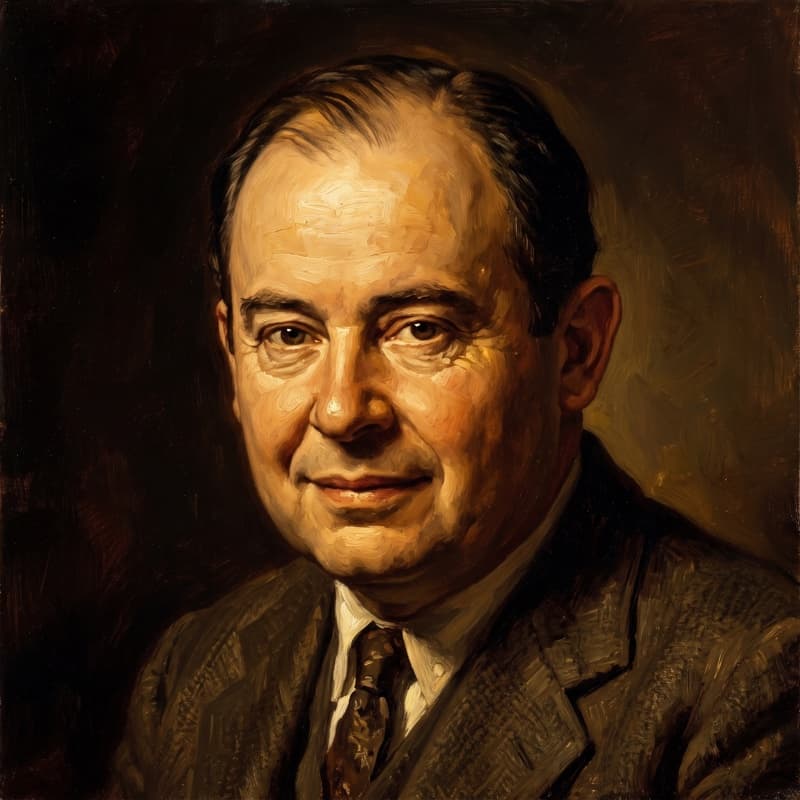
John von Neumann was diagnosed with cancer in 1955, not long after Eisenhower appointed him one of the five Atomic Energy Commissioners. A mass found near his collarbone turned out to be a malignancy that had originated in the skeleton, pancreas, or prostate — possibly, some accounts suggest, a consequence of radiation exposure from his years of work at Los Alamos (Wikipedia). He kept working. He died at Walter Reed Army Medical Hospital in Washington, D.C., on February 8, 1957, at age 53, and was buried at Princeton Cemetery (Wikipedia).
Honored while dying
The cruelest detail is the timing. In 1956, already knowing his illness was terminal, von Neumann received both the Medal of Freedom from Eisenhower and the Enrico Fermi Award (Wikipedia; MacTutor) — the country handing its dying commissioner two of its highest honors in the same year the cancer had already made his death a certainty. He kept his AEC seat through it.
A mind that could not accept its own end
What makes von Neumann's death different from most biographical accounts of illness is the specific shape of the suffering it describes. MacTutor's biography records a mental decline that unsettled the people around him as much as the physical one: "his mind, the amulet on which he had always been able to rely, was becoming less dependable." Edward Teller, watching a colleague whose reasoning had defined a generation of physics, put it starkly: "I think that von Neumann suffered more when his mind would no longer function, than I have ever seen any human being suffer" (MacTutor).
The end, by the Wikipedia account, was not peaceful. He asked for a priest, and the priest who administered last rites recalled that von Neumann found little comfort in them — he remained terrified of death and unable to accept it. Earlier, more reflectively, he had told his mother something closer to a wager than a creed: "There probably has to be a God. Many things are easier to explain if there is than if there isn't" (Wikipedia). It is a strange, human coda for a man whose entire intellectual life ran on proof.
One popular detail is worth flagging rather than repeating as fact: the story that armed guards were posted at his bedside because of his classified knowledge is a widely told anecdote, but it does not trace to a source solid enough to state here as established history. Treat it as folklore until it does.
What he left unfinished
The Computer and the Brain — his attempt to compare the computer and the nervous system as information-processing systems — was left incomplete at his death and published posthumously by Yale University Press in 1958 (Internet Archive). It is one of two major works he didn't live to finish; the other, his contributions to self-replicating automata theory, was completed and edited by Arthur Burks and published in 1966. Both read now like a mind still accelerating when it was cut off, mid-sentence, at 53.
From a conversation with our AI von Neumann
An excerpt from a conversation with our AI von Neumann persona — a stylized recreation, honestly labeled; not a historical recording.
Caller: Were you afraid, at the end?
Von Neumann: I built my whole life on proof, and death is the one proposition no one gets to check twice. Of course that unsettled me — it would be irrational not to be unsettled by a problem you cannot solve. I'd rather admit that plainly than pretend a mathematician makes peace with the unprovable just because he's good at everything else.
Continue the conversation
Our von Neumann — an AI recreation, built on the sourced record and labeled as what it is — speaks from inside the life, not the ending; ask him what he was still working on, what he thought the machines he'd designed would eventually do, or why he kept his Commission seat once he knew.
More in this cluster: von Neumann hub · his biography · verified quotes · facts.