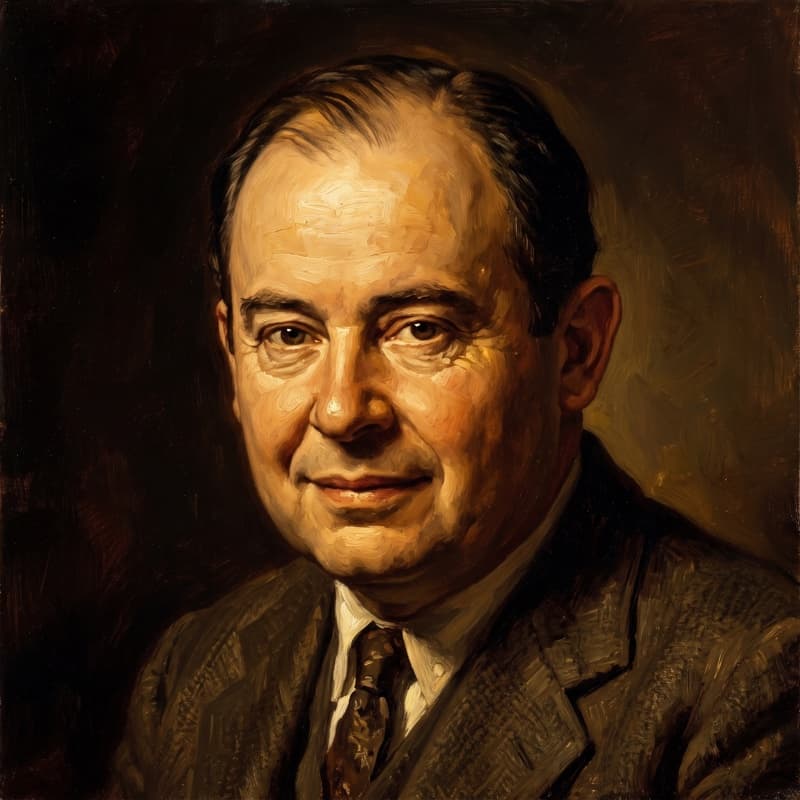
Every John von Neumann fact on this page is checked against a primary text or an established academic source — MacTutor, Wikipedia, the Atomic Heritage Foundation, and von Neumann's own published reports — with each citation shown inline. Short version: born December 28, 1903, in Budapest; a chemical-engineering diploma and a mathematics doctorate, both in 1926; the minimax theorem in 1928; a founding professorship at the Institute for Advanced Study in 1933; game theory with Oskar Morgenstern in 1944; the 1945 EDVAC report behind the "von Neumann architecture"; Manhattan Project work including target selection; death from cancer on February 8, 1957, at 53. Sources below, then three popular claims that don't hold up.
Nine verified facts
- Born December 28, 1903, in Budapest, eldest of three sons of banker Max von Neumann (MacTutor; Wikipedia).
- Finished two degrees the same year, 1926 — a chemical-engineering diploma from ETH Zürich (his father wanted a practical trade) and, simultaneously, a summa cum laude doctorate in mathematics on set theory from Pázmány Péter University, Budapest (Wikipedia).
- Published the minimax theorem in 1928, proving two-person zero-sum games have an optimal strategy — game theory's founding result, sixteen years before his book with Morgenstern (Wikipedia).
- Joined the Institute for Advanced Study in 1933, one of six founding mathematics professors alongside Albert Einstein and Hermann Weyl, a post he held for life (MacTutor).
- Co-wrote Theory of Games and Economic Behavior in 1944 with Oskar Morgenstern. Its preface: "The theory has been developed by one of us since 1928 and is now published for the first time in its entirety" — tying it directly to fact 3 (primary text).
- Worked Manhattan Project implosion design from 1943, contributing the math behind the explosive lenses used in Trinity and "Fat Man"; in April 1945 he also joined the Target Selection Committee that helped choose Hiroshima and Nagasaki — a specific role tech-focused retellings often skip (Atomic Heritage Foundation).
- Wrote the First Draft of a Report on the EDVAC, June 30, 1945, describing a stored-program computer built from arithmetic, control, and memory "organs" — later called the von Neumann architecture. Credit is shared with the wider Moore School EDVAC team, not his alone (primary text).
- Told Claude Shannon to call his new measure "entropy," because statistical mechanics already used the word and, as von Neumann put it, nobody really knows what entropy is — so in an argument, Shannon would always have the advantage (Today in Science History, quoting Myron Tribus's 1971 Scientific American account).
- Died February 8, 1957, at Walter Reed Army Medical Hospital, Washington, D.C., age 53, while serving as one of five Atomic Energy Commissioners — having received the Medal of Freedom and the Enrico Fermi Award the year before, already terminally ill. Buried at Princeton Cemetery (Wikipedia; Atomic Heritage Foundation).
Three circulating claims, corrected
"Von Neumann said we'd reached the limits of computer technology." He didn't. That line belongs to Stanislaw Ulam, from his 1958 memorial tribute to von Neumann — misattributed to von Neumann himself because it appears in an essay about him (Wikiquote talk page).
"With four parameters I can fit an elephant" is a direct von Neumann quotation. Treat it as an anecdote. Enrico Fermi told the line to physicist Freeman Dyson in 1953 as something von Neumann used to say; Dyson published the recollection in Nature in 2004 — real, but secondhand, passed through two people before print (Wikipedia).
"Von Neumann's IQ was 180" (or any other number). No credible primary source gives him a tested score. A doctorate at 22 and foundational work across half a dozen fields support calling him exceptionally able, without inventing a figure that isn't in the record.
Frequently asked, quickly answered
Did von Neumann invent the computer? No one person did. His 1945 EDVAC report described the stored-program architecture bearing his name, but it drew on the wider Moore School team's work — credit is shared, not solely his (primary text).
Did he work on the atomic bomb? Yes — he designed the implosion-lens mathematics and sat on the committee that helped select the bomb's targets, a more concrete role than the general "worked on the Manhattan Project" line usually gives him (Atomic Heritage Foundation).
How did he die? Cancer, diagnosed in 1955 while serving on the Atomic Energy Commission; he died February 8, 1957, at 53 (Wikipedia).
Related pages
Von Neumann hub · his death · verified quotes · biography.
For questions a fact list can't settle — why a chemical engineer became the century's most versatile mathematician, what the Los Alamos years actually cost him, how a man this fast thought about his own approaching death — this site hosts a conversational AI recreation of von Neumann, grounded in the sources cited above and labeled plainly as an AI persona. The facts are here; the voice is a conversation away.