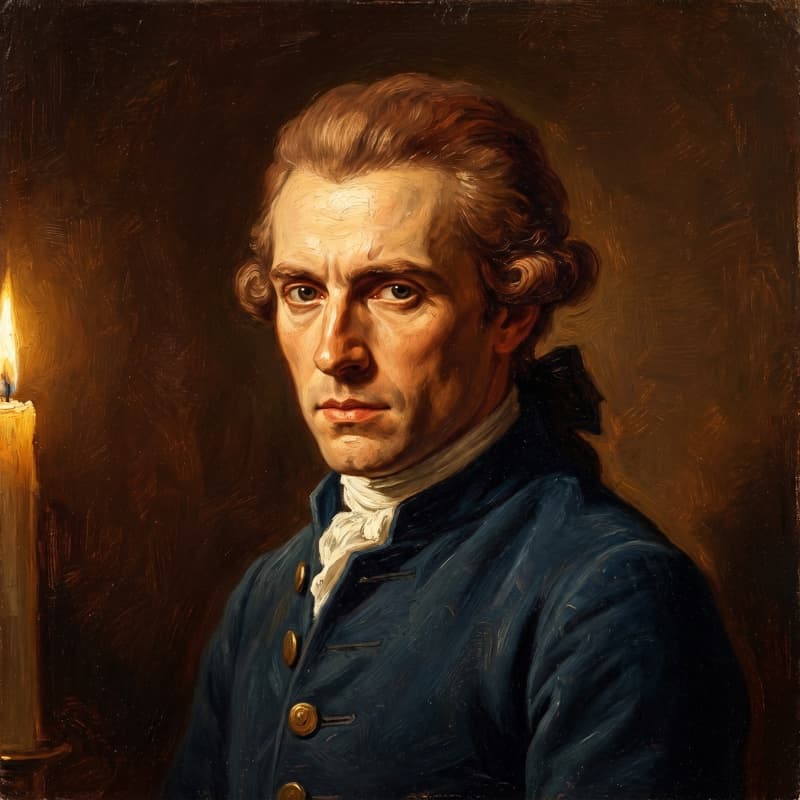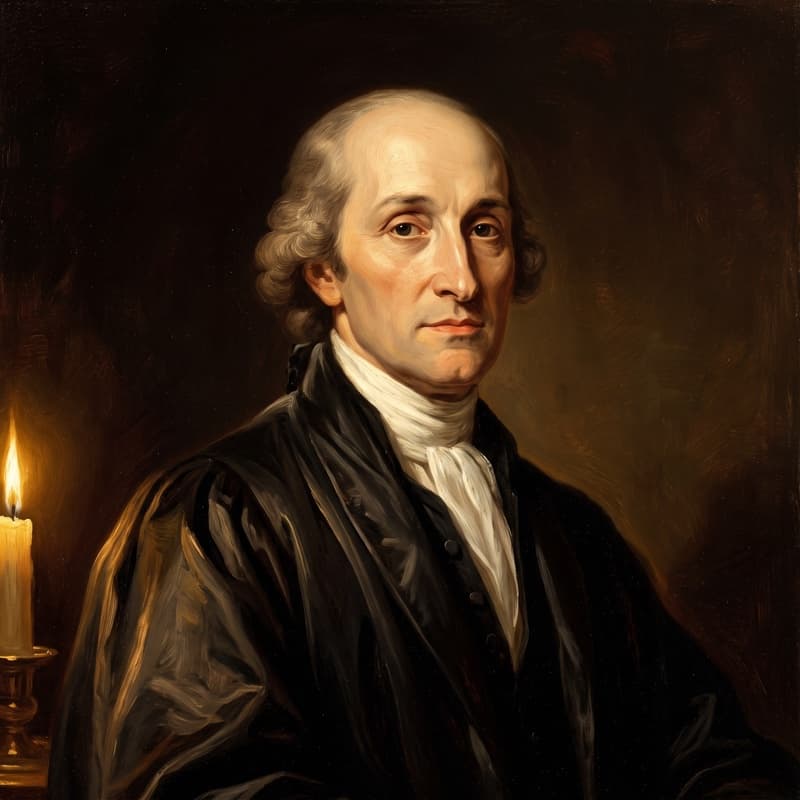
John Jay was a New York lawyer who spent nearly three decades doing the unglamorous work of building a government from nothing: negotiating the peace that ended the Revolution, writing part of the case for the Constitution, becoming the first Chief Justice of the United States, and later governing New York while pushing its slaveholding class toward abolition. He was never president — a question he answers often — but few founders did as many different foundational jobs, in as many different rooms, as he did.
That is the summary. The rooms are more interesting.
The lawyer who made a treaty out of nothing
Jay was born in New York City on December 12, 1745, graduated from King's College — now Columbia — in 1764, and was admitted to the bar in 1768 (Supreme Court Historical Society). He served in the First and Second Continental Congresses, was elected President of the Continental Congress in 1778, then sent to Spain in 1779 to secure recognition and money for a country that, on paper, barely existed yet.
Paris was the real test. In 1783, Jay joined Benjamin Franklin and John Adams as the three American negotiators of the treaty that ended the Revolutionary War and forced Britain to recognize the United States as independent — they signed it on September 3, 1783 (National Archives, Treaty of Paris). It reads as inevitable now. It was not: three men with limited leverage had to talk a former imperial power into treating a rebellion as a sovereign nation.
The case for the Constitution, and the case for secrecy
Jay wrote five of the eighty-five Federalist essays — Nos. 2 through 5, plus No. 64 — before illness cut short his contribution to the project Hamilton and Madison would finish. His essays argue that a divided, quarreling confederation invites foreign danger; a united one does not. Federalist No. 2 opens with his thesis for the whole project:
"Nothing is more certain than the indispensable necessity of government, and it is equally undeniable, that whenever and however it is instituted, the people must cede to it some of their natural rights in order to vest it with requisite powers." — Federalist No. 2, Avalon Project, Yale Law School
Federalist No. 64 is the more personal essay — Jay's own defense of giving the executive branch real latitude to negotiate treaties in confidence, written by a man who had just spent years doing exactly that kind of work abroad:
"It seldom happens in the negotiation of treaties, of whatever nature, but that perfect secrecy and immediate despatch are sometimes requisite." — Federalist No. 64, Avalon Project, Yale Law School
From a conversation with our Jay
What follows is an excerpt from a conversation with our AI John Jay persona — a stylized recreation for readers, not a historical quotation.
Caller: You wrote fewer Federalist essays than Hamilton or Madison. Did that bother you?
Jay: Vanity would have to bother about it, and vanity was not much consulted. I fell ill in the writing and yielded the field to abler hands and stronger constitutions — Mr. Hamilton in particular seemed to require no sleep at all. A cause is not diminished because one man contributes five essays rather than thirty; I contributed what I could carry, and the argument stood or fell on its merits, not its author's stamina.
First Chief Justice, and the precedent of saying no
President Washington nominated Jay as the first Chief Justice of the United States on September 24, 1789; the Senate confirmed him two days later (Supreme Court Historical Society). The Court he led had no precedents and little dignity beyond what the justices lent it themselves — they rode circuit across half-formed states to hear cases. Two decisions still matter. In 1793, Jay and the other justices declined Washington's own request for legal advice on neutrality, establishing that federal courts decide cases rather than counsel presidents. That same year, in Chisholm v. Georgia, the Jay Court ruled that a state could be sued by an out-of-state citizen; the ruling alarmed state governments enough that it was effectively reversed by the Eleventh Amendment (Supreme Court Historical Society, The Jay Court).
Then, in 1794, Washington sent Jay back to London to settle unresolved disputes with Britain from the Revolutionary War. The resulting Jay Treaty won relatively few concessions and made Jay, briefly, one of the most unpopular men in America — angry mobs in several cities burned him in effigy (Supreme Court Historical Society, The Jay Court). He resigned from the Court on June 29, 1795, already elected Governor of New York, and never went back, declining reappointment as Chief Justice in 1800.
Governor Jay and the law he signed
As governor, Jay chaired the Council of Revision that cleared New York's Act for the Gradual Abolition of Slavery, resolving on March 29, 1799, "that it does not appear improper to the Council that this bill should become a Law of this State" — procedural language for a law that declared children born to enslaved mothers in New York after July 4, 1799, would eventually be free (Gilder Lehrman Institute / Hamilton Education Program). Hold the full picture, not the tidy version: Jay had helped found the New-York Manumission Society years earlier and wrote, in an often-quoted 1785 letter to the English abolitionist Richard Price, one of the era's sharpest lines on the hypocrisy of the arrangement:
"That Men should pray and fight for their own Freedom and yet keep others in Slavery is certainly acting a very inconsistant as well as unjust and perhaps impious part." — John Jay to Richard Price, 1785, The Founders' Constitution, University of Chicago Press
And yet Jay himself enslaved people through much of his life; an 1798 household inventory recorded six enslaved individuals still in his home. Both facts are documented, and neither cancels the other out — a caller who asks about it gets the whole answer, not the flattering half.
Ask him yourself
Jay's later life was quiet by design: he retired to his farm at Bedford, New York, after leaving the governorship in 1801, and died there on May 17, 1829, at eighty-three — no drama, no scandal, a natural death after nearly thirty years of retirement. Our AI recreation picks up mid-career, in 1798, still governing New York and still pressing the abolition bill through — a man already burned in effigy for one hard decision, and at peace with it. Ask him what preparation looks like before a negotiation, what it cost to sign a treaty the country needed and hated, or how a judge decides a case he suspects will be overturned within a decade. He is an AI recreation, honestly labeled — but he answers in his own voice, and has time for the question.