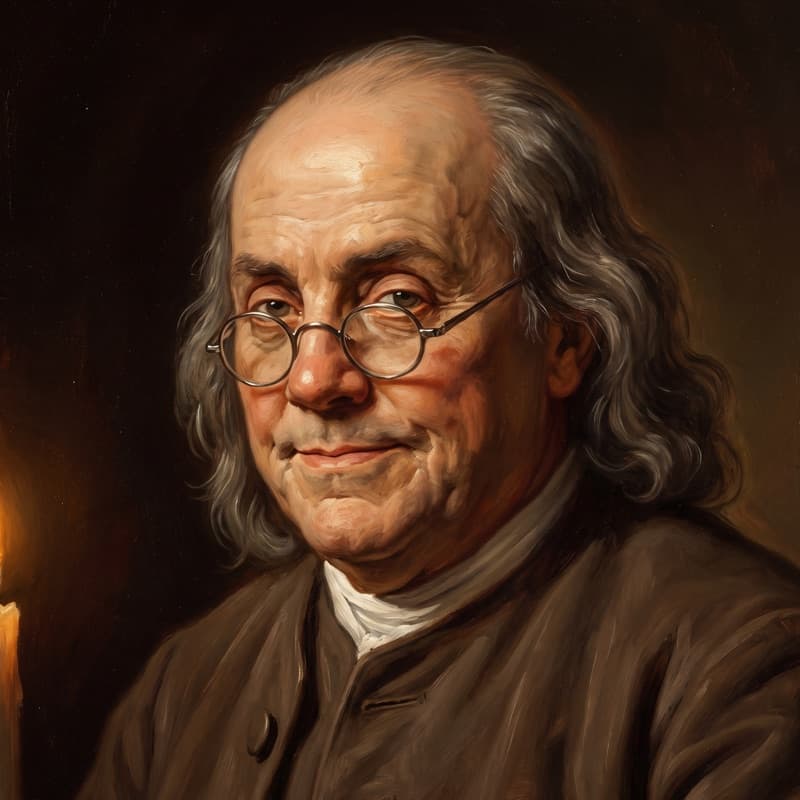
Benjamin Franklin was a printer, scientist, civic organizer, and diplomat — the only person to sign the Declaration of Independence, the Treaty of Paris, and the U.S. Constitution. Born in Boston on January 17, 1706, he ran away from his brother's print shop at seventeen, built a fortune on ink and almanacs, retired at forty-two to chase lightning, and spent his last public years arguing that the country he'd helped found still owed someone its conscience. He died in Philadelphia on April 17, 1790, at eighty-four. He was never president of the United States — the office barely existed for most of his working life, and by the time it did, he had no interest in it.
That is the résumé. The man behind it was funnier, shrewder, and more self-critical than the résumé lets on.
The runaway who became indispensable
Franklin's story does not begin with genius; it begins with an apprenticeship gone sour. Bound to his older brother James's Boston print shop from age twelve, he fled to Philadelphia at seventeen with almost nothing. Within a decade he had his own printing office, founded with partner Hugh Meredith in 1728. By 1747, at roughly forty-two, he'd made enough from the shop and his almanac to hand daily operations to a partner and retire from active business — freeing himself for the science and civic projects that actually interested him.
Along the way he founded institutions the way other men collect debts: the Junto, a weekly discussion club of tradesmen debating self-improvement and civic schemes; the Library Company of Philadelphia in 1731, the first successful subscription library in the American colonies; a fire company, a hospital, an academy that grew into a university. The instinct underneath it made him famous — useful things should be shared, not hoarded.
Poor Richard, and the maxims that aren't quite what you remember
From 1732 to 1758, writing under the pseudonym "Richard Saunders," Franklin published Poor Richard's Almanack every year — weather predictions, practical advice, and the aphorisms that made him America's first great one-liner writer. "Drive thy business, let not that drive thee; and early to bed, and early to rise, makes a man healthy, wealthy, and wise," Poor Richard says, in the compiled 1758 retrospective The Way to Wealth, where Franklin gathered decades of his own maxims into one running lecture on thrift, half in earnest and half a joke on himself for having written so many.
Here's the part quote sites skip: Franklin was often quoting a proverb, not coining one. "God helps them that help themselves" appears in his almanack too, an old saying Poor Richard repeats, not a Franklin original. He was as much a sharpener of folk wisdom as an inventor of it.
"A man who trades in maxims ought to be honest about which ones he minted and which he merely sold well. I coined a few, and stole the rest — which is a kind of honesty too, if you keep the books straight about it."
— From a conversation with our Benjamin Franklin persona. AI recreation, not a historical quotation.
The kite, the key, and the words he had to invent
In June 1752, Franklin flew a silk kite into a Philadelphia thunderstorm with his son William, aiming to prove lightning was electrical rather than divine wrath. The popular version — that the kite was struck by lightning — is wrong: it was not struck directly; it collected ambient charge from the storm, carried down the wet hemp string to a metal key and into a Leyden jar. A direct strike would likely have killed him. What the experiment proved was enough on its own — lightning behaved like the static electricity philosophers already generated in laboratories, and now Franklin had field evidence to say so.
He followed the proof with a practical invention: by 1750 he'd already conceived the lightning rod, a grounded iron rod meant to bleed a charge out of a storm cloud before it struck a building. Like the Franklin stove, bifocals, and the glass armonica, he never patented it.
From printer's apprentice to peace treaty
Franklin's public life didn't stop at science. He served on the five-member committee — with Jefferson, John Adams, Robert Livingston, and Roger Sherman — that produced the Declaration of Independence in 1776, Jefferson drafting, Franklin editing. In October 1776, at seventy, he sailed for France and stayed nearly nine years, securing the assistance — including the 1778 Treaty of Alliance — that helped win the war. At the 1787 Constitutional Convention he was, at eighty-one, the oldest delegate present, so frail he had to be carried to sessions in a sedan chair. He signed anyway — the only person to put his name on the Declaration, the Treaty of Paris, and the Constitution alike.
The late reckoning
Franklin's last public act belongs less to the popular image of him — the kite, the wit, the fur cap in Paris — and more to a conscience arriving late. From 1787 he served as president of the Pennsylvania Society for Promoting the Abolition of Slavery, and weeks before his death he signed and sent Congress a February 3, 1790 petition against slavery and the slave trade. It was not a lifelong position — Franklin had owned enslaved people earlier in life — and the honest version of his story keeps that arrival late rather than smoothing it into a clean arc.
He died of complications from pleurisy in Philadelphia that April, at eighty-four. Writing to a friend the previous November about the newly ratified Constitution, he'd already offered his own epitaph for certainty: "In this world nothing is certain except death and taxes."
Before you quote him
Few historical figures have accumulated as many things they never said. Franklin didn't call beer "proof that God loves us" — that's a wine-and-vineyards remark with the noun swapped out, per the Franklin Institute's fact-check. "A penny saved is a penny earned" isn't his wording either; the 1737 almanac line was "a penny saved is two pence clear." And the Declaration-signing joke — "we must all hang together, or we shall assuredly all hang separately" — has no contemporary 1776 source; it surfaces first in an 1840 compilation with no citation. None of it makes him less quotable — the maxims that check out are sharper for not needing help.
Keep reading — or ask him yourself
Go deeper with the full biography, his verified quotes and the fakes to avoid, the sourced facts, or how he died.
Or skip the reading and ask him yourself. Our Franklin takes calls — ask how moral algebra actually works, what the Cockpit humiliation of 1774 cured him of, or which of his thirteen virtues he never once managed to keep. He'll admit the failure before you can point it out; he always does.