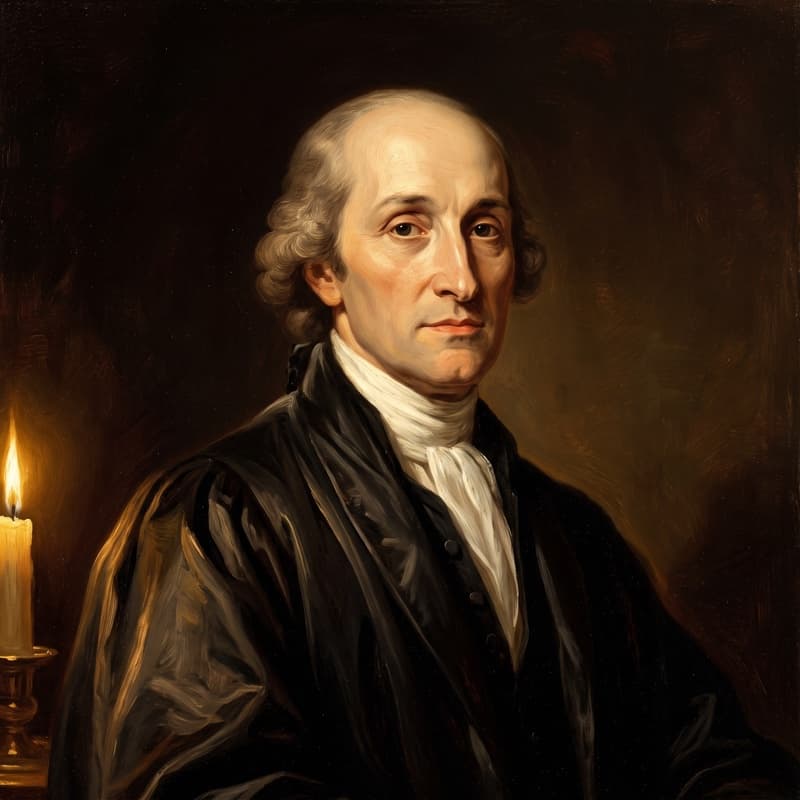
The core facts about John Jay: he was the first Chief Justice of the United States, nominated by George Washington on September 24, 1789, and confirmed by the Senate two days later (Supreme Court Historical Society); he was one of three American negotiators, alongside Benjamin Franklin and John Adams, who signed the Treaty of Paris in 1783 (National Archives); he wrote five of the Federalist essays; he negotiated the controversial 1794 treaty with Britain that bears his name; and, as governor of New York, he signed the state's 1799 law for the gradual abolition of slavery while continuing to enslave people in his own household. He was never U.S. president. This page holds the facts, including the ones that don't sit comfortably together.
The facts, with the context that makes them matter
He is the first Chief Justice — and he almost turned the job down twice. Washington nominated Jay on September 24, 1789; the Senate confirmed him two days later (Supreme Court Historical Society). He resigned the seat in 1795 to become governor of New York, then declined a second appointment to the Court in 1800.
He is one of only three men who signed the Treaty of Paris. Jay, Franklin, and Adams negotiated the 1783 treaty that ended the Revolutionary War and forced Britain to recognize American independence outright (National Archives).
He wrote five Federalist essays, not dozens. Illness interrupted his contribution after Federalist No. 5, and he didn't return to the project until No. 64, months later (Supreme Court Historical Society) — a small share of the 85 essays for a name people assume ranks with Hamilton's.
His Court, not Congress, decided that federal judges don't hand out legal advice. In August 1793, Jay and the other justices declined Washington's request for guidance on neutrality questions, establishing that the Supreme Court doesn't issue advisory opinions — a rule still followed today (National Archives). That same year, the Jay Court ruled in Chisholm v. Georgia that a state could be sued by a citizen of another state, a decision so unpopular it was effectively reversed by the Eleventh Amendment (Supreme Court Historical Society).
The Jay Treaty made him one of the most hated men in America — for securing peace. His 1794 treaty with Britain avoided a second war but conceded little in return; Jay was burned in effigy in several cities over it (Supreme Court Historical Society). He resigned the Court the following year and became governor instead.
As governor, he signed New York's abolition law — and still enslaved people. Jay chaired the Council of Revision that cleared "An Act for the Gradual Abolition of Slavery" on March 29, 1799 (Gilder Lehrman Institute), the law that began freeing children born to enslaved mothers after that July. He also helped found the New-York Manumission Society. Yet an 1798 household inventory records six enslaved people under Jay's own roof (Columbia University Libraries).
From a conversation with our John Jay
An excerpt from our AI John Jay persona — a stylized recreation, honestly labeled; not a historical quotation.
Caller: People are surprised you were never president.
Jay: I am not surprised they are surprised — the offices blur at this distance. I was President of a Congress once, a different chair entirely, and I sat as Chief Justice, and then as governor. The presidency was never mine to hold. A republic needs more chairs filled than the one everyone remembers.
One thing John Jay is not
"Is John Jay College named for this John Jay?" Only in name. The CUNY institution was founded as the College of Police Science in 1965 and renamed within the year to honor the Founding Father, but it has no institutional lineage back to him (John Jay College). If you're searching for campus dining or webmail, that's the college, not the man on this page.
Ask him what the record leaves out
The facts above are the skeleton. What they can't tell you is how a man argues for union in one essay and treaty secrecy in another, or how he weighed signing an abolition law against the household he kept. Our John Jay — an AI recreation grounded in the sourced record and labeled as exactly that — takes those questions directly. Ask him about the treaty table in Paris, or the year illness kept him off the Federalist.
More in this cluster: John Jay hub · his death · verified quotes · biography.