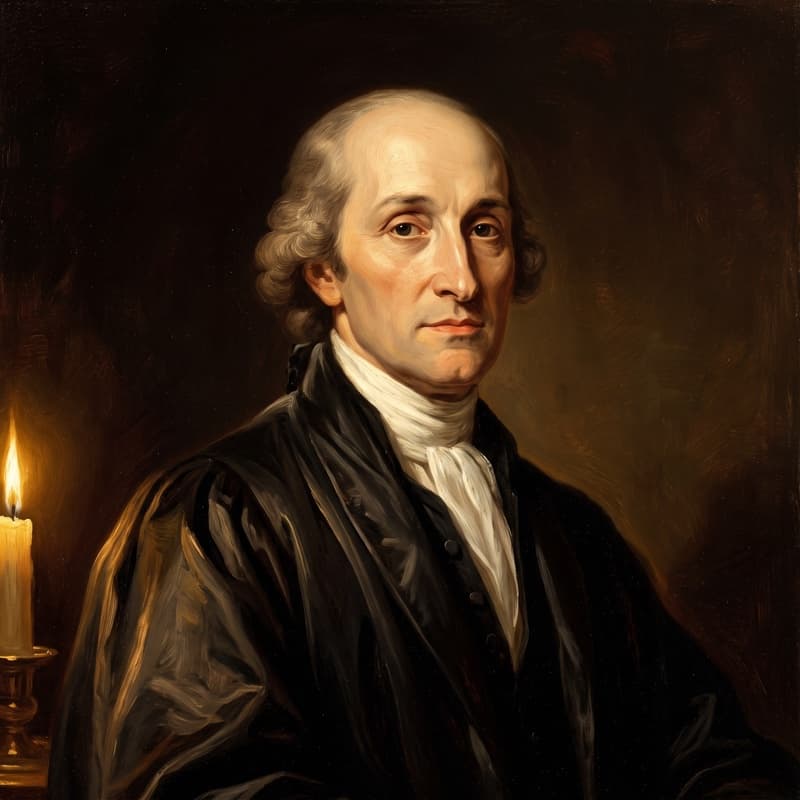
Who was John Jay? A New York lawyer, born December 12, 1745, who graduated King's College in 1764 and was admitted to the bar in 1768 (Supreme Court Historical Society). From there the offices pile up: delegate to the Continental Congress, its President in 1778, a peace negotiator in Paris, a Federalist essayist, the first Chief Justice of the United States, and a two-term governor of New York. Every date above is cited. But the throughline is not the résumé — it's the pattern underneath it. Jay kept taking the harder, less popular job when the easier one was available, and he kept doing it in the branch of government that needed a first occupant willing to set the precedent rather than chase the applause.
Congress, Spain, and Paris
Jay's Revolutionary career was diplomatic before it was judicial. In 1779, Congress sent him to Spain seeking recognition and money for the new United States (Supreme Court Historical Society) — a hard, thankless posting with little to show for it. It prepared him for Paris. On September 3, 1783, Jay joined Benjamin Franklin and John Adams in signing the Treaty of Paris, ending the Revolutionary War and formally securing Britain's recognition of American independence (National Archives).
The case for union
Back home, Jay turned to persuasion. He wrote five of the Federalist essays — Nos. 2 through 5 and No. 64 — making the case for ratifying the Constitution. His argument was safety first: "Nothing is more certain than the indispensable necessity of government, and it is equally undeniable, that whenever and however it is instituted, the people must cede to it some of their natural rights in order to vest it with requisite powers" (Federalist No. 2, Avalon Project). No. 64, on the treaty power, reads almost like a note to his future self as a negotiator: "It seldom happens in the negotiation of treaties, of whatever nature, but that perfect secrecy and immediate despatch are sometimes requisite" (Federalist No. 64, Avalon Project).
Building the bench from nothing
President Washington nominated Jay as the first Chief Justice of the United States on September 24, 1789; the Senate confirmed him two days later (Supreme Court Historical Society). There was no precedent to lean on, so the Jay Court made its own — most consequentially in 1793, when Jay and the other justices declined to give President Washington legal advice on neutrality questions, establishing that federal courts don't issue advisory opinions, a rule still followed today. The Court's most controversial ruling of the era, Chisholm v. Georgia (1793), held that a state could be sued by a citizen of another state — a decision so unpopular it was effectively overturned by the Eleventh Amendment.
From a conversation with our Jay
An excerpt from a conversation with our AI John Jay persona — a stylized recreation, honestly labeled; not a historical quotation.
Caller: You signed a treaty everyone hated. Would you sign it again?
Jay: I would, sir, and gladly — though "gladly" is not quite the word one uses while an effigy of oneself burns in the public square. A negotiator does not get to choose between a popular peace and an unpopular one; he chooses, if he is fortunate, between an unpopular peace and a war. I chose the peace. History has been kinder to that choice than my contemporaries were.
The treaty that cost him, and the office after
In 1794, Jay negotiated the treaty with Great Britain that came to bear his name — deeply unpopular at the time, with Jay burned in effigy in several cities even as the agreement secured a decade of peace. He resigned from the Supreme Court on June 29, 1795, having just been elected Governor of New York, and declined a second term as Chief Justice in 1800. As governor, he chaired the Council of Revision that cleared New York's "Act for the Gradual Abolition of Slavery" on March 29, 1799 — Jay's own resolution reads simply, "Resolved that it does not appear improper to the Council that this bill should become a Law of this State" (Gilder Lehrman Institute). The law is real and the record is also honest about the contradiction sitting beside it: Jay enslaved people in his own household into the late 1790s even as he worked toward abolition. Both facts belong in the story.
Retirement, and a death without a mystery
Jay left the governorship in 1801 and retired to his farm at Bedford, New York, moving into the renovated farmhouse that year (John Jay Homestead). He stayed there, out of public life, for nearly three decades. He died at Bedford on May 17, 1829, at age eighty-three (Supreme Court Historical Society) — no duel, no assassination, no deathbed drama, just a long life ending quietly on the land where he'd chosen to spend it.
Put your question to him
The record above is cited; the interior life is what you ask about. Our Jay is an AI recreation built on that same record, labeled honestly as such. Ask him about negotiating with an ocean between himself and Congress, what it felt like to write law with no precedent to copy, or how he squares the abolition act with his own household. Ask him yourself — he answers in his own voice, and you can start the conversation right now.
More in this cluster: Jay hub · his death · verified quotes · facts.