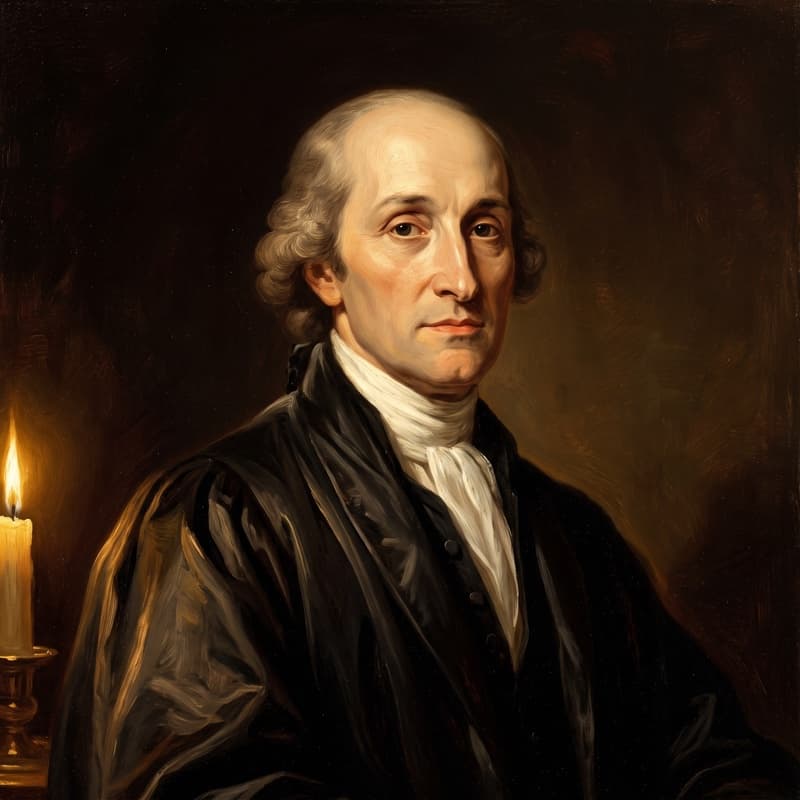
John Jay opened his contribution to the Federalist Papers with a claim as plain as a legal brief: "Nothing is more certain than the indispensable necessity of government, and it is equally undeniable, that whenever and however it is instituted, the people must cede to it some of their natural rights in order to vest it with requisite powers" (Federalist No. 2, Avalon Project, Yale Law School). That is Jay's register — careful, sequential, arguing rather than declaiming. Below are his verified lines, grouped by the work they came from, followed by one widely circulated "Jay quote" this page won't vouch for.
The Federalist voice: safety first
Jay wrote five of the eighty-five Federalist essays — Nos. 2 through 5 and No. 64 — while Hamilton and Madison wrote the rest. Illness cut his run short, but his four opening essays share one argument: a divided America invites foreign danger.
"Among the many objects to which a wise and free people find it necessary to direct their attention, that of providing for their safety seems to be the first." — Federalist No. 3, November 3, 1787 (Avalon Project).
"But the safety of the people of America against dangers from foreign force depends not only on their forbearing to give just causes of war to other nations..." — Federalist No. 4, November 7, 1787 (Avalon Project).
"We may profit by their experience without paying the price which it cost them." — Federalist No. 5, November 10, 1787, on the divided kingdoms of Europe (Avalon Project).
The treaty power, stated by the man who used it
Jay negotiated the Treaty of Paris and, later, the Jay Treaty — so his one essay on foreign policy mechanics reads like a professional's aside: "It seldom happens in the negotiation of treaties, of whatever nature, but that perfect secrecy and immediate despatch are sometimes requisite." — Federalist No. 64, March 5, 1788 (Avalon Project). It is the clearest window into how Jay, the diplomat, thought about the job Publius the essayist was defending.
Freedom, slavery, and the tension Jay never resolved
Jay's most quoted line on slavery comes from a private letter, and it indicts the exact contradiction he was living: "That Men should pray and fight for their own Freedom and yet keep others in Slavery is certainly acting a very inconsistant as well as unjust and perhaps impious part." — Letter to Richard Price, September 27, 1785 (The Founders' Constitution, University of Chicago Press; original spelling preserved). Jay wrote that sentence while he still enslaved people himself — an 1798 household inventory counted six (Columbia University Libraries, Slavery & Abolition). In a conditional manumission for a man named Benoit, Jay went further still: "The Children of Men are by Nature equally, free and cannot without Injustice be either reduced to, or held in Slavery" (Columbia University Libraries) — language he wrote even as he attached conditions to that one man's freedom. As governor, Jay's Council of Revision cleared the path for law with a single procedural sentence: "Resolved that it does not appear improper to the Council that this bill should become a Law of this State" — the March 29, 1799 resolution approving New York's Act for the Gradual Abolition of Slavery (Gilder Lehrman Institute / Hamilton Education Program). Read the three together, not separately: the private letter's conscience, the manumission document's principle, and the governor's signature all belong to the same man who also owned people.
From a conversation with our Jay persona
An excerpt from our AI John Jay persona — a stylized recreation, clearly labeled; not a historical quotation.
Caller: You wrote that keeping others in slavery while fighting for your own freedom was unjust — and then you kept people enslaved for years after. How do you square that?
Jay: I do not square it, friend. A man may see a wrong plainly and still be slow, or worse, in setting it right — that is not a defense, only an accounting. I signed the law that freed the children born after; I did not free myself from the habit of the age in time to spare my own household the same reckoning. Judge the sentence and the man separately if you must, but I'd rather you judge them together, honestly, than let the sentence excuse me.
One line worth doubting
You may see Jay credited with "those who own the country ought to govern it," usually traced to his son William Jay's 1833 biography. This page leaves it out: the exact wording could not be confirmed against a fetchable primary source, so treat any version you see elsewhere as unverified rather than settled.
Keep reading: biography · facts · death. Or ask our Jay persona to answer for the Federalist arguments — or the household inventory — himself.