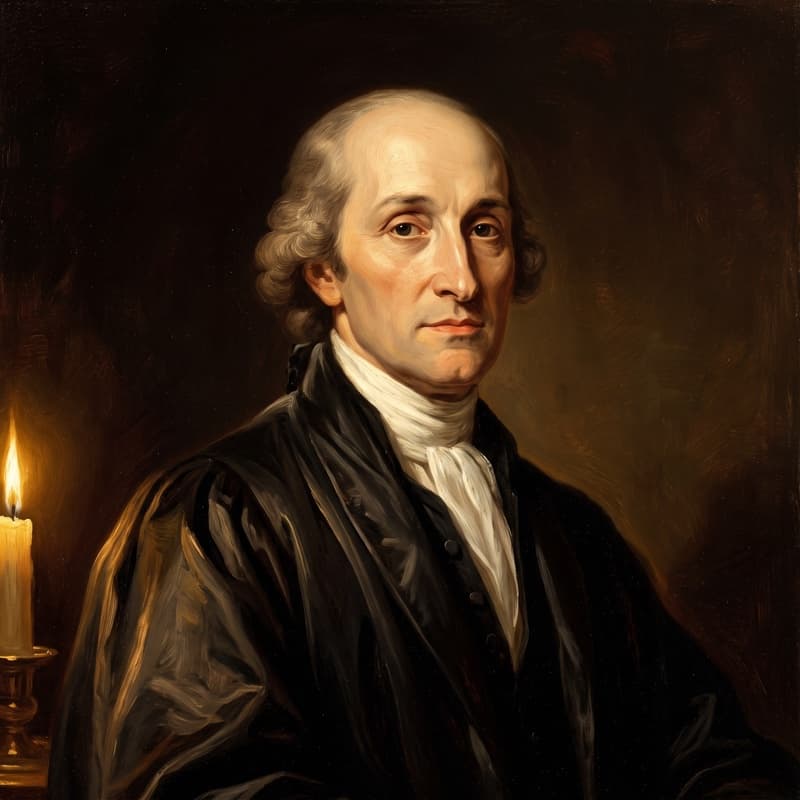
John Jay died at his farm in Bedford, New York — near present-day Katonah — on May 17, 1829, at eighty-three (Supreme Court Historical Society). No duel, no assassin, no sudden fever: the first Chief Justice of the United States simply lived to old age on land he'd chosen for retirement, nearly three decades after he last held office. That plainness is worth stating, since founders' deaths so often carry drama that Jay's genuinely does not.
Thirty years of walking away
He had been declining power longer than most people hold it. Jay resigned from the Supreme Court on June 29, 1795, to become Governor of New York, then declined a second offer of the Chief Justiceship in 1800 — Adams turned to John Marshall instead (Supreme Court Historical Society). He finished his second term as governor and, in 1801, retired for good to a roughly 750-acre farm in Bedford, Westchester County, renovating the farmhouse during his final term as governor in preparation for exactly this (John Jay Homestead).
A retirement he barely got to share
The timing made it bittersweet before it began. Jay had married Sarah Van Brugh Livingston on April 28, 1774, at Liberty Hall in Elizabeth, New Jersey; she'd looked forward to this stretch of life for years, writing of how happy she'd be once "freed from public care," with his company to enjoy it (Columbia University Libraries). They had barely a year together in the new house before she died on May 28, 1802, at forty-five (Columbia University Libraries). Jay spent the rest of his life there as a widower — twenty-seven more years — devoted to farming, Bible study, and family, including seven years as president of the American Bible Society (John Jay Homestead).
The farmhouse survives today as the John Jay Homestead State Historic Site in Katonah; the grounds are open to the public daily, though the house itself is closed for preservation work (John Jay Homestead). It's the closest thing to a monument to the version of Jay who mattered most to him at the end — not the diplomat or the justice, but the farmer who read his Bible and worked his own land.
A quieter ending than some of his peers got
Worth naming the contrast, gently: Alexander Hamilton, Jay's fellow Federalist essayist, died young and violently in an 1804 duel; more than three decades later came the kind of death — Lincoln's assassination in 1865 — people now most associate with power cut short. Jay got neither. He got twenty-eight unhurried years to finish being a farmer, then died the way most people do. No deathbed quotation survives in the record, and none should be invented for him here — the trail simply ends at May 17, 1829.
From a conversation with our Jay
An excerpt from a conversation with our AI John Jay persona — a stylized recreation built from the historical record and clearly labeled as such, not a transcript of anything Jay actually said.
Caller: You had every excuse to stay in public life. Why walk away twice?
Jay: Twice, and I would have done it a third time gladly. A republic that cannot spare a man is no republic — it is a monarchy that has misplaced its crown. I helped sign the treaty that ended a war, wrote what I could toward a Constitution, told a president plainly we would not advise him in secret. Having done the asking of an office, I found I preferred the asking of the soil — whether the wheat would take, whether the fence would hold. A man ought to know when his public usefulness has been spent. Mine, I judged, had been. The farm did not care what I had once been. I found that restful.
Ask him about the years before Bedford
Our Jay — an AI recreation, honestly labeled, built on the record cited above — can speak to the diplomacy, the Federalist essays, the bench, and the governorship that filled the decades before this quiet ending. Ask what it cost to negotiate a treaty much of the country hated him for, or how he squares writing New York's abolition law with the enslaved people still listed in his own household. Start the conversation whenever you're ready.
More in this cluster: John Jay hub · verified quotes · biography · facts.