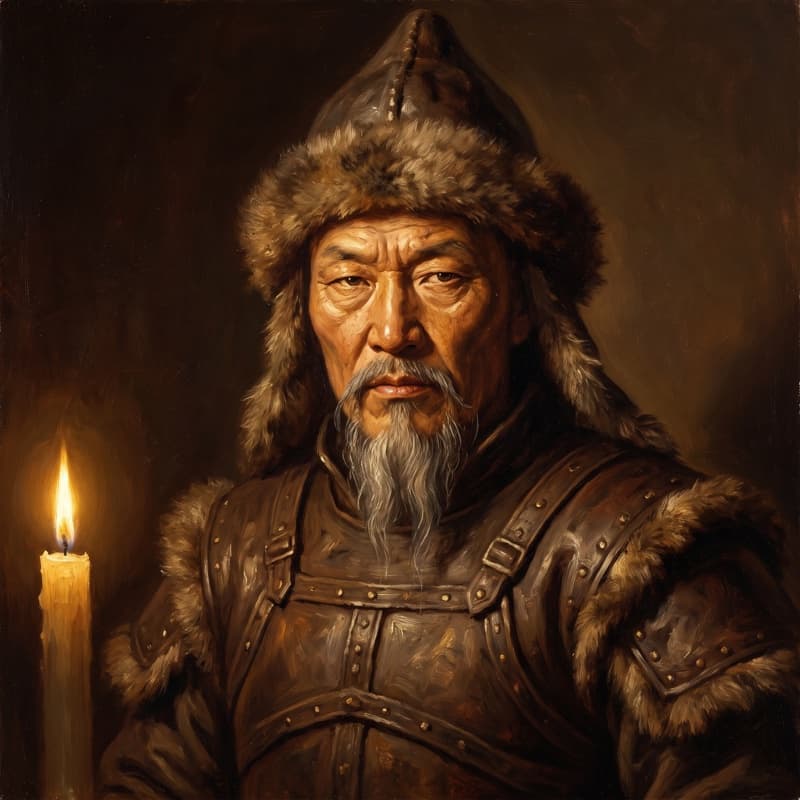
Genghis Khan died in 1227, during his final campaign against the Tangut state of Western Xia — and the honest answer to how is that nobody knows. The chronicles record the death; they do not settle its cause. Rashid al-Din, whose account preserves the fullest notice, places the death in the Tangut region and notes that Chinese sources give variant dates. Everything more dramatic that you have heard sits somewhere between later tradition and pure invention. This page walks through what the record actually holds, and why the gap in it has been filling with legends for eight centuries.
The scene the sources agree on
Picture the frame the chronicles allow: an old ruler — perhaps sixty or sixty-five, depending on which birth year you accept, since even that is uncertain — at war one last time. The campaign against Western Xia was not new business; the Tangut state had first been forced into submission back in 1209, and this was a later, final campaign against it. In 1227, in the middle of that campaign, Genghis Khan died.
That is the stable core. Rashid al-Din records the death in the Tangut region, and his notes point to Chinese sources with differing dates — a reminder that even the when wobbles at the edges. On the how, the traditions diverge, and no account close enough to the event can arbitrate between them.
Why the cause is unknowable
It helps to remember what kind of evidence exists. No physician's report, no contemporary eyewitness memoir — only chronicles compiled afterward, each shaped by its patrons and its distance from events. Where they touch the death at all, they disagree or stay vague. His remains have never been identified, so no modern examination can break the tie. When the primary sources are silent and the body is lost, "the cause remains disputed" is not scholarly hedging; it is the entire truth.
"What carried me off? The chronicles you have are the chronicles I can offer; they give a year and a region and fall silent. An old man dies in camp on campaign and the world demands a story worthy of the name. The record does not owe you a story."
— From a conversation with our Genghis Khan persona. This is an AI recreation speaking in character, not testimony about the death.
The persona holds the same line the sources do: it does not claim to remember a cause, because no source close to the event preserves one.
"You would rather I named an assassin or an illness — anything but a blank page. I will not fill it. Where the scribes wrote nothing, I have nothing to sell you."
— From a conversation with our Genghis Khan persona. This is an AI recreation speaking in character, not testimony about the death.
The stories that filled the silence
Because the record is quiet, later tellers were not. Over the centuries the death has been attributed to illness, to injury, to battle, to vengeance — each version more narratively satisfying than "an old man died on campaign," and none of them anchored in a source close to 1227 that historians can verify. The pattern is the same one that produced the flood of fake Genghis Khan quotes: where the documentation runs out, invention runs in, and the most shareable version wins. Treat any confident, colorful cause of death as a claim about storytelling, not about history.
Did his empire die with him?
The other search that leads here — how did Genghis Khan lose his empire — rests on a false premise. He never lost it. He died sovereign, mid-campaign, having already arranged the succession through his family. The empire continued under his heirs and grew substantially larger before its later fragmentation, which belongs to his descendants' story, not his. Whatever ended in 1227, it was a life, not the Mongol state.
What the record leaves
Genghis Khan died during the Western Xia campaign; the source record gives a date and a region, not a narratively fitting death. The conquests had destroyed cities and killed enormous numbers of people; the ledger of that cost is drawn honestly on the main Genghis Khan page and the facts page. His own death, by contrast, comes down to us small and unwitnessed: a date, a region, a dispute.
If you want to press the questions the chronicles can't answer — what he expected death to settle, what he thought the empire was for — our AI persona of Genghis Khan takes them straight, in the blunt voice the sources suggest. It won't invent a cause of death either. The full life leading to 1227 is in the biography.