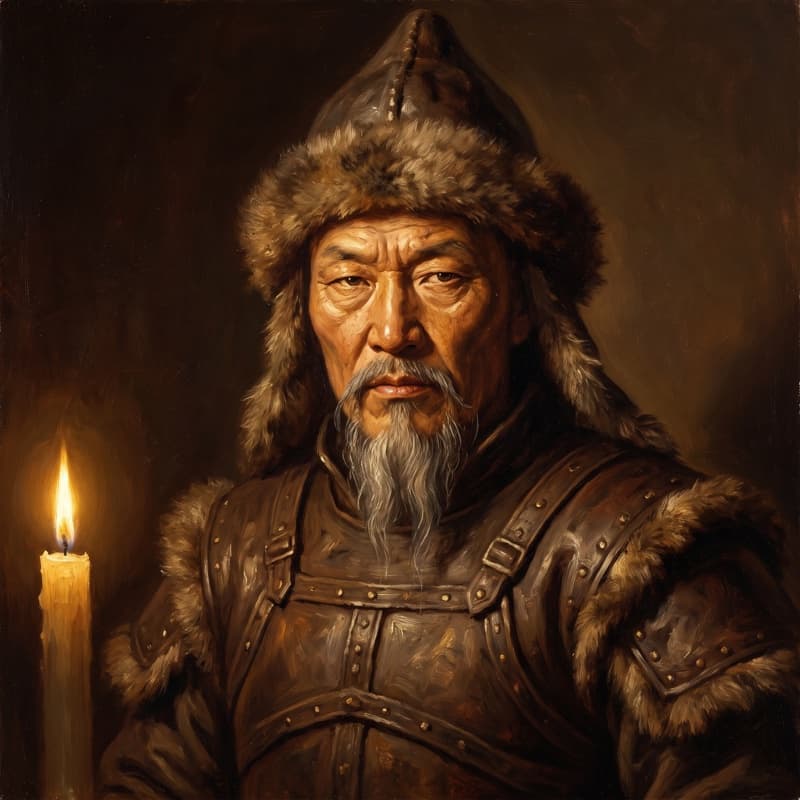
Genghis Khan was born Temujin; after his father Yesugei was poisoned, his family was abandoned and survived in poverty on the steppe before he became the founder of the Mongol Empire. His biography runs from an uncertain birth year — around 1162 or 1167 — through abandonment, captivity, and coalition wars, to the kurultai of 1206 that made him Genghis Khan, and on through two decades of conquest that reorganized Eurasia and devastated much of it, ending with his death on campaign in 1227. This page tells that life in order, keeping the chronicles' reports labeled as reports and the human cost in plain view.
The abandoned boy (c. 1162–1180s)
He was born into the Borjigin lineage by the Onon River, in a year historians still argue about. The pivot of his childhood is not disputed in outline: his father Yesugei was poisoned — the traditional story places Temujin at nine years old — and the family's followers abandoned them. His mother Hoelun held the children alive through poverty on the open steppe.
The Secret History of the Mongols, the great insider chronicle, carries the rest of the early drama: captivity among the Tayichiud in the 1170s and an escape made possible by the household of Sorqan Shira, who hid the fugitive at real risk. In the 1180s came his marriage to Borte — and her abduction by the Merkits, the crisis that forced Temujin into serious alliance politics. These episodes are reported tradition, not verifiable fact, but they are the formation story the Mongols themselves preserved: kin who deserted, strangers who saved, a wife worth a war.
"You ask what made me. The chronicle says my father's people rode away from a widow and her children, and that strangers sheltered me when kin did not. I will not tell you what that proves — I will tell you it is what the record keeps."
— From a conversation with our Genghis Khan persona. This is an AI recreation speaking in character, not a historical quotation.
The unification wars (1203–1206)
Temujin's rise was neither quick nor clean; it ran through shifting alliances and their betrayals. The decisive blows came late: in 1203 he broke Ong Khan's Kereyit, the great power that had once sheltered him, and in 1204 he defeated the Naiman, leaving no rival standing on the steppe.
In 1206, a kurultai on the Onon River acclaimed him Genghis Khan. The title's exact meaning is still debated; its effect is not. The Secret History describes him appointing ninety-five commanders of a thousand, tying military organization to personal service and reward rather than tribal descent.
Building while conquering (1206–1219)
The empire's two faces developed together. On one side, administration: Juvaini reports that Genghis Khan ordered Mongol children taught writing by the Uighurs and had laws and ordinances written down; relay couriers and stations moved his word across the growing realm; and his religious policy, in Juvaini's telling, honored learned and pious figures across sects rather than preferring one creed.
On the other side, war. Western Xia was forced into submission by 1209. The campaign against the Jurchen Jin state opened in 1211, and in 1215 the Jin capital Zhongdu — near modern Beijing — was captured and burned. The couriers and the sieges were one system, and this biography declines to pick a favorite face.
Khwarazm and the cost (1219–1221)
The war that fixed his name in the world's memory began with dead ambassadors: Khwarazmian authorities killed Mongol envoys and merchants, and Genghis Khan answered with the destruction of the Khwarazmian Empire. Between 1219 and 1221, Bukhara, Samarkand, and other major cities fell or were devastated. Juvaini — a Persian historian serving under Mongol rule — describes resisting cities destroyed along with the families that led them. His numbers need careful historical handling; the scale of killing and ruin they gesture at does not. Whatever the provocation, this is the ledger's heaviest page, and it stays open in any honest telling of the life.
"You want the count of the dead, and the chronicles will not give you a number worth repeating. Do not let that comfort you. The cities were destroyed; the families that led them were destroyed. Read the ledger whole, or put it down."
— From a conversation with our Genghis Khan persona. This is an AI recreation speaking in character, not a historical quotation.
The last campaign (1227)
Genghis Khan died in 1227, at war one final time against the Tangut state of Western Xia. Rashid al-Din records the death in the Tangut region, with Chinese sources preserving variant dates; the cause remains disputed — the death page sorts the sources from the legends. He died with succession already arranged through his family, and the empire outlived him, expanding under his heirs before its eventual fragmentation.
The life in one line
Deserted by his own at nine; sovereign of the steppe at roughly forty-five; dead on campaign at about sixty-five, leaving an empire, a written law, a courier network — and a trail of destroyed cities that the sources will not let anyone forget. For claims graded by evidence, see the facts page; for the handful of words that are really his, the quotes page; for the overview, the main Genghis Khan page.
Or ask the man's likeness yourself. Our AI persona of Genghis Khan speaks in the blunt register the chronicles suggest — try the question his biography keeps asking: who stood by you when it cost them, and what did you build on it?