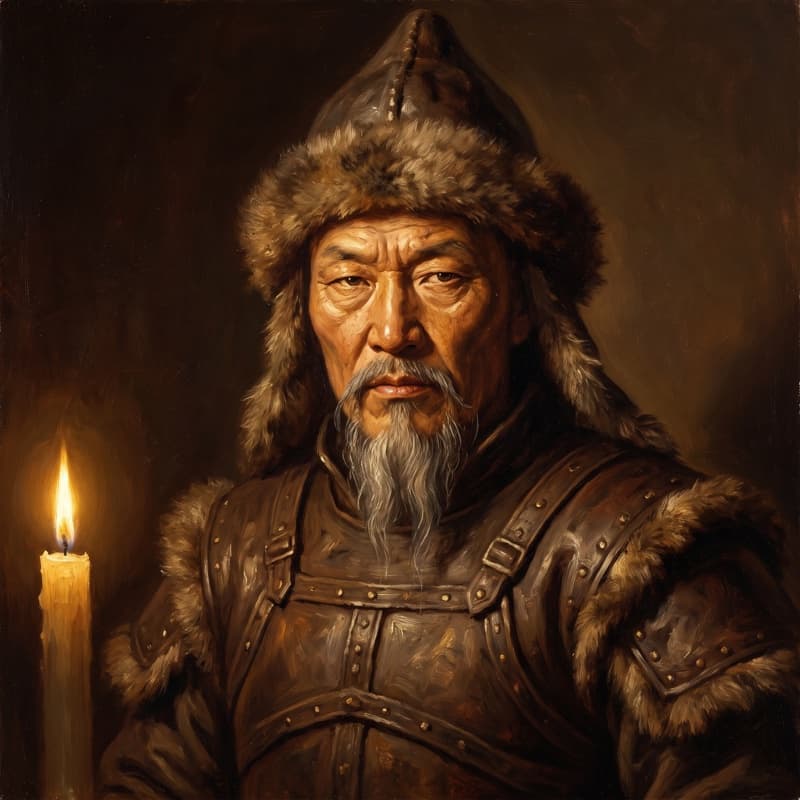
The most useful fact about Genghis Khan facts is that they come in three grades. Some things are well supported: he was born Temujin, was acclaimed Genghis Khan at a kurultai in 1206, destroyed the Khwarazmian Empire after his envoys were killed, and died in 1227 on campaign. Some things are chronicle reports — vivid, early, but unverifiable. And some of the most famous "facts," like the percentage of humanity carrying his DNA, are popular claims the evidence doesn't actually support. This page sorts all of them honestly, because a fact list that doesn't grade its evidence is just a rumor list with confidence.
Well supported
He was born Temujin; Genghis Khan is a title. He received it at the kurultai on the Onon River in 1206, after defeating the rival steppe powers — the Kereyit in 1203, the Naiman in 1204. Even the title's exact meaning is debated.
His birth year is genuinely unknown. Commonly placed around 1162 or 1167 — a five-year disagreement about a major historical figure, and a good calibration for everything else on this page.
His childhood began in catastrophe. After his father Yesugei was poisoned — traditionally when Temujin was about nine — the family was abandoned by its followers and survived in poverty on the steppe.
The Khwarazmian war began with murdered envoys. After Khwarazmian authorities killed Mongol envoys and merchants, the Mongol invasion of 1219–1221 destroyed the empire and left major cities, including Bukhara and Samarkand, fallen or devastated.
The human cost was severe. Juvaini — a historian employed by the Mongol state itself — describes resisting cities annihilated together with their ruling families. His numbers need careful handling; the reality of mass killing and destroyed communities does not.
He died in 1227, still at war. During the campaign against Tangut Western Xia; Rashid al-Din records the death in the Tangut region, with Chinese sources preserving variant dates. The cause is disputed — see how he died.
Chronicle-reported
These come from the Secret History of the Mongols and Juvaini — early, serious sources, but reports rather than proof. The Secret History describes Temujin's captivity among the Tayichiud and escape with help from Sorqan Shira's household, and the abduction of his wife Borte by the Merkits. It describes him appointing ninety-five commanders of a thousand in the new imperial army, organized by service and reward rather than birth. Juvaini reports that Mongol children were ordered to learn writing from the Uighurs, that laws and ordinances were written down, and that religious policy honored learned and pious people across sects. The relay courier network — messages moving station to station across the empire — belongs here too, as a reported administrative system.
"Ninety-five commanders of a thousand, and not one owed his post to his grandfather. Write that down as you heard it — from a chronicle, through a scribe, across three hundred translations. Even true things travel like rumors. Weigh them."
— From a conversation with our Genghis Khan persona. This is an AI recreation speaking in character, not a source.
Popular but disputed
"Millions of men carry his DNA." No verified count exists — his remains have never been identified or tested. A 2003 Y-chromosome study proposed that about 0.5% of the world's men carried a lineage plausibly linked to his male-line descendants; later genetic-ancestry guidance warns that tying a haplogroup to a named historical person is speculative. So the honest version is: an interesting hypothesis about a lineage, not a fact about his descendants.
"His wars killed X% of the world's population." No percentage deserves your trust. Chronicle casualty figures are often rhetorical, and historical world-population totals are far too uncertain to be a denominator. What can be said plainly: the conquests killed very large numbers of people and destroyed many communities.
"He had hundreds of wives." The sourced version is more modest: he had multiple wives, with Borte as the senior wife whose sons anchored the succession. Precise counts are genealogical guesswork.
"He was the greatest/strongest khan ever." A ranking, not a fact. Defensible only if "strongest" means founding power and territorial consequence — and rankings are exactly the kind of claim a facts page should refuse to launder.
Nearly every quote you've seen. Only four lines trace to real chronicles. The quotes page has all of them, sourced and certainty-labeled.
"So the famous claims sit on the doubtful shelf, and the abandonment of a widow's children sits among the certainties. That is the record you have. Judge by what is graded, not by what is loud."
— From a conversation with our Genghis Khan persona. This is an AI recreation speaking in character, not a source.
Where to go from here
The full arc is in the biography; the overview is the main Genghis Khan page. And if the graded list leaves you with questions no list answers — what merit cost the people promoted past princes, what fast messages do to truth — our AI persona of Genghis Khan will take them bluntly, and it is always labeled as the recreation it is.