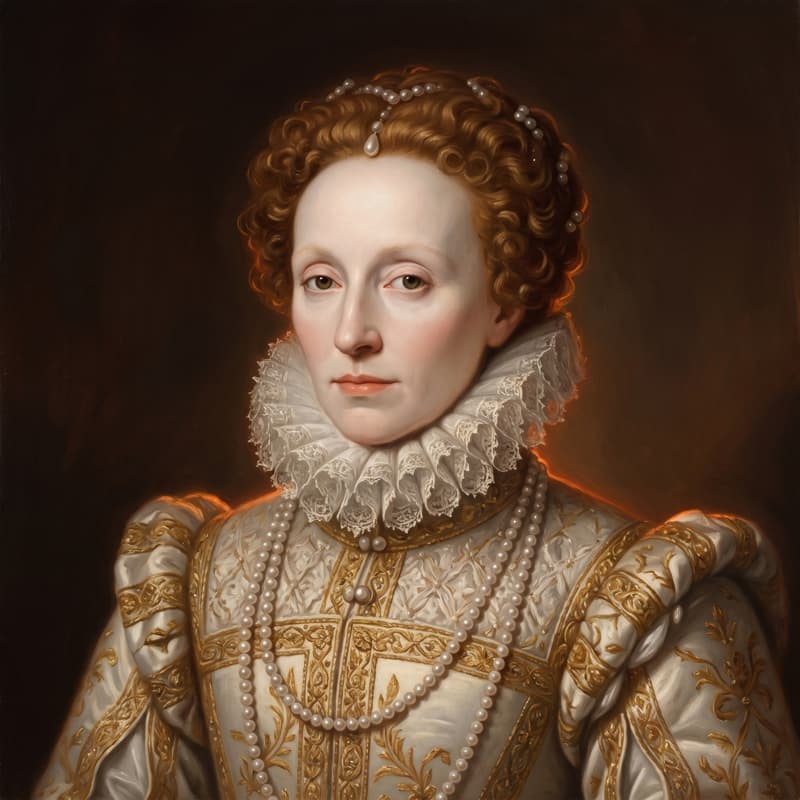
Elizabeth was born on September 7, 1533, at Greenwich, the daughter of Henry VIII and his second wife, Anne Boleyn, and died on March 24, 1603, at Richmond Palace, the last monarch of the Tudor dynasty. Between those dates sits a reign of forty-five years built on the management of risk: a queen who survived her own family before she ever ruled anyone, then spent four decades turning caution into an instrument of government.
A dangerous inheritance
Being Henry VIII's daughter was not, in the 1530s, a safe position. Elizabeth was not yet three when her mother was executed, and her status shifted with her father's marriages — declared illegitimate at times, restored to the succession at others. Under her tutor Roger Ascham from 1548, she acquired a formidable education, fluent enough in multiple languages that a Venetian ambassador said each seemed her native tongue.
The Tower and the throne
The danger became acute under her half-sister, Mary I. On suspicion tied to Wyatt's Rebellion, Elizabeth was imprisoned in the Tower of London from March 18 to May 19, 1554 — the same fortress where her mother had died — before release to house arrest. She succeeded Mary in November 1558 and was crowned at Westminster Abbey on January 15, 1559, a date chosen by her astrologer, John Dee. That same year, Parliament passed the Act of Supremacy, naming her "the only supreme governor" of the realm in ecclesiastical and temporal matters, settling in law the religious question that had destabilized the two reigns before hers.
Marriage as statecraft, not romance
Elizabeth never married, but the record does not support the popular idea that she vowed never to as a young queen and held to it unmoved. Her February 1559 response to Parliament left the marriage question open in careful, conditional language. In April 1563 she told Parliament directly that anyone who assumed she was bound "by vow or determination" never to marry should abandon that belief. Read together, the speeches describe decades of courtship used as diplomatic leverage — most prominently the Anjou negotiations of the early 1580s — rather than a settled renunciation from the start.
The Armada summer
The reign's best-known moment arrived in 1588, when Elizabeth addressed land forces gathered at Tilbury as England awaited a Spanish invasion. The lines most often quoted — about the "heart and stomach of a king" — come from an account by Dr. Leonel Sharp, written decades later and first printed in 1654; no contemporaneous transcript survives, and historians debate how closely it matches what was said that day. That does not diminish what the appearance accomplished, in a year the Armada was turned back.
Mary Stuart, empire, and the last Parliament
Mary, Queen of Scots, held in English custody for almost nineteen years, was executed at Fotheringhay Castle on February 8, 1587, a week after Elizabeth signed the warrant — removing a rival claimant at real political cost. In 1600 she chartered London merchants as what became the East India Company, with a monopoly on English trade to Asia. In the Golden Speech to her last Parliament on November 30, 1601, she answered the monopolies controversy in the language of mutual obligation: "Though God hath raised me high, yet this I account the glory of my Crown, that I have reigned with your loves."
Death and the end of a dynasty
Elizabeth died at Richmond Palace on March 24, 1603, unmarried and without a direct heir, leaving the crown to James VI of Scotland as James I of England and closing the Tudor line she had defended for forty-five years. She also left the realm with significant debts — a plainer legacy than the golden-age image later built around her.
Continue the conversation
The life above rests on speeches, statutes, and near-contemporary accounts, with disputed passages — Tilbury above all — flagged rather than smoothed over. Our Elizabeth I, an AI recreation built on that sourced record and labeled as what it is, speaks from inside it. Ask her about the Tower, turning marriage offers into diplomacy for decades, or signing the warrant that ended Mary Stuart's life.
More in this cluster: Elizabeth I hub · her death · verified quotes · facts.