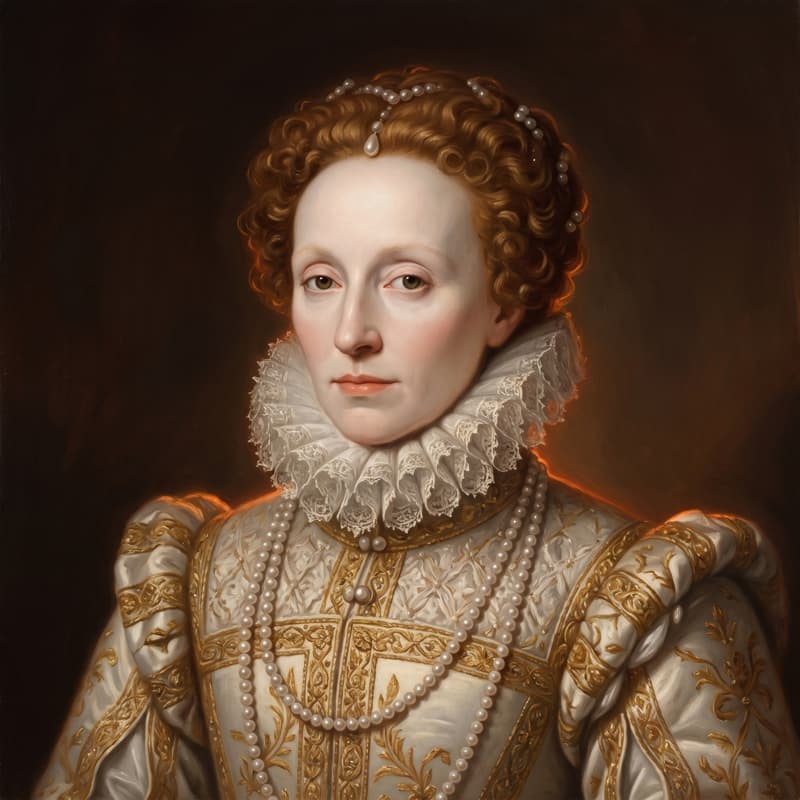
Every Elizabeth I fact on this page is checked against a primary or institutional source — the Royal Family website, Wikipedia's cited scholarship, Luminarium's primary-text archive, and the East India Company's own digitized records — with the citation shown inline. Short version: born September 7, 1533, at Greenwich to Henry VIII and Anne Boleyn; imprisoned in the Tower under Mary I in 1554; crowned January 15, 1559; made supreme governor of the church that year; never married, though not by an early vow; oversaw the Armada's defeat in 1588; signed Mary, Queen of Scots's death warrant in 1587; chartered the East India Company in 1600; died March 24, 1603, ending the Tudor line. Details and sources below, then one popular claim corrected.
Eight verified facts
- Born September 7, 1533, at Greenwich, the daughter of Henry VIII and his second wife, Anne Boleyn (The Royal Family).
- Imprisoned in the Tower of London from March 18 to May 19, 1554, during Mary I's reign on suspicion of involvement in Wyatt's Rebellion, before being moved to house arrest at Woodstock — the same fortress where her mother had been executed twenty years earlier (Wikipedia).
- Succeeded to the throne in November 1558, crowned January 15, 1559, at Westminster Abbey on a date chosen by her astrologer John Dee (The Royal Family; Wikipedia).
- The 1559 Act of Supremacy named her "the only supreme governor" of the realm in ecclesiastical and temporal matters, formally rejecting papal jurisdiction (Luminarium). This is the fact that actually defines her constitutional role, not the "Virgin Queen" image.
- Educated by Roger Ascham from 1548, and reportedly fluent enough in multiple languages that a Venetian ambassador said in 1603 each "appeared to be her native tongue" (Wikipedia); the Royal Family's own site separately calls her "fluent in five languages" (The Royal Family).
- She never married — but not because of an early, fixed vow. Her 1559 and 1563 responses to Parliament treat marriage and the succession as live political questions; in 1563 she told doubters that assuming she was "by vow or determination bent never to" marry was mistaken (1559; 1563).
- She signed the death warrant for Mary, Queen of Scots on February 1, 1587, after Mary had spent almost nineteen years in English custody; the execution followed on February 8, 1587, at Fotheringhay Castle (Wikipedia).
- In 1600 she granted a royal charter establishing the East India Company, giving London merchants trading rights to Asia that grew into one of history's most powerful commercial entities (East India Company digital archive).
One popular claim, corrected
"On her deathbed, Elizabeth said, 'God may forgive you, but I never can,' about a ring the Countess of Nottingham had withheld from Essex." No contemporary account of this exchange exists. Its first known appearance is a romantic novel published in 1695, nearly a century after Elizabeth's death, and historians call it fiction outright — Lytton Strachey wrote it belonged "to a sentimental novelette... but it does not belong to history," and Alison Weir has termed it a fabrication (Wikipedia). A good story about the Essex affair; not a documented quotation.
A related caution: the most-quoted Tilbury line, "the heart and stomach of a king," is genuine to the record but not a stenographic transcript — it survives through a letter written decades later and first printed in 1654.
Frequently asked, quickly answered
Why is Elizabeth I called the Virgin Queen? She never married, and the image became central to her reign — though marriage stayed an open political question for years, not a vow made at the start (Luminarium).
How long did Elizabeth I reign? Forty-five years, from November 1558 to her death on March 24, 1603 (The Royal Family).
Related pages
Elizabeth I hub · her death · verified quotes · biography.
For what a fact list can't hold — how decades of courtship became statecraft rather than romance, what it took to survive the Tower and then rule the people who once imprisoned her — this site hosts a conversational AI recreation of Elizabeth I, grounded in the sources above and labeled plainly as an AI persona. The facts are here; the voice is a conversation away.