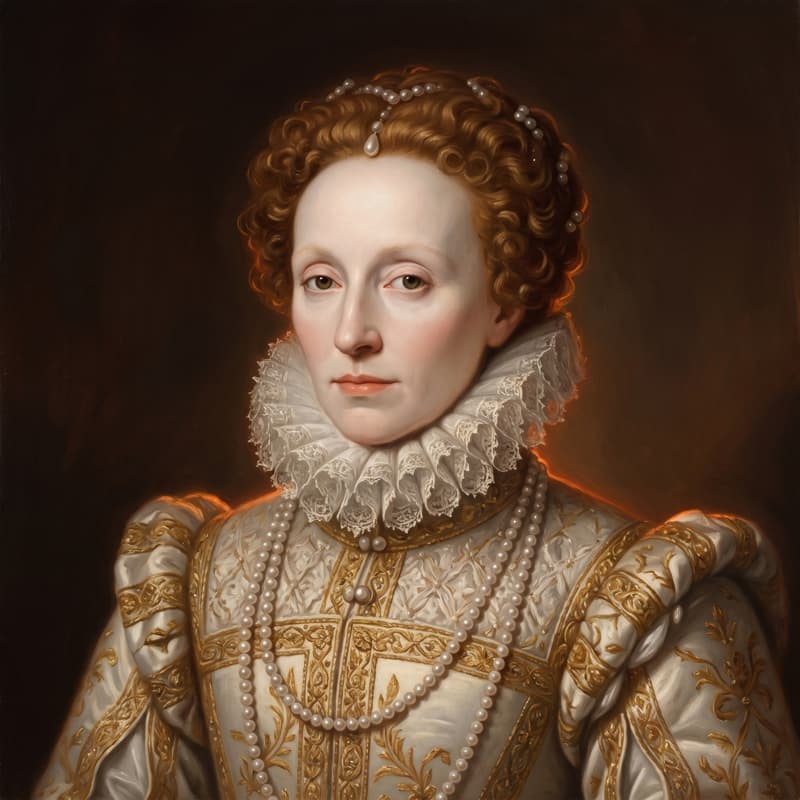
Elizabeth I died at Richmond Palace on March 24, 1603, bringing a 45-year reign to a close (Royal Family). She was the last of the Tudor monarchs. Her cousin's son, James VI of Scotland, succeeded her as James I of England, uniting the two crowns for the first time (Royal Family).
That is the plain record. What surrounds it mixes well-attested tradition with, in one famous case, outright legend.
An unresolved question, to the end
Elizabeth spent her whole reign declining to name an heir, treating the succession the way she had long treated marriage: as leverage kept open, not a question to be closed. By tradition, in her final days at Richmond, unable to speak, she indicated that James VI of Scotland — son of the cousin whose execution she had once ordered — should have the throne. That detail comes down through later accounts, not a contemporaneous transcript, so it belongs in the record as well-attested tradition rather than a verbatim eyewitness quotation. What is documented plainly is the outcome: James succeeded her within hours (Royal Family).
Not the same death as Mary's
Worth being precise about which death is which. In 1587, Elizabeth signed the death warrant that sent Mary, Queen of Scots to the block at Fotheringhay Castle, then reportedly turned on the councillor who carried it out, protesting he had acted without her final word (Wikipedia). That was a death Elizabeth caused, sixteen years before her own. The two connect only by irony: the throne Elizabeth left in 1603 went to Mary's son.
What she left behind
The image was of a golden age; the ledger told a different story. Despite Elizabeth's reputation for frugal government, she left large debts to her successor — decades of war, chiefly against Spain, had cost more than the Crown's ordinary revenue could cover (Royal Family). A reign remembered for stability closed with the accounts in the red.
The legend the search engines keep surfacing
The most persistent death-adjacent story about Elizabeth isn't documented history at all. As she lay dying, the tale goes, she learned that the Countess of Nottingham had years earlier intercepted a ring meant to reach her from the imprisoned Earl of Essex — a ring that could have won him mercy — and cried, on hearing it, "God may forgive you, but I never can." It's a good story. It is also, per historians including John Lingard, Lytton Strachey, and Alison Weir, fiction: no account from anyone's lifetime supports it, and its earliest printed appearance is a romantic novel from 1695, nearly a century after Elizabeth died (Wikipedia). Worth knowing if it comes up — and worth not repeating as fact.
From a conversation with our Elizabeth
An excerpt from a conversation with our AI Elizabeth persona — a stylized recreation, honestly labeled, not a historical record. Our Elizabeth's knowledge ends before that final illness at Richmond.
Caller: Did it ever frighten you, never saying who would come after you?
Elizabeth: Frighten is a subject's word, not a sovereign's. Name an heir too soon and every ambitious lord gathers round the rising sun and leaves the setting one to govern alone. I kept the question open because an open question cannot be plotted against. Whether that was wisdom or simply nerve held steady for forty-five years, history may judge better than I can. I only know the alternative was worse.
The line that ended, and the one that began
Elizabeth's death closed the Tudor century that had opened with her grandfather Henry VII's victory at Bosworth. What followed was not chaos but a change of house: the Stuart line, arriving in a king who had never expected to inherit an English throne until it was placed in his hands.
More in this cluster: Elizabeth's verified quotes · her biography · fact file · back to the Elizabeth I hub.