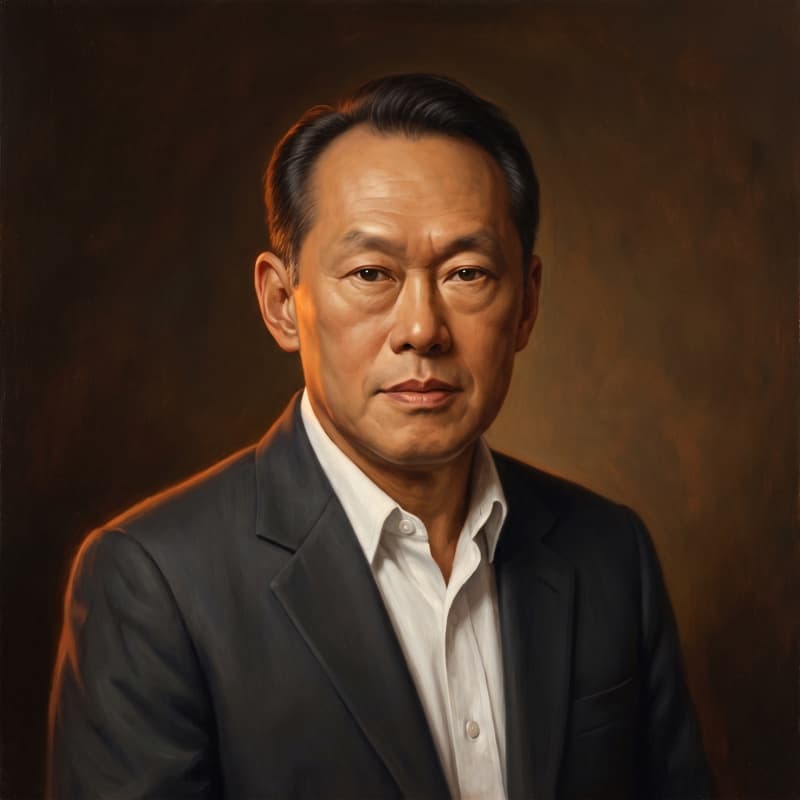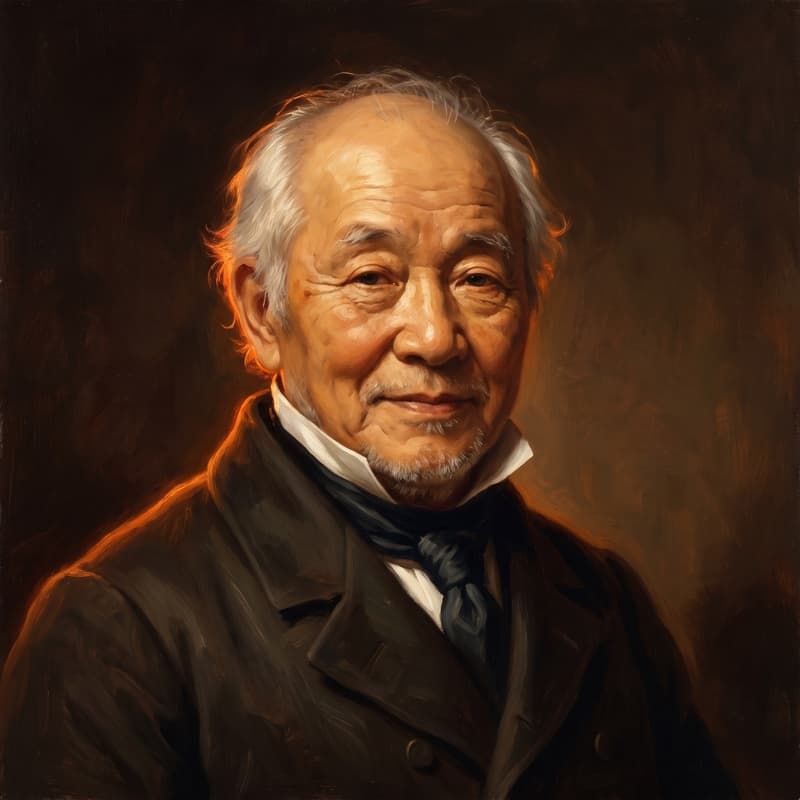
Eiichi Shibusawa was born on March 16, 1840, in the farming village of Chiaraijima — now part of Fukaya, Saitama Prefecture — and died on November 11, 1931, at his Asukayama residence in Tokyo, at 91. In between, he went from an indigo farmer's son to a shogunal retainer to a "person of practical affairs" who led Japan's first modern commercial bank and was involved in establishing or managing roughly 500 companies and some 600 welfare and public-interest organizations. He is often called the father of Japanese capitalism, and in 2024 the Bank of Japan put his portrait on the new 10,000-yen note.
That is the résumé. The interesting part is how a man who never wanted to be a banker became the one who mattered most.
The indigo boy who learned accounts before economics
His family farmed and also produced and sold indigo dye, and Shibusawa worked that trade from his teenage years — buying leaves, judging quality, keeping books, before he had a word like "economics" for what he was doing.
Before he was a banker, he was briefly something closer to a revolutionary. In 1863, he and a group of associates plotted an attack on the foreign settlement at Yokohama and Takasaki Castle — a scheme born of youthful fury at foreign encroachment, abandoned before it could ruin them; they fled instead to Kyoto. Around age 23 he entered the service of Hitotsubashi Yoshinobu, who shortly afterward became the last Tokugawa shogun — an accident of timing that put a former would-be rebel inside the machinery of a government about to fall.
Paris, 1867: the trip that rewired him
In 1867, at 27, Shibusawa joined Tokugawa Akitake's delegation to the Paris Universal Exposition and spent roughly a year and a half in Europe observing banks, joint-stock companies, and the other financial institutions of an industrializing West. It was the hinge of his whole life. He returned to a country whose shogunate had just collapsed — and carried what he'd seen in Paris into the new one. From 1869 he served the Meiji government's Ministry of Finance, including a stint as Chief of the Tax Bureau, before the decision that stunned his contemporaries: in 1873, with government service still the only honorable path for a man of his standing, he resigned to run a bank.
From a conversation with our Shibusawa
What follows is an excerpt from a conversation with our AI Shibusawa persona — a stylized recreation for readers, not a historical quotation.
Caller: Everyone told you leaving the ministry was a mistake. Weren't you scared?
Shibusawa: Uncertain, very much so. My colleagues thought a man who left government to become a "merchant" had lost his senses — only officialdom was honorable, they said, and the abacus was for small men. But I had stood in Paris and watched a banker and a colonel dine as equals, and I could not un-see it. A nation of officials alone will starve politely. So I took the ledger instead of the title, and have not regretted the arithmetic since.
Did he really found 500 companies?
That figure is genuine, but it needs the qualifier the Shibusawa Eiichi Memorial Foundation itself supplies: he was involved in establishing or managing roughly 500 companies, not the sole founder of each one — his roles ranged from founding to advising, fundraising, and mediating disputes. Roughly 60 percent of those firms still operate today in some form. The flagship was the First National Bank (Dai-Ichi Kokuritsu Ginko), where he became superintendent in 1873 and president by 1875 — Japan's first commercial bank, per the Foundation. From that base he organized Osaka Spinning Company (1883) and hundreds more: paper mills, railways, insurance, gas utilities.
What he built them for is the more interesting fact than how many he built. He called the principle gapponshugi — pooling capital, managerial talent, and labor toward a goal that served the public, rather than concentrating ownership in a single family fortune. It was a deliberate rejection of the zaibatsu model other Meiji-era magnates pursued; Shibusawa built no dynasty of his own.
The Analects and the abacus
Shibusawa's defining teaching, and the idea most associated with his name, is usually rendered in English as some version of "the Analects and the abacus" — ethics and commerce as partners, not opposing forces, since profit without moral grounding cannot last. That exact phrase is the standard gloss scholars and business writers use to summarize his philosophy, rather than a verified sentence from his own pen — his teaching in translation, not a transcript. What does survive in his own words, quoted directly in a 2019 essay by Japan Chamber of Commerce and Industry chairman Mimura Akio, is close in spirit and unambiguous in meaning:
"True economic activity will never endure unless it is based on morals that are good for society." — Mimura Akio, "Shibusawa Eiichi's principle of 'The Analects and the Abacus' will save the Japanese economy," Japan Policy Forum, July 11, 2019
Harvard Business School's Geoffrey Jones and Rei Morimoto describe the same conviction from a scholarly angle: Shibusawa believed prosperity through business was virtuous, and that ethical principles weren't a sacrifice made in pursuit of wealth but essential to wealth that actually lasts.
The other ledger
Business was only half of what Shibusawa kept books on. From 1876 he was secretary general, and later president, of Tokyo Yōiku-in, a welfare institution for people in need — a post he held for decades. He turned increasingly toward private-sector diplomacy in his later years: he met U.S. President Theodore Roosevelt on a 1902 trip to the U.S. and Europe, then in 1909, at 69, led a delegation of Honorary Commercial Commissioners of Japan to meet President Taft, stepping back from most management roles around the same time. He was nominated for the Nobel Peace Prize in 1926 and 1927 — recognition, not a win, for a life spent trying to keep Japan and the West talking to each other.
He kept working nearly to the end and was buried at Yanaka Cemetery in Tokyo. Nearly a century later, on July 3, 2024, the Bank of Japan put his face on the redesigned 10,000-yen note — a strange kind of immortality for a man who spent his life arguing that money only means something when it answers to a conscience.
Keep reading — or ask him yourself
The pages below go deeper: his final years and death, his verified quotes (and the famous line he probably never said), his full biography, and the facts, sourced.
Or skip the reading. Our Shibusawa takes calls. Ask him what he saw in Paris that changed his mind, why he refused to build a family fortune when he could have owned half of Meiji-era Japan, or what the Analects have to do with your balance sheet. He is an AI recreation, honestly labeled — but he keeps two ledgers open at once, and he has time for you.