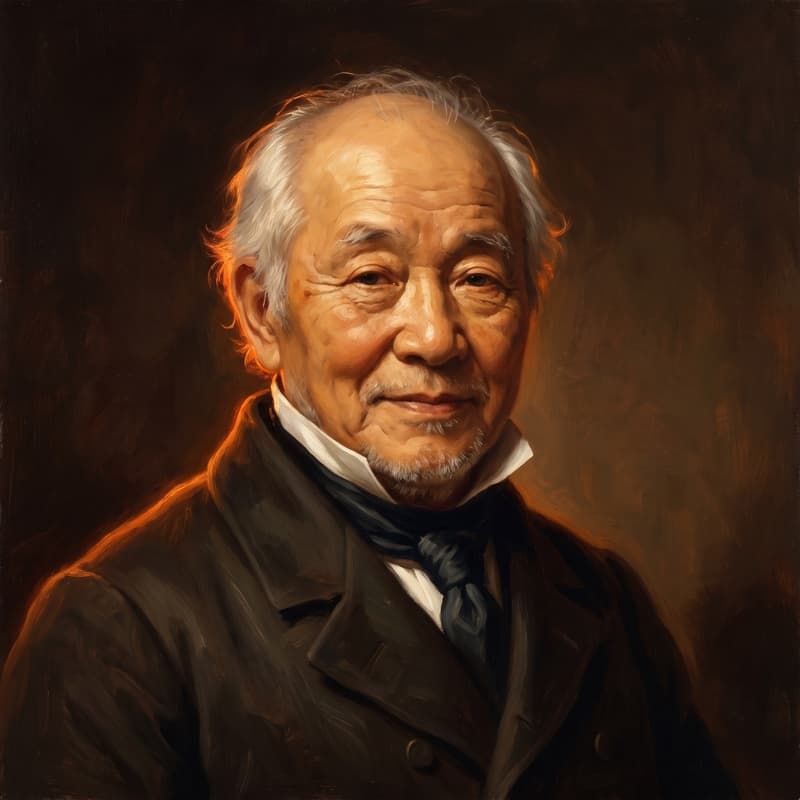
Eiichi Shibusawa

Eiichi Shibusawa Quotes: What He Actually Said (and What's Just the Gloss)

The one Shibusawa line that survives word-for-word sourcing, the famous 'Analects and the abacus' phrase explained as a teaching rather than a transcript, and the lines wrongly pinned on him.

Fact-checked · last reviewed 2026-07-13

Search "Eiichi Shibusawa quotes" and you'll mostly find one sentence, repeated everywhere, in slightly different English: something about the Analects and the abacus being inseparable. It's the right idea. It is very likely not his exact wording. This page keeps those two facts separate — the one line that traces to Shibusawa in quotation marks, the teaching that's a widely used English gloss rather than a transcript, and a few lines making the rounds that don't hold up at all.

The one line confirmed word for word

Writing in 2019, Japan Chamber of Commerce and Industry chairman Mimura Akio quoted Shibusawa directly, introducing the sentence with "he also said":

"True economic activity will never endure unless it is based on morals that are good for society."

Mimura Akio, "Shibusawa Eiichi's principle of 'The Analects and the Abacus' will save the Japanese economy," Japan Policy Forum, July 11, 2019

It is the plainest, most checkable version of the idea he's known for: that profit without a moral basis doesn't last.

"The Analects and the abacus" — his teaching, not his transcript

The phrase everyone associates with Shibusawa — that the Analects and the abacus are inseparable, that ethics and commerce have to be practiced together — is real as an idea, but it reaches English readers as a gloss, not a sentence he wrote or said in those words. Nippon.com's own explainer says as much: it describes Shibusawa "paraphrasing morality as the Analects and economy as the abacus," summarizing decades of his writing rather than quoting one line from Rongo to Soroban (1916) itself. Cite it as his philosophy in translation, not as a transcript.

Gapponshugi: the second core idea

Shibusawa's other lasting idea has less quotable packaging but more substance: gapponshugi, pooling capital, managerial talent, and labor toward a goal that served the public rather than concentrating ownership in one family's hands. It's the principle scholars point to when explaining why he built roughly 500 companies without building a personal dynasty out of any of them — a deliberate contrast with the zaibatsu model other Meiji-era magnates chose instead.

Lines that don't hold up

  • "Honesty is essential for economy." Widely repeated as a Shibusawa quote, but on the page most often cited for it, the only sentences set off in quotation marks are lines from Confucius's Analects — not from Shibusawa's own writing. Don't caption it as his.
  • "A business with one winner is a robbery with paperwork." A punchy, modern-sounding line that circulates online. No documented source connects it to him.
  • Peter Drucker's comparison — that Shibusawa's achievements were "a good deal more spectacular than those of Rothschild, Morgan, Krupp, or Rockefeller" — is genuine, but it's Drucker's assessment of Shibusawa, not a line from his own mouth. Fine to cite, wrong to file under "things he said."

From a conversation with our Shibusawa

An excerpt from a conversation with our AI Shibusawa persona — a stylized recreation, honestly labeled; not a historical quotation.

Caller: Everyone quotes you as saying the Analects and the abacus are inseparable. Did you actually put it that way?

Shibusawa: Close enough that I won't quarrel with the tailor over the stitching! I said many versions of it, in lectures, in essays, across forty years — a man repeats his one true idea in a hundred different coats. But if you want the sentence I'll stand behind exactly, it's the shorter one: that economy without a moral foundation does not endure. The abacus line is my reputation. That one is my signature.

Keep reading

The rest of the record — his life, his death, and the facts checked against primary sources — is here: Shibusawa hub · biography · his death · facts.

Or ask him directly. Our Shibusawa takes calls, and he's more interesting on what he actually meant by "the other ledger" than any single quotation can capture.

Eiichi's verified quotes

Every quote below is checked against a primary or scholarly source — the citation sits right under it.

True economic activity will never endure unless it is based on morals that are good for society.
Shibusawa Eiichi's principle of 'The Analects and the Abacus' will save the Japanese economy — Japan Policy ForumPresented in quotation marks and introduced as something Shibusawa 'also said' by Mimura Akio, chairman of the Japan Chamber of Commerce and Industry. Verbatim for this English rendering as published on the cited page; not checked against a Japanese primary edition.
Shibusawa taught that ethics and commerce had to be practiced together — a teaching often summarized in English as "the Analects and the abacus are inseparable."
The 'Analects' and the Abacus: The Contemporary Relevance of Shibusawa Eiichi's Business Philosophy — Nippon.comThis is the article's own paraphrase of his teaching, not a quotation in his own words; the only quotation-marked lines on the cited page are from the Analects of Confucius, not from Shibusawa.
Historian John Sagers describes Shibusawa as urging business leaders to look to Confucian principle for moral guidance in order to maintain the public's trust.
Shibusawa Eiichi, Dai Ichi Bank, and the Spirit of Japanese Capitalism, 1860-1930 — Shashi: The Journal of Japanese Business and Company HistoryCharacterization from the article's landing-page abstract of Sagers's research on Shibusawa's recorded remarks, not a verbatim quotation.
Scholar John Sagers describes Shibusawa as defining himself as a "person of practical affairs" (jitsugyoka) — distinct from government officials, military leaders, politicians, scholars, or old-fashioned merchants — and grounding that identity in Confucian study.
Review: Confucian Capitalism: Shibusawa Eiichi, Business Ethics, and Economic Development in Meiji Japan — Mises Institute / Quarterly Journal of Austrian EconomicsParaphrase of Sagers's argument in this review, not a Shibusawa verbatim line; cite as Sagers's characterization, not as something Shibusawa said.
Business historians Geoffrey Jones and Rei Morimoto describe Shibusawa's philosophy as holding that prosperity through business was virtuous, and that ethical principles were essential to durable wealth rather than something to sacrifice in pursuit of it.
Is the Business World Finally Ready for the Wisdom of Shibusawa? — Harvard Business School Working KnowledgeThe article's characterization of his philosophy; no Shibusawa quotation marks appear on the cited page.
Shibusawa's organizing principle, gapponshugi, called for pooling monetary capital, managerial talent, and labor toward a public-interest goal rather than concentrating ownership in a single family, the zaibatsu model he pointedly avoided.
Shibusawa Eiichi — WikipediaConcept description drawn from the cited page's summary of his business philosophy, cross-checked against the Foundation's own materials; not a verbatim Shibusawa line.
Portrait of Eiichi Shibusawa

Live from the archive

Ask Eiichi yourself

Reading about Eiichi Shibusawa is one thing. Talking to Eiichi is the product. Try a call — 2 minutes free, no card.

An AI voice persona of Eiichi Shibusawa — not a recording.

Start a call

2 free minutes with Eiichi

Live voice, right in your browser — just press call.