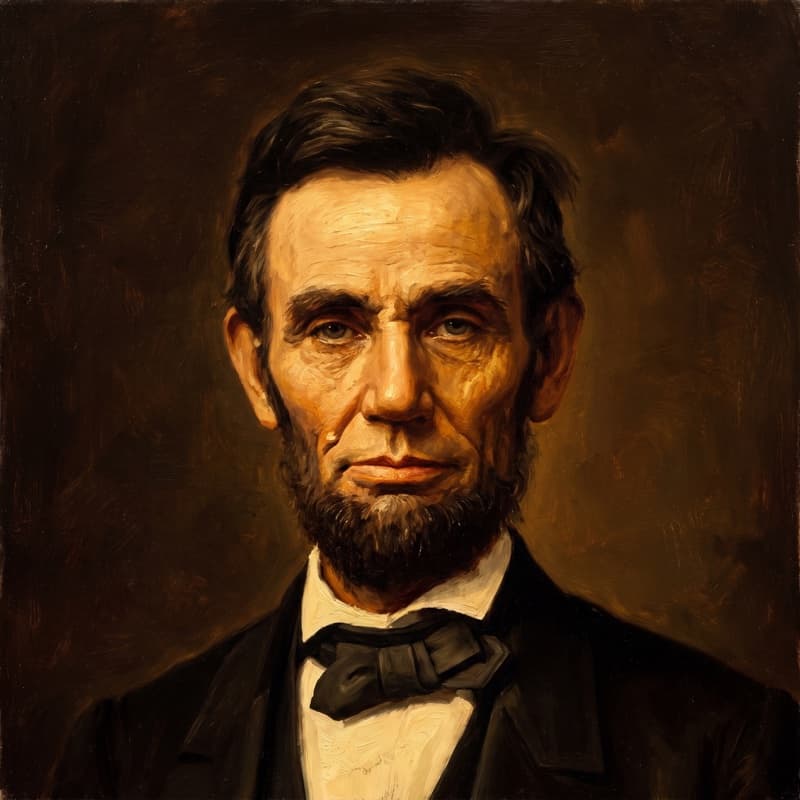
Abraham Lincoln was the 16th president of the United States, serving from March 4, 1861, until his death on April 15, 1865. Born on February 12, 1809, in a one-room log cabin on his father's Sinking Spring Farm in Kentucky, he rose from frontier obscurity to lead the country through the Civil War, preserve the Union, and make emancipation a central purpose of the war. He was shot by John Wilkes Booth at Ford's Theatre on April 14, 1865, and died the next morning — days after Confederate surrender news, just as the war he had carried was ending.
That is the summary. The man is more interesting than the summary.
The lawyer who framed the question
Lincoln did not arrive in national politics as a myth. He arrived as a working politician: a Whig who served a single term representing Illinois in the 30th Congress, from 1847 to 1849, and who later became the first Republican president. His breakthrough came with the House Divided speech of 1858, when he warned that the country could not go on indefinitely as it was:
"A house divided against itself can not stand." — House Divided speech, 1858
In the same speech he made the stakes explicit: "I believe this government can not endure permanently, half slave, and half free." The warning framed the question the whole country would soon have to answer, and in 1860 the country answered by electing him president with 180 electoral votes.
What Lincoln actually did as president
Lincoln's presidency was the Civil War, and his record is a sequence of decisions made under its pressure. He fought first to preserve the Union — writing to Horace Greeley that "My paramount object in this struggle is to save the Union, and is not either to save or to destroy slavery." Then, on January 1, 1863, the Emancipation Proclamation took effect, declaring enslaved people in rebelling Confederate areas free and opening Union military service to Black men. It changed the character of the war.
The Proclamation did not end slavery everywhere — it was a wartime measure aimed at areas in rebellion. Permanence took the Thirteenth Amendment, which Lincoln pressed for: passed by Congress on January 31, 1865, and ratified later that year, it abolished slavery in the United States constitutionally and for good.
Between those two acts came the speech schoolchildren still memorize. On November 19, 1863, at the dedication of the national cemetery at Gettysburg, Lincoln spoke roughly 272 words, beginning "Four score and seven years ago our fathers brought forth, upon this continent, a new nation," and resolving "that the nation, shall have a new birth of freedom."
From a conversation with our Lincoln
What follows is an excerpt from a conversation with our AI Lincoln persona — a stylized recreation for readers, not a historical quotation.
Caller: Why only 272 words at Gettysburg? Everyone else spoke for hours.
Lincoln: Mr. Everett had already given the day its two hours, and given them well. What was left for me was the nub of the thing, and the nub of a thing is short or it isn't the nub. I have held all my life that if a speech can't be short, it mostly can't be good. Besides, friend — those boys in the ground had said the most of it already. I only had to say what they said it for.
Was Lincoln a Republican or a Democrat?
This is one of the most-searched questions about him, and the answer is plain: Lincoln was a Republican — the first Republican president. Earlier in his career he was a Whig; he was never a Democrat. He won the presidency twice, in 1860 and again in 1864, when voters returned him to office over George B. McClellan in the middle of the war.
He was also, famously, admired by Walt Disney — Disney's own D23 history says Walt had long admired Lincoln and built his Lincoln figure for Great Moments with Mr. Lincoln before the Hall of Presidents concept existed. Whether Lincoln was Disney's "favorite president" in some private ranking, the record doesn't say; that he was the president Disney chose to bring to life is a matter of record.
The end, and what he left unfinished
At his second inauguration on March 4, 1865, with victory near, Lincoln did not gloat. He preached something harder: "With malice toward none; with charity for all." Six weeks later, on the night of April 14, 1865, John Wilkes Booth — a famous actor and Confederate sympathizer — shot him at Ford's Theatre while he watched the comedy Our American Cousin. Carried across the street to the Petersen House, Lincoln died at 7:22 a.m. on April 15. The reconciliation he had begun to describe, he never got to attempt.
Even his rest was unquiet: the popular claim that Lincoln was "buried 17 times" is shorthand for decades of coffin moves, hidden storage after an 1876 attempt to steal his body, and the eventual reconstruction of his tomb — not 17 funerals.
Caller: Do you think you were a great president?
Lincoln: I claim not to have controlled events — I confessed as much in a letter once, and confess it still. Events controlled me. A man does his honest best with the day's portion of trouble, and the verdict he leaves to the people and to the Almighty, in whichever order they get around to it.
Excerpt from our AI Lincoln persona — stylized, and labeled as such.
Keep reading — or ask him yourself
The pages below go deeper: his assassination and death, his verified quotes (and the famous ones he never said), his full biography, and the facts, sourced.
Or skip the reading. Our Lincoln takes calls. Ask him what the war was truly fought over, how the Emancipation Proclamation got drafted under wartime pressure, or what "malice toward none" was supposed to mean once the guns went quiet. He is an AI recreation, honestly labeled — but he answers in his own voice, and he has time for you.