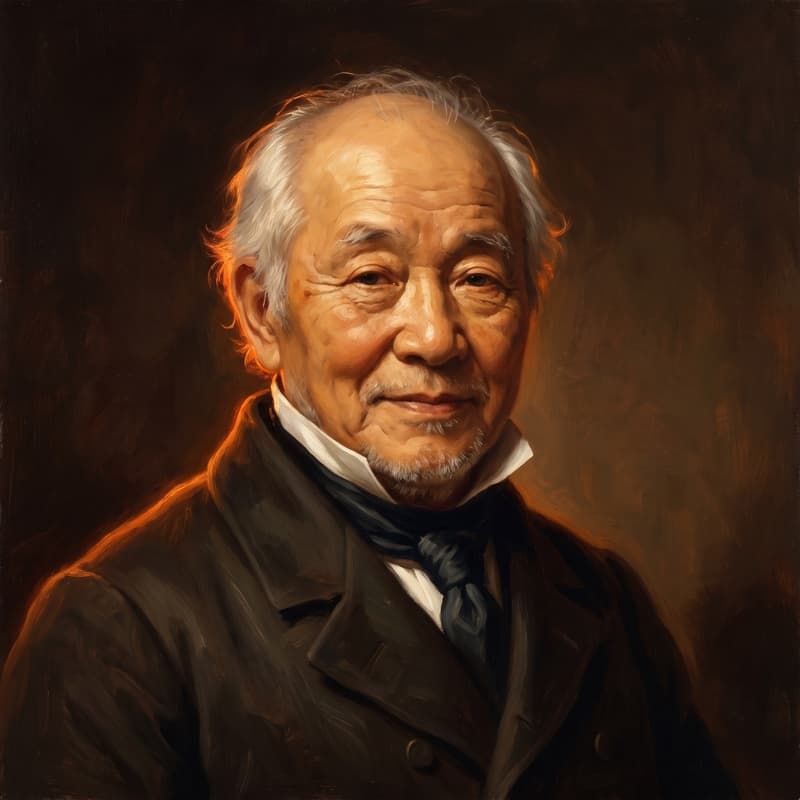
Eiichi Shibusawa died on November 11, 1931, at his Asukayama residence in Tokyo, at age 91. He was buried at Yanaka Cemetery in Tokyo.
That answers the question people search for. The fuller picture is a man who kept working almost to the end, and a death that closed one ledger while leaving several others still open.
A long last chapter, not a quiet retirement
Shibusawa stepped back from most of his management positions around 1909, in his late sixties, not long after he headed a delegation of Honorary Commercial Commissioners of Japan to the United States and met President William Howard Taft. But stepping back from management was not the same as stopping. The Shibusawa Eiichi Memorial Foundation's own chronology and Harvard Business School's retrospective on his career both frame his final years as active ones — welfare work, education, and the private-sector Japan-U.S. diplomacy he had practiced since meeting President Theodore Roosevelt in 1902 all continued into his eighties.
Recognized, but never a Nobel winner
That later diplomatic work brought him recognition at the very end of his life: Shibusawa was nominated for the Nobel Peace Prize in both 1926 and 1927. He did not win in either year. It is a fact about the esteem he had accumulated by his eighties, not a claim that the prize itself came to him.
What outlived him
Much of what Shibusawa built kept going without him. The Shibusawa Eiichi Memorial Foundation estimates that roughly 60% of the approximately 500 companies he was involved in establishing or managing — through founding, advising, fundraising, or mediation — are still operating today in some form, alongside the roughly 600 social and public-work organizations he helped organize over his career. The most visible recent marker of that legacy arrived nearly a century after his death: on July 3, 2024, the Bank of Japan began issuing a new 10,000-yen note bearing his portrait, with Tokyo Station's Marunouchi Building on the reverse.
From a conversation with our Shibusawa
An excerpt from a conversation with our AI Shibusawa persona — a stylized recreation, honestly labeled, not a historical quotation. Our Shibusawa's knowledge ends before that day in 1931.
Caller: People will remember you for the bank, and for the abacus. Does that sit right with you?
Shibusawa: The abacus is only half the sentence, friend — it needed the Analects to mean anything. A ledger balances or it does not; that tells you nothing about whether the business deserved to exist. I would rather be remembered for the quieter work alongside it — the hospitals, the schools, the argument that morality was never a luxury reserved for the already profitable. Wealth that outlives its maker has to rest on something sturdier than the maker's own ambition.
Ask him about the rest of it
Our Shibusawa — an AI recreation, built from the historical record and labeled as what it is — can't tell you about that November day at Asukayama; his knowledge ends before it. But he can tell you about Paris in 1867, why he walked away from a government post to build a bank instead, and what he meant by insisting the Analects and the abacus travel together. Start the conversation whenever you're ready; he has time.
More in this cluster: Shibusawa's verified quotes · his biography · fact file · back to the Shibusawa hub.