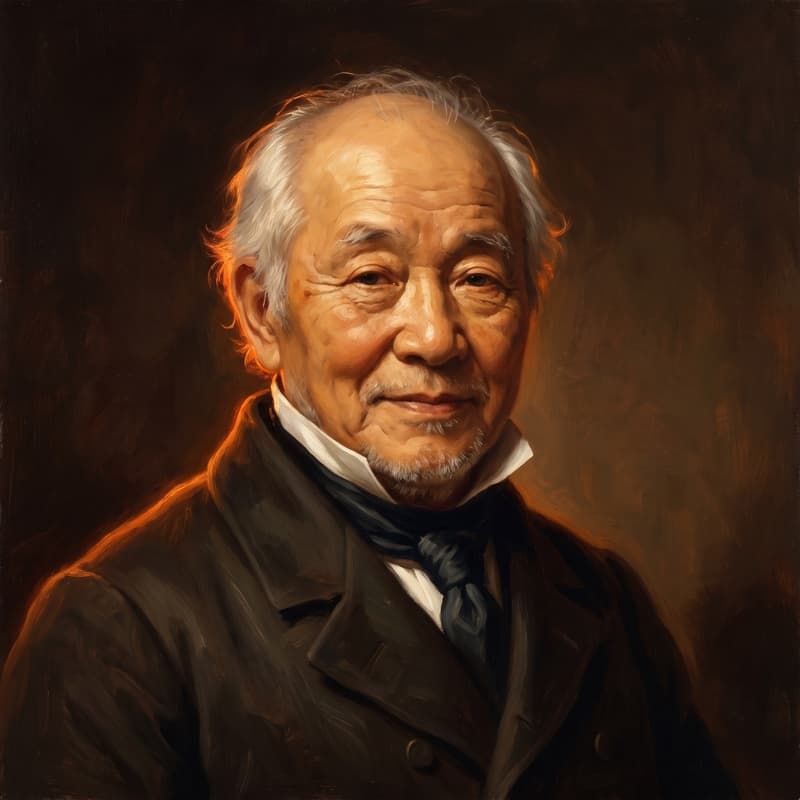
The essential Eiichi Shibusawa facts: born March 16, 1840, in the farming village of Chiaraijima, now part of Fukaya, Saitama Prefecture; traveled to Paris in 1867 with Tokugawa Akitake's delegation and spent roughly a year and a half observing European institutions; served the Meiji government from 1869 to 1873 before resigning to run a bank; became superintendent of the First National Bank in 1873, which the Shibusawa Eiichi Memorial Foundation calls Japan's first commercial bank; was involved in establishing or managing roughly 500 companies and about 600 social and public-work organizations; and in 2024 Japan put his portrait on a new 10,000-yen note. All verified against the Foundation's own record and the Bank of Japan. This page gives you the facts worth keeping — and flags the popular "facts" that don't survive checking.
The core facts, with why they matter
Born into an indigo-farming family, not a merchant dynasty. His household farmed and also produced and sold indigo dye, and Shibusawa worked that trade as a teenager — buying leaves, judging quality, keeping accounts. The instinct for ledgers and reputation that later ran a bank started on a farm, not in a counting house.
Paris, 1867, is the hinge fact of his life. At 27 he joined the shogunate's delegation to the Paris Universal Exposition and spent about eighteen months in Europe watching banks, joint-stock companies, and other financial institutions operate. Nearly everything that follows — including a career choice his peers thought was madness — traces back to what he saw there.
He served the Meiji government from 1869 to 1873, then walked away from it to run a bank. Officialdom was considered the only honorable path for a man of his standing; resigning a government post for banking was a genuinely startling move, not an obvious one.
In 1873 he became superintendent of the First National Bank — Japan's first commercial bank, per the Foundation. He was its president by 1875. Through later mergers, its lineage connects to today's Mizuho Bank.
"Roughly 500 companies" is real, but it needs its qualifier. The Foundation is explicit that his roles ranged from founder to advisor, fundraiser, recruiter, and dispute mediator across those ~500 companies and 600 organizations — not that he personally founded every one. About 60 percent of the ~500 firms still operate today in some form, roughly 30 percent dissolved, and about 10 percent have unknown status.
He's the face of the 10,000-yen note issued July 3, 2024. The Bank of Japan's new series carries his portrait on the front and Tokyo Station's Marunouchi Building on the reverse — a modern honor for a career that ended in 1931.
From a conversation with our Shibusawa
An excerpt from our AI Shibusawa persona — a stylized recreation for readers, not a historical quotation.
Caller: People just remember the number — five hundred companies. What do you want remembered instead?
Shibusawa: The number is a tally, not a testimony. Ask instead what each ledger was kept for, and whose labor it recorded. I did not found five hundred fortunes; I helped assemble five hundred efforts, and most outlived my hand in them — the only proof that matters. A man who needs his name on every brick has built a monument, not an economy.
Popular "facts" that need correcting
"Shibusawa personally founded exactly 500 companies." An overstatement. The Foundation's own account is that he was involved with approximately 500 companies in varied capacities, not that he single-handedly established every one.
"Shibusawa founded Japan's first bank." Imprecise. The supported claim is narrower: the First National Bank, which he led from 1873, was Japan's first commercial bank.
"The Analects and the abacus are inseparable" — presented as his own sentence. That phrase is the standard English gloss for his philosophy, repeated across business writing, but it isn't a verified quotation from his own hand. What is directly attributable to him, quoted in a 2019 essay by Japan Chamber of Commerce and Industry chairman Mimura Akio, is close in meaning: "True economic activity will never endure unless it is based on morals that are good for society." — Japan Policy Forum, July 11, 2019
Five things Eiichi Shibusawa did (the honest short list)
- Led the First National Bank, Japan's first commercial bank, from 1873.
- Traveled to Paris in 1867 and brought European financial institutions' lessons home.
- Was involved in establishing or managing roughly 500 companies.
- Supported nearly 600 welfare, education, and public-interest organizations.
- Appeared on Japan's new 10,000-yen note starting July 3, 2024.
The fact pages can't hold him
Facts are the skeleton; the voice is the man. Our Shibusawa — an AI recreation, built from the sourced record and labeled as what it is — can tell you about the indigo trade, the year and a half in Paris that changed his mind, and what gapponshugi actually meant in practice, beyond the slogan. Ask him why he walked away from government for a bank everyone thought was beneath him. He's ready when you are.
More in this cluster: Shibusawa hub · his death · verified quotes · biography.