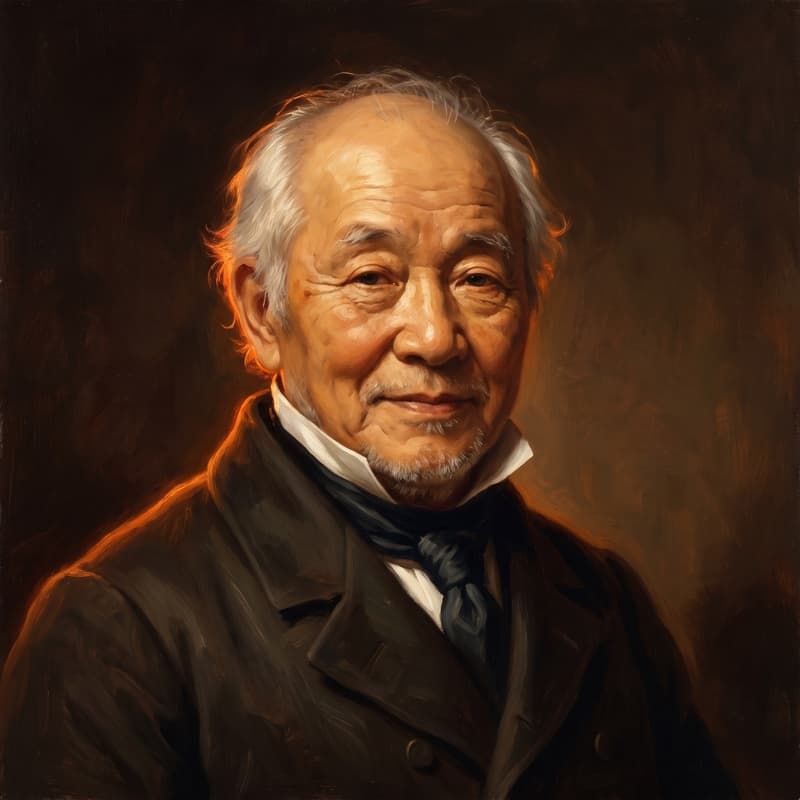
Who was Eiichi Shibusawa? A farmer's son born March 16, 1840, in Chiaraijima, now part of Fukaya in Saitama Prefecture (Shibusawa Eiichi Memorial Foundation); superintendent, from 1873, of the First National Bank, which the Foundation calls Japan's first commercial bank (Foundation Q&A); a man the Foundation credits with involvement in roughly 500 companies and some 600 social and public-work organizations, in roles ranging from founder to advisor, fundraiser, and dispute mediator (Foundation Q&A); dead at 91, at his Asukayama residence in Tokyo, on November 11, 1931 (Foundation chronology). The dates are the skeleton. The life is what happened between an indigo farm and a bank president's desk, and how a man kept insisting, the whole way, that the two belonged in the same ledger.
The indigo years
Nothing about the beginning predicts a bank. Shibusawa's family farmed and also produced and sold indigo dye, and he worked that trade as a teenager, learning to judge quality and hold accounts before he had any title at all (Foundation biography). It was not a peaceful adolescence, either. In 1863 he and his associates planned an attack on foreign settlements at Yokohama and on Takasaki Castle — then abandoned the scheme and fled to Kyoto (Foundation chronology). It is worth keeping that episode in the record honestly: not a triumph, a young man's near-miss, talked out of it before it became a disaster he couldn't have undone.
Paris rewired the plan
By his early twenties Shibusawa had entered the service of Hitotsubashi Yoshinobu, who would soon become the last Tokugawa shogun (Wikipedia) — an accidental front-row seat to the shogunate's final years. In 1867, at 27, he joined Tokugawa Akitake's delegation to the Paris Universal Exposition and spent roughly a year and a half in Europe, observing banks, joint-stock companies, and the machinery of Western commerce firsthand (Foundation biography). He came home to a government that no longer existed and a template for one that could work.
Choosing a bank over a ministry
From 1869 he served the new Meiji government, including posts in the Tax Bureau and the currency office of the Ministry of Finance, before resigning in 1873 (Foundation biography) — a genuinely strange move by the standards of the day, when officialdom was the respectable path and banking was not. That same year he became superintendent, and by 1875 president, of Dai-Ichi Kokuritsu Ginko, the First National Bank (Foundation chronology).
The five hundred companies, and the ledger that wasn't for sale
From that bank outward, Shibusawa organized what the Foundation describes as involvement — founding, advising, fundraising, mediating — in roughly 500 companies and 600 public-interest organizations, a nuance worth holding onto against the flatter claim that he personally built every one (Foundation Q&A). The organizing idea behind that scale, described in secondary sources as gapponshugi, was to pool capital, management, and labor toward a shared public goal rather than concentrate ownership in one family fortune — the zaibatsu model he pointedly did not build (Wikipedia). His own stated principle was blunter and survives in an on-the-record quotation: "True economic activity will never endure unless it is based on morals that are good for society" (Japan Policy Forum). English-language commentary often summarizes his broader teaching — joining the Analects to the abacus — as the idea that ethics and commerce have to be practiced together, not traded off against each other (Nippon.com).
From a conversation with our Shibusawa
An excerpt from a conversation with our AI Shibusawa persona — a stylized recreation, honestly labeled; not a historical quotation.
Caller: Why did you leave the government for a bank? Everyone thought you were mad.
Shibusawa: They mourned as if I had died! But I had already been a farm boy, a would-be rebel, and a retainer to a shogun who lost his whole country while I sat in Paris — every ladder I climbed had already been pulled down behind me once. A bank, I thought, at least keeps its own books honest. And a nation of officials, however dignified, will starve rather politely. So I went where the arithmetic and the conscience could sit at the same desk.
Continue the conversation — literally
The record above is cited; the reasoning behind it is what you ask about. Our Shibusawa is an AI recreation built on that same record, labeled honestly as such. Ask him about buying indigo leaves alone at fourteen, what actually changed his mind in Paris, why he refused to build a family empire out of five hundred companies, or what he thought the "other ledger" of charity owed back to society. He answers in his own voice — start the conversation now.
More in this cluster: Shibusawa hub · his death · verified quotes · facts.