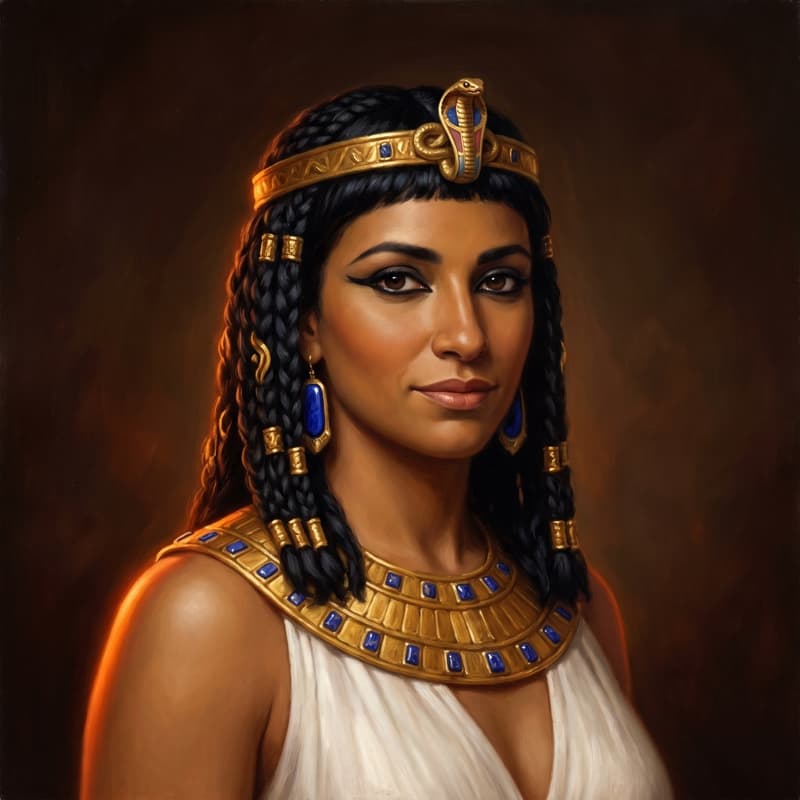
No speech, letter, or inscription written in Cleopatra's own words survives. Every line below that reads as "Cleopatra said" is reported speech, recorded by Greek and Roman historians writing decades to centuries after her death and passed down through English translators. Read them as testimony about her, not transcripts of her — mainly from Plutarch, writing his Life of Antony around AD 100, and Cassius Dio, writing a full century after that. Neither man heard her speak.
Reported to Antony, after his rigged catch
Antony had a diver secretly attach a salted fish to his line to impress her while they fished together. Plutarch says Cleopatra saw through it and answered in front of his officers:
"Imperator, hand over thy fishing-rod to the fishermen of Pharos and Canopus; thy sport is the hunting of cities, realms, and continents."
Reported by Plutarch, not a surviving quotation of Cleopatra herself — but the wording matches the Bernadotte Perrin translation exactly. (Plutarch, Life of Antony, ch. 29, Perseus Digital Library)
Reported to a frightened Roman officer
Plutarch tells of Geminius, a Roman sent to warn Antony off Cleopatra, who ended up confessing his real errand at her table. Her reply, per Plutarch:
"Thou hast done well, Geminius, to confess the truth without being put to the torture."
One of the few moments the sources let her sound sharp rather than merely magnificent. (Plutarch, Life of Antony, ch. 59, Perseus Digital Library)
Two sources, two different surrenders
When Octavian's forces took Alexandria, Plutarch and Cassius Dio each describe a meeting between Cleopatra and Octavian — and they disagree. Plutarch's version centers on her pleading for mercy after her steward Seleucus publicly accused her of hiding valuables. Cassius Dio, writing a century later, gives her a different opening line entirely:
"Hail, master — for Heaven has granted you the mastery and taken it from me."
That line never appears in Plutarch's account of the same encounter. Treat the mismatch as informative: ancient biography was never single-sourced. (Cassius Dio, Roman History, Book 51, 12.2, Cary translation, ToposText)
Reported at Antony's tomb, near the end
After Actium and Antony's death, Plutarch describes Cleopatra visiting his tomb one last time:
"Do not abandon thine own wife while she lives, nor permit a triumph to be celebrated over thyself in my person."
Composed for a Roman biographical tradition, not a document in her own hand — but it is the closest the sources come to her grieving in her own voice. (Plutarch, Life of Antony, ch. 84, Perseus Digital Library)
Quotes Cleopatra never said
"Age cannot wither her, nor custom stale her infinite variety." This is the line most searchers expect to find here, and it isn't hers. It's spoken by the character Enobarbus, describing Cleopatra to Maecenas and Agrippa, in Act 2, Scene 2 of Shakespeare's Antony and Cleopatra — a play written in 1607, roughly 1,600 years after her death. (Folger Shakespeare Library, Antony and Cleopatra, Act 2, Scene 2)
"Was this well done of your lady, Charmian?" Often paraphrased online as if Plutarch records this exchange at the death scene. He doesn't — it belongs to Shakespeare's Act 5, Scene 2, not to history.
What the sources won't settle
Even Plutarch, the closest thing to an authoritative ancient account, refuses to certify how Cleopatra actually died. Describing the competing stories about the asp and a hidden hollow comb, he writes plainly:
"The truth of the matter no one knows."
That is a fair closing thought for this whole page. Most of what circulates as "Cleopatra's words" is later reconstruction, translation, and — in Shakespeare's case — invention layered on top of a life the ancient sources themselves admit they couldn't pin down. (Plutarch, Life of Antony, ch. 86, Perseus Digital Library)
More in this cluster: Cleopatra hub · her death · biography · facts.