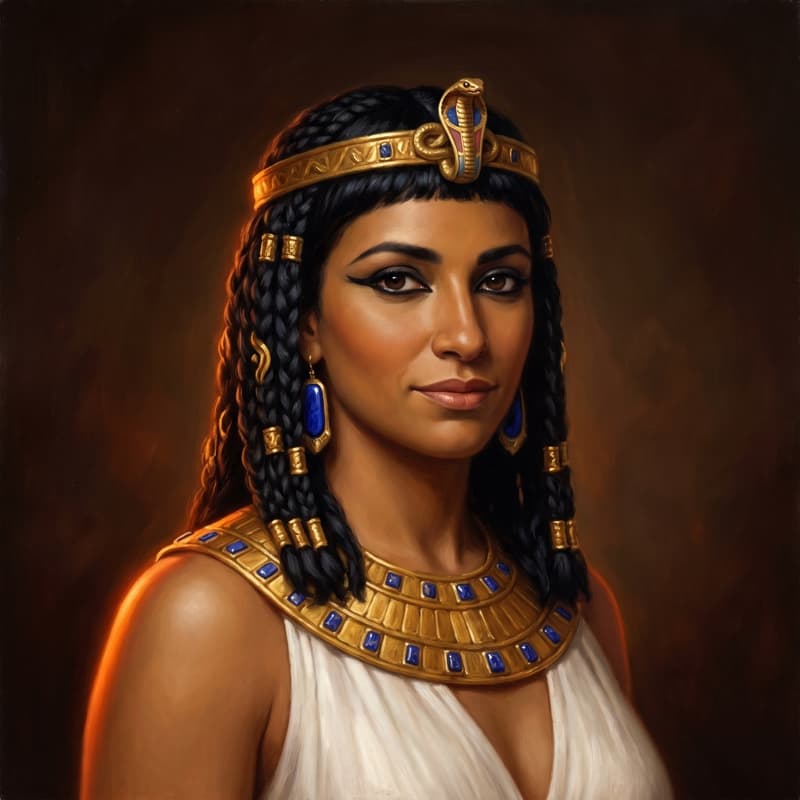
Cleopatra VII was born in late 70 or early 69 BC in Alexandria, daughter of Ptolemy XII Auletes, and died in the same city on 10 or 12 August 30 BC, days after Octavian's forces took it — the last active ruler of a Macedonian Greek dynasty that had governed Egypt from Alexandria since 305 BC. Between those dates sits a twenty-one-year reign spent running the wealthiest kingdom of the Hellenistic world through two rounds of Rome's civil wars, with steadily narrowing room to maneuver. Almost everything vivid in the record that survives her — the barge, the wit, the manner of her death — was written by Greek and Roman men active decades to centuries later, worth stating before telling their story.
Inheriting a shrinking throne
Her father died in 51 BC and left her, at about eighteen, co-ruler with her younger brother Ptolemy XIII, in the sibling-marriage pattern the Ptolemaic dynasty had leaned on for generations. It did not hold. Civil war with Ptolemy XIII's court drove her out of Alexandria, and by 48 BC she was seeking outside backing to reclaim the throne. She found it in Julius Caesar, who arrived in Egypt that year and backed her side of the dispute.
The Caesar years
Ptolemy XIII died in 47 BC in the Alexandrian War, and Cleopatra returned to power — paired now, on paper, with her other younger brother, Ptolemy XIV. That same year she bore a son, Caesarion, understood to be Caesar's child. She and Ptolemy XIV later traveled to Rome while Caesar held the dictatorship, until his assassination in 44 BC sent her home. Plutarch, writing roughly a century and a half afterward, credits her with a command of languages that let her address many foreign envoys without an interpreter — Plutarch's testimony about her, not an independently verified skill.
Tarsus and the Antony alliance
Cleopatra met Mark Antony at Tarsus in 41 BC, arriving by a barge Plutarch describes in detail — gilded stern, purple sails, silver oars — a display aimed at Roman power as much as at Antony. The alliance restored territory the Ptolemies had lost and produced three more children: twins Alexander Helios and Cleopatra Selene II, and a younger son, Ptolemy Philadelphus. In 34 BC, after Antony's Armenian campaign, she was proclaimed "queen of kings" in Alexandria and linked herself publicly with the goddess Isis — the high point of her reach, and the moment Rome's opposing faction turned most easily into propaganda about a foreign queen commanding a Roman general.
From a conversation with our Cleopatra
An excerpt from a conversation with our AI Cleopatra persona — a stylized recreation, honestly labeled; not a historical quotation.
Caller: You were about eighteen when you took the throne, co-ruling with a brother who wanted you gone. Were you ready?
Cleopatra: Ready is a word men use afterward. My brother's regents thought a sister could be managed. I spent the next years teaching Rome, one dictator at a time, that I could not.
Actium and the end
That opposing faction belonged to Octavian, and in 31 BC his forces defeated the combined fleets of Antony and Cleopatra at Actium. She returned to Alexandria and tried, without success, to negotiate terms preserving her children's position and the kingdom itself. Antony took his own life first; Cleopatra died soon after, once Octavian's army had taken the city, by an act ancient sources agree was suicide but disagree on the method — a question this site's page on her death treats directly rather than settling for the popular asp story. With her death, the Ptolemaic dynasty ended and Egypt became a Roman province, closing out the last independent kingdom of the Hellenistic world.
Continue the conversation
The record above is what ancient historians, writing well after her lifetime, chose to preserve. Our Cleopatra — an AI recreation built on that record and labeled as what it is — speaks from inside it. Ask her about the throne at eighteen, or the Caesar and Antony alliances as statecraft rather than romance.
More in this cluster: Cleopatra hub · her death · verified quotes · facts.