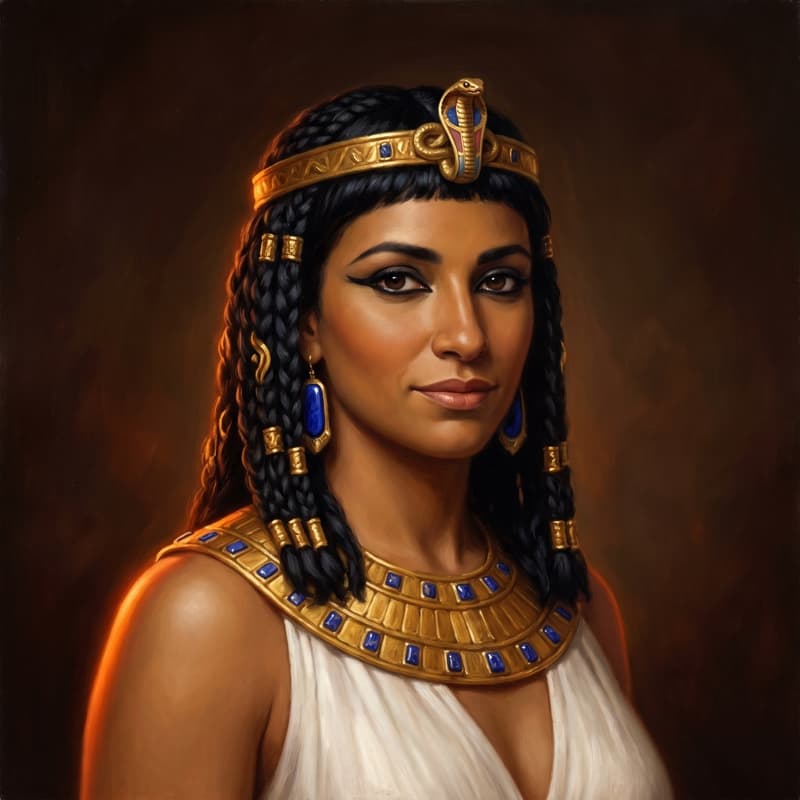
Cleopatra died in Alexandria on 10 or 12 August 30 BC, after Octavian's forces took the city following the defeat at Actium (Wikipedia). Ancient sources agree it was suicide and disagree on almost everything else. The most detailed account comes from Plutarch, writing roughly 100–150 years later, and even he concludes plainly that "the truth of the matter no one knows" (Plutarch, Life of Antony, ch. 86, Perseus Digital Library). This page leads with that uncertainty rather than treating the asp as settled fact.
What led to it
Cleopatra and Mark Antony's combined forces were defeated by Octavian at the Battle of Actium in 31 BC (Livius; Wikipedia). Antony took his own life once Octavian's forces reached Alexandria; Cleopatra, besieged and with her negotiating position gone, died days later in the same city (Wikipedia).
Two ancient accounts, one meeting
Plutarch and Cassius Dio both describe a meeting between Cleopatra and Octavian in her final days — and describe it differently. Plutarch centers his version on her steward Seleucus, who told Octavian she had held back valuables; he reports her reply as a protest that the goods were meant as "trifling gifts to Octavia and thy Livia," offered to win Caesar's mercy — reported speech in his narrative, not a document in her own hand (Plutarch, ch. 83, Perseus). Cassius Dio, writing two centuries later and generally regarded as less reliable, gives a different line for a comparable encounter: "Hail, master — for Heaven has granted you the mastery and taken it from me" (Cassius Dio, Bk. 51.12.2, Cary translation, ToposText). Plutarch's account of the same period contains no such line. Before her death, Plutarch also records Cleopatra visiting Antony's tomb and asking him not to "permit a triumph to be celebrated over thyself in my person" (Plutarch, ch. 84, Perseus) — a plea to avoid the fate Rome reserved for captured enemies.
The asp, the figs, and what Plutarch actually says
The image most people associate with her death — an asp smuggled in among figs — comes from Plutarch, and he does not present it as confirmed. His chapter 86 lays out competing versions: a servant bringing the snake hidden under figs and leaves; poison concealed in a hollow comb in her hair; punctures later found on her arm. Plutarch's own conclusion refuses to adjudicate: "the truth of the matter no one knows; for it was also said that she carried about poison in a hollow comb... and yet neither spot nor other sign of poison broke out upon her body" (Plutarch, ch. 86, Perseus). National Geographic agrees there is no proof the asp story is what happened, only that Cleopatra barricaded herself in her mausoleum and, by every ancient account, took her own life there (National Geographic).
From a conversation with our Cleopatra
An excerpt from a conversation with our AI Cleopatra persona — a stylized recreation, honestly labeled, not a historical quotation. Our Cleopatra's knowledge ends before that final week.
Caller: If Octavian had offered you Egypt back, would you have taken it his way?
Cleopatra: His way was never an offer, friend — it was a leash with better manners. Twenty-one years I kept this kingdom fed and independent by knowing exactly when to bend and when not to. A queen paraded through Rome in chains is not a queen anymore; she is a lesson Rome teaches its citizens about what happens to the ambitious. I would rather write my own ending than star in his triumph.
Correcting two popular misquotes
"Was this well done of your lady, Charmian?" is often repeated online as if Plutarch recorded it; the exchange does not appear in his chapter on her death — it is Shakespeare's invention, Act 5, Scene 2 of Antony and Cleopatra (1607). And "Age cannot wither her, nor custom stale her infinite variety" is not something Cleopatra said at all — it is spoken by the character Enobarbus, describing her to other Romans, in Act 2, Scene 2 of the same play (Folger Shakespeare Library). Neither line belongs on a page of sourced quotations.
Aftermath
With Cleopatra's death, the Ptolemaic dynasty ended, and Rome annexed Egypt as a province (Wikipedia). Her tomb has never been located; National Geographic notes archaeologists have never found the mausoleum where she, and likely Antony, died (National Geographic). What ended in Alexandria that August was twenty-one years of the last independent Egypt the region would have for the next two thousand years.
Our Cleopatra can't tell you about that final week — her knowledge ends before it. But she can tell you how she read Rome and what it cost to run a kingdom from shrinking leverage. Start the conversation whenever you're ready.
More in this cluster: verified quotes and misattributions · biography · fact file · back to the Cleopatra hub.