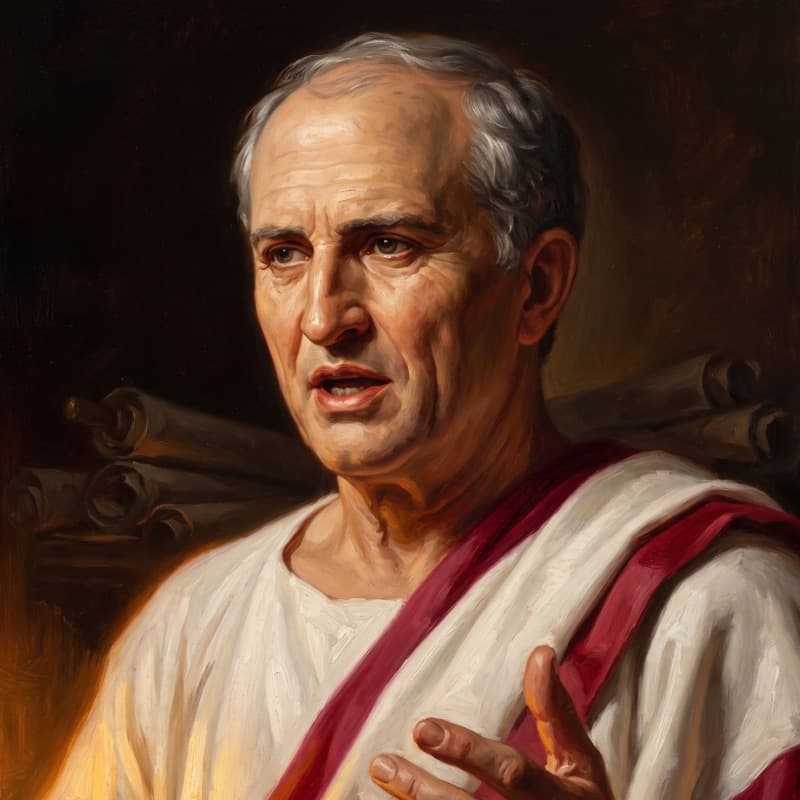
Marcus Tullius Cicero was born on 3 January 106 BC at Arpinum, a hill town some sixty-two miles southeast of Rome, and was killed on 7 December 43 BC near his villa at Formiae, caught fleeing the proscription lists of men he had spent his last years denouncing. Between those two dates he became the Republic's foremost courtroom advocate, its highest elected official, and — in the grief and collapse of his final years — one of the writers who carried Greek philosophy into Latin for good. This is a biography of someone who won by argument in a city increasingly settled by armies.
A new man from Arpinum
Cicero's family was equestrian, not senatorial — wealthy, but without ancestors in the Senate's ranks. Everything he became in public life he had to earn rather than inherit; Romans had a term for that, novus homo, "new man." He trained in law, rhetoric, and Greek philosophy, then built a reputation the only way a man without a name could: in court. His prosecution of the corrupt governor Gaius Verres in 70 BC made him famous as an orator and set the template for his career — facts marshaled, sequence established, the audience walked step by step to a conclusion he had already reached.
The consulship and the conspiracy
He climbed the cursus honorum on that reputation: quaestor in Sicily in 75 BC, praetor in 66 BC, and in 63 BC the consulship itself, won without the ancestral rank that normally carried a man there. That same year, as consul, he exposed Catiline's conspiracy against the state in four public orations — including a line early in the first of them, "O tempora, o mores!" ("Oh, the times! Oh, the customs!"). Cicero then backed the execution of the captured conspirators without a formal trial. It saved the Republic from an immediate plot. It also gave his enemies a weapon.
Exile and return
In 58 BC, Publius Clodius Pulcher used those trial-less executions to drive Cicero into exile; he left Rome on 23 May and reached Thessalonica in disgrace. Rome recalled him within a year, and on 5 August 57 BC he landed at Brundisium to a welcome as loud as the exile had been bitter. The reversal did not erase the wound: a man who had built his identity on defending the law had been punished, however unjustly enforced, for stepping outside it.
A second career, written in grief
Cicero composed De Oratore, his dialogue on the ideal orator, in 55 BC, but his deepest philosophical work came later and darker. His daughter Tullia — his child by his wife Terentia — died in February 45 BC, weeks after childbirth, and the loss broke something open in him. In the burst of writing that followed, across 45 and 44 BC, he turned to the Tusculan Disputations, De Officiis, De Amicitia, and De Senectute, translating Greek philosophy into a Latin later centuries would learn to think in. Of philosophy's purpose he wrote, in the Tusculan Disputations, that "the whole life of a philosopher is... a meditation on death" — and he was living the line as he wrote it.
The last stand
After Julius Caesar's assassination in 44 BC, Cicero turned his oratory on Mark Antony in the Philippics, speeches modeled on Demosthenes's attacks on Philip of Macedon, and gambled his safety on backing the young Octavian against him. The gamble failed him personally: the Second Triumvirate of Octavian, Antony, and Lepidus placed Cicero on its proscription list. He was caught on 7 December 43 BC leaving his villa at Formiae by litter for the coast, and killed. His hands and head were displayed on the Rostra in the Forum — the hands that had written against Antony, the head that had spoken it.
Related reading: the Cicero hub, how he died, his verified quotes sorted from the lines falsely attributed to him, and the facts page. Our Cicero AI persona — clearly labeled as a modern recreation — takes questions on any of it, courtroom to Rostra.