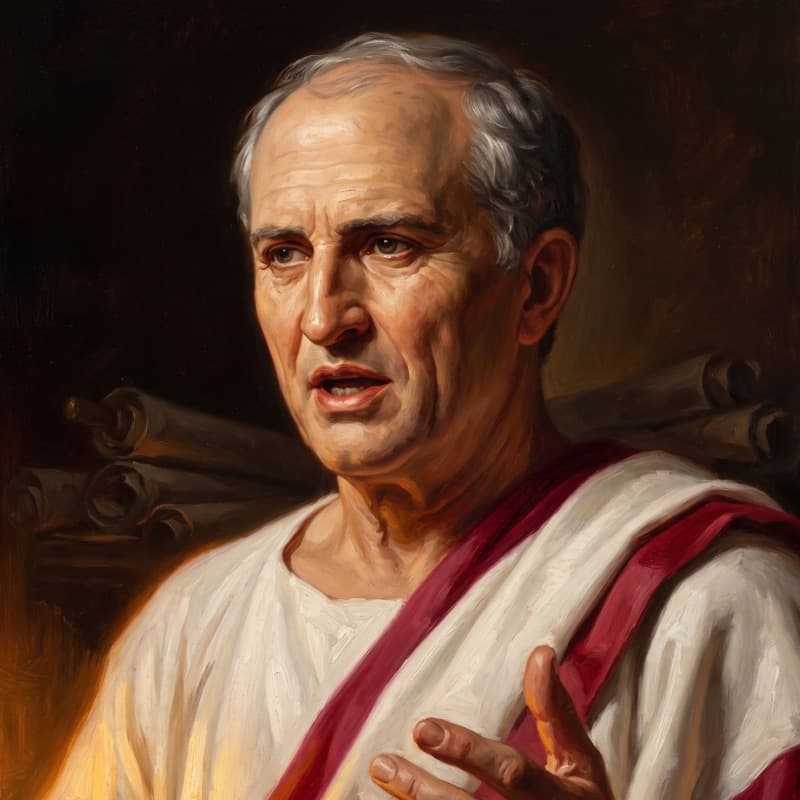
Cicero was killed on 7 December 43 BC. After Julius Caesar's assassination, Cicero had attacked Mark Antony in a series of speeches called the Philippics; when Antony joined Octavian and Lepidus in the Second Triumvirate, the three men drew up a proscription list — a public roll of citizens who could be killed on sight, their killers rewarded — and put Cicero's name on it. He was caught leaving his villa at Formiae by litter, trying to reach the coast. His killers cut off his hands and head and had them nailed up on the Rostra in the Roman Forum, the very platform from which he had spoken for thirty years.
A death list with his name already on it
The proscriptions of 43 BC were not a courtroom verdict; they were a list, and being on it was the sentence. Once Octavian, Antony, and Lepidus formed the Second Triumvirate after Caesar's death, they used the proscriptions to eliminate political enemies and seize their property in one stroke. Cicero's place on it followed directly from the Philippics, the speeches he had aimed at Antony through 44 and 43 BC, styled on Demosthenes's old orations against Philip of Macedon. Antony did not forget who had written them.
The chase from Formiae
By December, Cicero was moving between coastal properties, weighing whether flight by sea was still possible. On 7 December 43 BC his pursuers caught him leaving his villa at Formiae by litter, apparently trying to reach the water. There was no trial, no Senate hearing — proscription had already done that work in advance. He was killed where he was found.
What was done with the body
What made the killing infamous, even by the standards of a violent decade, was the display: his severed hands and head were taken to Rome and fixed to the Rostra in the Forum, the speaker's platform he had used through his entire public life. Tradition holds Antony wanted it that way in particular — the hands that had drafted the Philippics, the head that had delivered them, put up where every senator and citizen who passed would see exactly what the new order did to its critics.
A myth worth correcting
Two mix-ups are common enough to name directly. First: Cicero was not killed in the Senate — that was Caesar, stabbed by conspirators on the Senate floor in 44 BC, a separate event Cicero survived, though he was not among the plotters. Second: Cicero did not choose his own death. He was hunted down and executed by Antony's men — not a suicide, unlike some other doomed Republicans of his generation. It was assassination by state order, not a chosen exit.
From a conversation with our Cicero
An excerpt from a conversation with our AI Cicero persona — a stylized recreation built from his surviving speeches and letters, not a transcript of anything he actually said. No ancient source records his last words.
Caller: You had to know the list was coming. Why not just stop writing against Antony?
Cicero: Because an advocate who goes silent to save himself has already lost the only case that mattered. I defended the Republic as a young man; I was not going to desert her as an old one, whatever the ledger said it would cost me. A man can calculate the odds of a courtroom. He cannot always calculate the odds of his own conscience — and I had already made mine up long before Formiae.
Ask him about the case he never got to finish
Our Cicero — an AI recreation, clearly labeled as such, built from his speeches, letters, and dialogues — argues from the same instincts that built his career: facts first, sequence second, then the question of who profits. He can walk you through the Catiline crisis, the exile, the grief behind De Officiis and the Tusculan Disputations, or the political math of backing Octavian against Antony. Start the conversation whenever you're ready.
More in this cluster: Cicero's verified quotes · his biography · fact file · back to the Cicero hub.