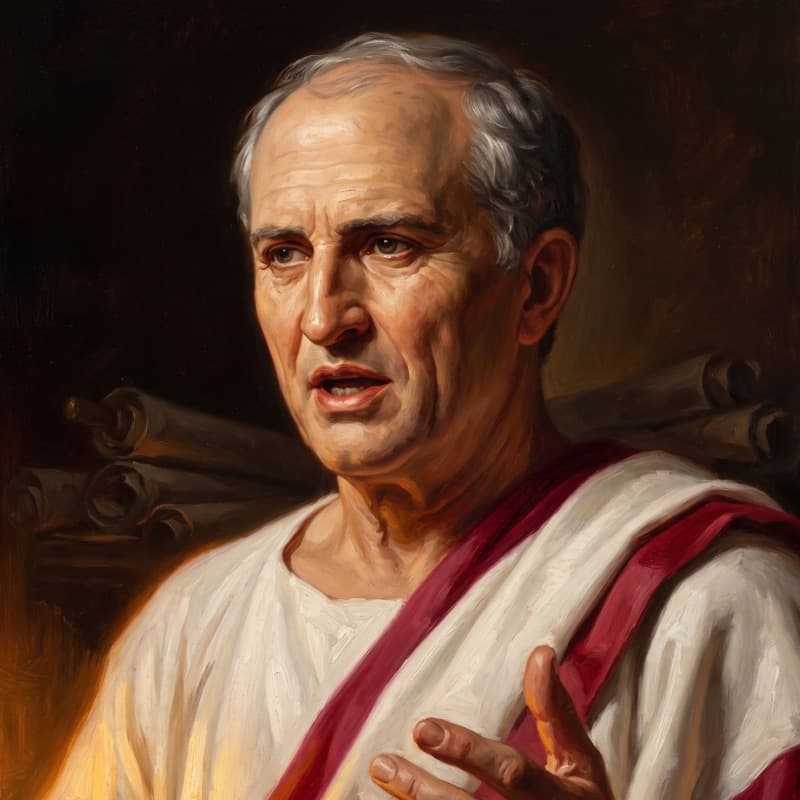
The essential Cicero facts: born 3 January 106 BC at Arpinum, into a wealthy equestrian family with no senatorial ancestry — a "new man" by Roman standards; he prosecuted Gaius Verres in 70 BC, then climbed Rome's ladder as quaestor (75 BC), praetor (66 BC), and consul (63 BC); as consul he crushed the Catiline conspiracy and backed executing the conspirators without trial, which got him exiled in 58 BC; he returned in 57 BC, wrote his major philosophy after daughter Tullia's death in 45 BC, attacked Mark Antony in the Philippics, and was killed in the proscriptions on 7 December 43 BC. Verified against the Stanford Encyclopedia of Philosophy and Wikipedia — including the "facts" that don't survive checking.
The core facts, with why they matter
Born to an equestrian family, not the nobility. No senatorial ancestors opened doors — everything that follows is a man arguing his way into Rome's highest office on merit alone.
He held every rung of Rome's ladder: quaestor in Sicily (75 BC), praetor (66 BC), consul (63 BC). Each office was won by advocacy and votes, not inherited rank — why Romans called men like him novi homines, "new men."
His prosecution of Gaius Verres in 70 BC made his reputation. Verres, a corrupt former governor of Sicily, was so thoroughly exposed that he fled into exile before the trial even finished.
As consul, he exposed the Catiline conspiracy and backed executing the captured conspirators without trial. It saved the Republic short-term and cost him politically long-term — the executions became the pretext for his exile five years later.
Publius Clodius Pulcher drove him into exile in 58 BC; he returned in 57 BC. He left Rome on 23 May and reached Thessalonica; he landed back at Brundisium on 5 August to a celebrated welcome, though the wound of it stayed with him.
His daughter Tullia died in February 45 BC, shortly after childbirth. Her death coincides almost exactly with a burst of writing — Tusculan Disputations, De Officiis, De Amicitia, De Senectute. His surviving work also includes courtroom speeches and more than 800 letters.
He was killed in the proscriptions on 7 December 43 BC, at 63 years old. After Caesar's assassination he attacked Antony in the Philippics; the Second Triumvirate proscribed him, and he was caught leaving his villa at Formiae, trying to reach the coast.
Popular "facts" that need correcting
"A nation can survive its fools, and even the ambitious. But it cannot survive treason from within." Not Cicero. PolitiFact traced the viral version and found no documentation of it in his writings or speeches.
"The budget should be balanced, the treasury should be refilled, public debt should be reduced..." Also not Cicero — the University of Texas at Austin traced it to Taylor Caldwell's 1965 novel A Pillar of Iron.
"To philosophize is to learn how to die," as an exact quotation. Close, but not his wording. Cicero wrote that "the whole life of a philosopher is... a meditation on death" (Tusculan Disputations) — the crisper aphorism is a later paraphrase.
Five things Cicero did (the honest short list)
- Prosecuted Gaius Verres (70 BC), the case that made his name.
- Reached the consulship in 63 BC as a "new man," no senatorial ancestry.
- Exposed and suppressed the Catiline conspiracy while consul.
- Wrote De Oratore, Tusculan Disputations, De Officiis, De Amicitia — Greek philosophy in Latin.
- Attacked Mark Antony in the Philippics after Caesar's assassination — the speeches that got him killed.
The fact pages can't hold him
Facts are the skeleton; the voice is the man. Our Cicero — an AI recreation, sourced and labeled as what it is — can walk you through a case the way he built one in court, or argue whether the advantageous can be separated from the honorable. Ask him about the Catiline crisis from the inside, or grief and philosophy after Tullia. He's ready when you are.
More in this cluster: Cicero hub · his death · verified quotes · biography.