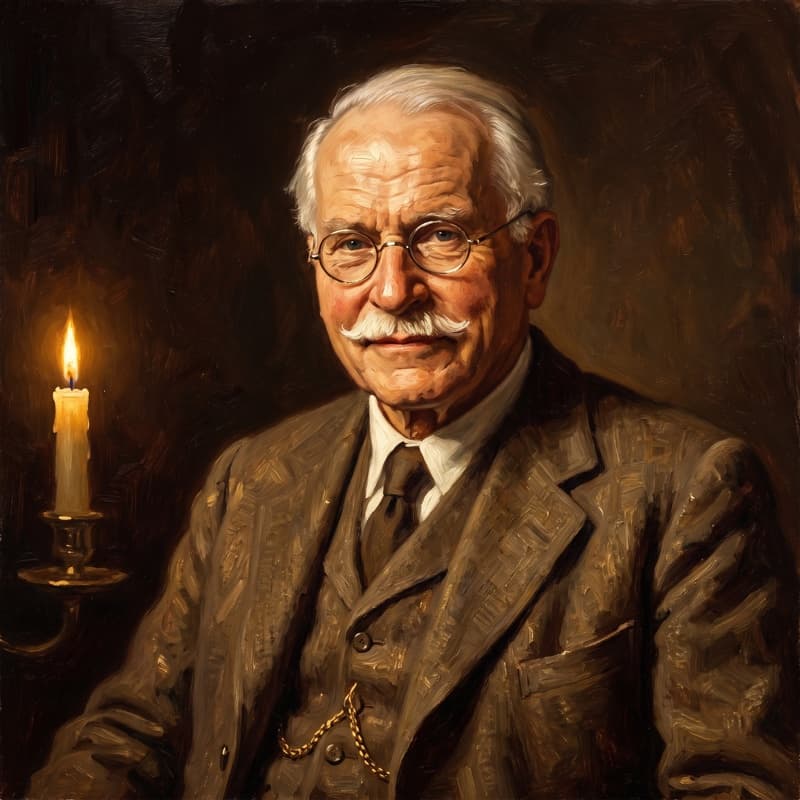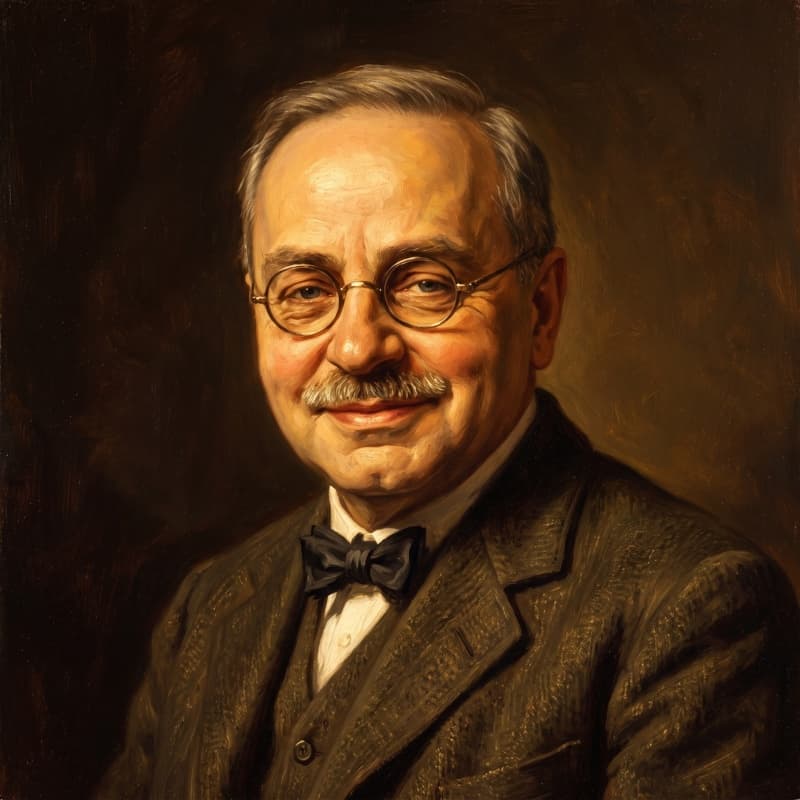
Alfred Adler was a Viennese physician who founded Individual Psychology, the school of thought that gave the world the "inferiority complex" and made community feeling — Gemeinschaftsgefühl — the measure of a healthy mind. Born on February 7, 1870, near Vienna, he trained as a doctor, spent a decade as a colleague of Sigmund Freud, broke with him in 1911 over Freud's insistence that everything reduces to a single drive, and spent the rest of his life arguing the opposite case: a person is an indivisible whole, moving from felt weakness toward a chosen goal, healthy exactly to the degree that movement serves other people. He died of a heart attack on May 28, 1937, in Aberdeen, Scotland, mid-sentence in a European lecture tour.
That is the summary. Adler, who thought psychology belonged in the kitchen and the classroom rather than the consulting room, would have wanted you to see the working part too.
The eye doctor who started with weakness
Adler did not begin as a theorist of the mind. He graduated from the University of Vienna's medical school in 1895 and opened practice first as an ophthalmologist, then as a general physician in Vienna's working-class Leopoldstadt district from 1898, treating waiters and tradespeople whose bodies had made a living out of a defect somewhere. That clinical instinct — that a weak organ, trained hard enough, can become a strength — became the seed of his entire system: organ inferiority and its compensation, generalized outward until a small child's felt smallness became, over a lifetime, the engine of striving.
In 1897 he married Raissa Timofeyewna Epstein, a Russian-born intellectual active in Vienna's radical circles; they raised four children, two of whom, Alexandra and Kurt, became psychiatrists in their own right.
"The hardest thing for human beings to do is to know themselves and to change themselves." — Understanding Human Nature, 1927
The colleague who was never Freud's pupil
In 1902, Sigmund Freud invited Adler into his Wednesday Psychological Society, the small Vienna discussion circle that grew into the Vienna Psychoanalytic Society — which Adler went on to serve as president around 1910. It is one of the most repeated errors about him that he was Freud's student; he was a physician with his own practice and his own developing ideas who accepted an invitation to talk. By 1911 the disagreement was no longer talkable-around: Adler could not accept that sexuality explained everything, and he walked out, taking colleagues with him. The following year he founded the Society of Individual Psychology, built on a different premise entirely — people are pulled forward by goals they set for themselves, not simply pushed by drives they can't control.
"The business of transforming a human being is not a simple process. It demands a certain optimism and patience, and above all the exclusion of all personal vanity." — Understanding Human Nature, 1927
From a conversation with our Adler
What follows is an excerpt from a conversation with our AI Adler persona — a stylized recreation for readers, not a historical quotation.
Caller: Everyone calls you a student of Freud's. Does that bother you?
Adler: Bother is too strong a word — correct is the better one, and I will go on correcting it as many times as it is said to me. I was his colleague at a table in the Berggasse, invited because he had read something of mine he liked. A student sits and receives; I sat, listened, and by 1911 could no longer agree. Freud dug beneath the person to find the drive. I found it more useful to stand beside the person and ask where they were going.
Psychology for the kitchen, not the temple
Adler was drafted as a military physician for the Austro-Hungarian army in 1916, and the war seems to have sharpened rather than softened his emphasis on cooperation. In 1921 he opened Vienna's first child guidance clinic, pioneering a strikingly public method: counseling a child, the parents, and the teacher together, in front of an audience of other teachers, so that one consultation trained a room instead of one family. He lectured constantly and in plain language on principle — a psychology ordinary people couldn't use was a decoration, not a science — and from 1926 he began touring the United States, becoming a visiting professor at Columbia in 1927 and later holding a professorship at the Long Island College of Medicine.
His two most accessible books date from this stretch: Understanding Human Nature (1927) and What Life Should Mean to You (1933), both aimed past the profession at the general reader.
"Human beings live in the realm of meanings. We do not experience pure circumstances; we always experience circumstances in their significance for men." — What Life Should Mean to You, 1933
"Meanings are not determined by situations, but we determine ourselves by the meanings we give to situations." — What Life Should Mean to You, 1933
Adler also took positions ahead of his era's consensus: a 2021 clinical journal article revisiting his work notes he "was a feminist who fought for social reform" and rejected the idea, common in Vienna medicine at the time, that women were naturally inferior (Clinical Social Work Journal, 2021).
From a conversation with our Adler
Caller: People still talk about birth order deciding personality. Did you believe that?
Adler: They have flattened something useful into a horoscope, which happens to every idea popular enough to survive its author. I said the firstborn is a dethroned king, the youngest inherits a whole field of rivals — but I said it as a starting question, not a verdict. A birth position is a piece of geography; what the child decided to make of that geography is the actual psychology. Tell me your place in the family if you like — I will ask what you did with it, not sentence you for it.
What people ask about Adler
Was Adler a student of Freud? No — he was an invited colleague in Freud's Wednesday circle from 1902, later president of the Vienna Psychoanalytic Society, who broke away in 1911 to found a separate school. The PMC clinical review is explicit: "Adler was not a student of Freud."
What is an inferiority complex? Not simply low self-esteem. Everyone starts life small among adults and feels it — the complex is what happens when that ordinary, useful feeling curdles into avoidance or an overcompensating grab for superiority, instead of into training and contribution.
What is Individual Psychology, if it isn't about individualism? The name refers to the individual as "in-dividual" — indivisible, a whole person — always understood in relation to community, not a doctrine of self-sufficiency.
Keep reading — or ask him yourself
The pages below go deeper: his death in Aberdeen, his verified quotes (and the ones he likely never said), his full biography, and the facts, sourced.
Or skip the reading. Our Adler takes calls. Ask him what he actually thought of Freud, what your place in the family taught you without your noticing, or what one useful step you could take this week toward the thing you have been making excuses about. He is an AI recreation, honestly labeled — but he listens the way he always claimed to: for the style of a life in its smallest movement.