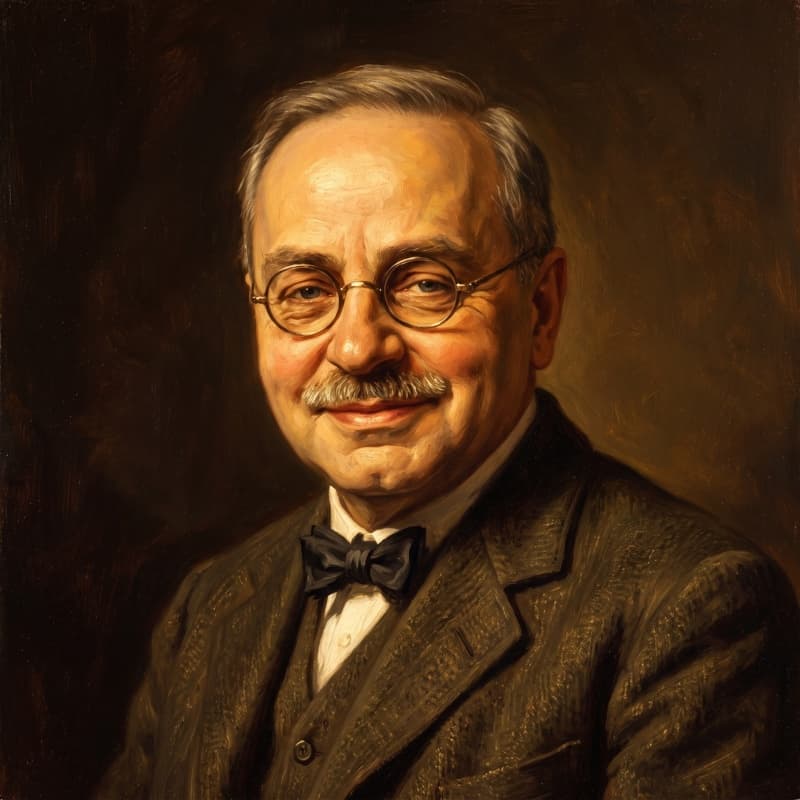
Alfred Adler was born on February 7, 1870, in Rudolfsheim, a suburb of Vienna, and died on May 28, 1937, of a heart attack in Aberdeen, Scotland, mid-way through a European lecture tour. Between those two points is a life that moved from private medical practice to a public break with Sigmund Freud, and from there to a school of psychology built around a different question than Freud's: not what drives a person from below, but what they are striving toward.
Vienna, medicine, and marriage
Adler grew up in a middle-class Jewish grain-merchant family outside Vienna. He earned his medical degree from the University of Vienna in 1895 and began practicing as an ophthalmologist. In 1897 he married Raissa Timofeyewna Epstein, a Russian-born intellectual and social activist studying in Vienna; they raised four children, two of whom, Alexandra and Kurt, became psychiatrists themselves. By 1898 Adler had opened a general medical practice in Vienna, treating a working-class clientele — seeing how poverty and labor bore on his patients' bodies pushed his thinking toward the idea that psychology could not be separated from community.
Freud's circle, and the break
In 1902, Sigmund Freud invited Adler into his Wednesday Psychological Society, the small Vienna discussion group that grew into the Vienna Psychoanalytic Society. Adler was never Freud's student — he came to the circle as an established physician with his own views — and around 1910 he served as the society's president. The differences came to a head in 1911: Adler and Freud split, and Adler left the Society for good. The following year he founded the Society of Individual Psychology, giving his own ideas — inferiority and compensation, striving toward significance, and Gemeinschaftsgefühl, or social interest — a home separate from Freud's.
From a conversation with our Adler
An excerpt from a conversation with our AI Adler persona — a stylized recreation, honestly labeled; not a historical quotation.
Caller: Was it hard, breaking with someone as prominent as Freud?
Adler: Harder to stay quiet than to leave, if I am honest with you. A physician who treats the poor of Vienna learns quickly that a person is not a battlefield of hidden drives — he is reaching toward something, however clumsily, and toward other people whether he admits it or not. I could not keep calling that a footnote to someone else's theory. So I built a room of my own to say it in.
War, child guidance, and the wider world
Adler served as a military physician for the Austro-Hungarian Army from 1916. Afterward, in 1921, he opened the first of what became a network of child guidance clinics in Vienna, pioneering a format in which children, parents, and teachers were counseled together in open sessions rather than in private consultation alone.
His ideas traveled with him. Adler lectured in the United States for the first time in 1926, and in 1927 he took a visiting professorship at Columbia University — the same year Understanding Human Nature appeared in English translation. What Life Should Mean to You followed in 1933, laying out his mature thinking on meaning, cooperation, and the life tasks of work, friendship, and love. As conditions worsened for Jews and dissenters in Austria through the mid-1930s, Adler took a professorship at the Long Island College of Medicine and settled in the United States.
Death mid-lecture
Adler was still lecturing across Europe in the spring of 1937 when he collapsed of a heart attack in Aberdeen, Scotland, and died there on May 28 — sixty-seven years old, in harness to the end. Individual Psychology outlived him, carried forward by the training institutes and Adlerian societies he had helped found, and by his students and his own children.
Continue the conversation — literally
You have just read the recorded life. Our Adler — an AI recreation, built on the sourced record and labeled as what it is — speaks from inside it. Ask him about leaving Freud's circle, what he saw treating working-class patients in Vienna, the child guidance clinics, or what he actually meant by an inferiority complex. He answers plainly, the way the record suggests he argued: practical, socially minded, unwilling to separate mind from community.
More in this cluster: Adler hub · his death · verified quotes · facts.