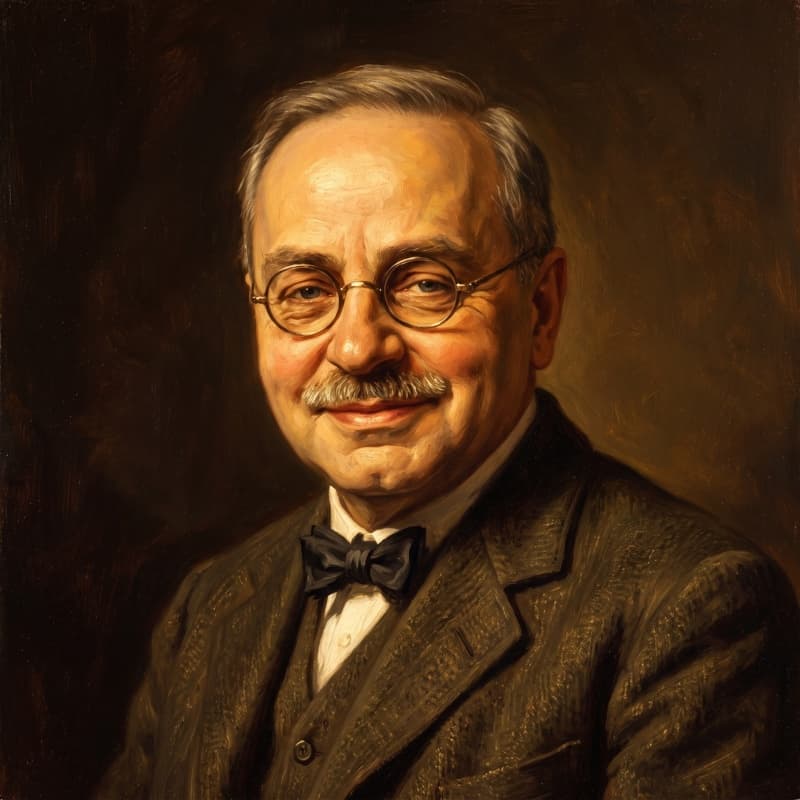
Alfred Adler died of a heart attack on May 28, 1937, in Aberdeen, Scotland, while on a European lecture tour. He was 67. That is the confirmed record — a physician and psychologist who had spent four decades studying how people keep moving toward their goals, dying in mid-motion, on the road, between lectures.
Still touring, still working
By the mid-1930s Adler had relocated to the United States, taking a professorship at the Long Island College of Medicine as conditions worsened for Jews and dissenting intellectuals in Austria. He was not winding down. He had been crossing the Atlantic for lecture tours since 1926, and in the spring of 1937 he was doing it again, working through a European schedule that brought him to Aberdeen. A man who had built his whole theory around striving toward significance was, at 67, still striving — still on tour, still lecturing, right up to the end.
What happened in Aberdeen
The confirmed facts are narrow and specific: Adler collapsed of a heart attack in Aberdeen and died there on May 28, 1937. That is what the institutional record states plainly, and it's worth being honest about what it doesn't state. Some circulating detail — an exact street, a particular morning routine, autopsy specifics — cannot be pinned to a source solid enough to repeat here. If you've read a version of this story with more color than that, treat the extra color as embellishment until someone can point to where it comes from. The confirmed version is plainer, and it's the one this page sticks to.
First of the Vienna three
Adler's death carries a particular weight in the history of psychology because of who was still living. He, Freud, and Jung were the three figures whose Vienna-era arguments shaped twentieth-century psychotherapy, and Adler — the one who broke from Freud's circle first, back in 1911 — was also the first of the three to die. Freud outlived him by two years; Jung by more than two decades. Adler's break with Freud had already given Individual Psychology its own institutional life by 1912; his sudden death in 1937 tested whether that independence could survive its founder.
From a conversation with our Alfred Adler
An excerpt from a conversation with our AI Adler persona — a stylized recreation pinned to his mid-career teaching years, before any of this happened, honestly labeled as fiction rather than historical record.
Caller: Do you ever worry about slowing down?
Adler: Worry, no — plan for it, also no. A useful life is not a savings account you draw down carefully; it is a direction you keep walking in. I have never met a man who was cured by resting from his purpose. If the work is good, the work continues to matter whether or not I am the one standing at the lectern. That is rather the point of teaching others to do it.
The work outlived the tour
Adler did not finish that lecture tour, but he had spent the previous quarter-century making sure the ideas didn't depend on him finishing it. The Society of Individual Psychology he founded in 1912, the child guidance clinics he opened starting in Vienna in 1921, and the students and family who carried the practice forward — two of his own children, Alexandra and Kurt, became psychiatrists in the Adlerian tradition — meant the sudden stop in Aberdeen was a loss, not an ending. Individual Psychology kept its clinics, its training institutes, and its core idea that a person's felt inferiority is only the starting point of a life, never its verdict.
Ask him about the years before
Our Adler persona doesn't know about Aberdeen — his knowledge is pinned to the working years, still lecturing, still convinced the tasks of life are solved together rather than alone. Start a conversation and ask him what he thought courage required.
More in this cluster: his verified quotes · his biography · fact file · back to the Alfred Adler hub.