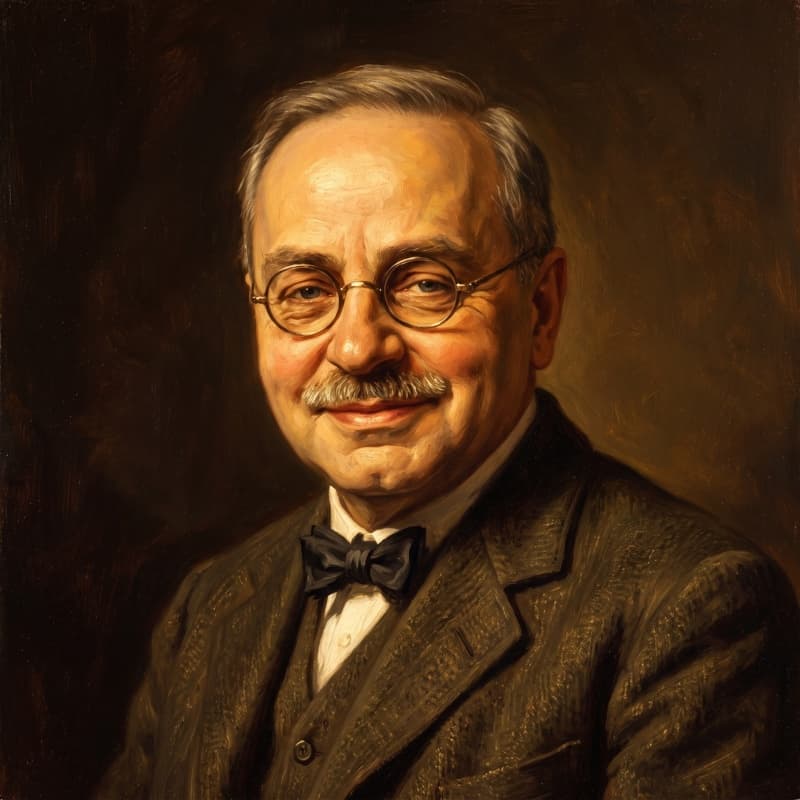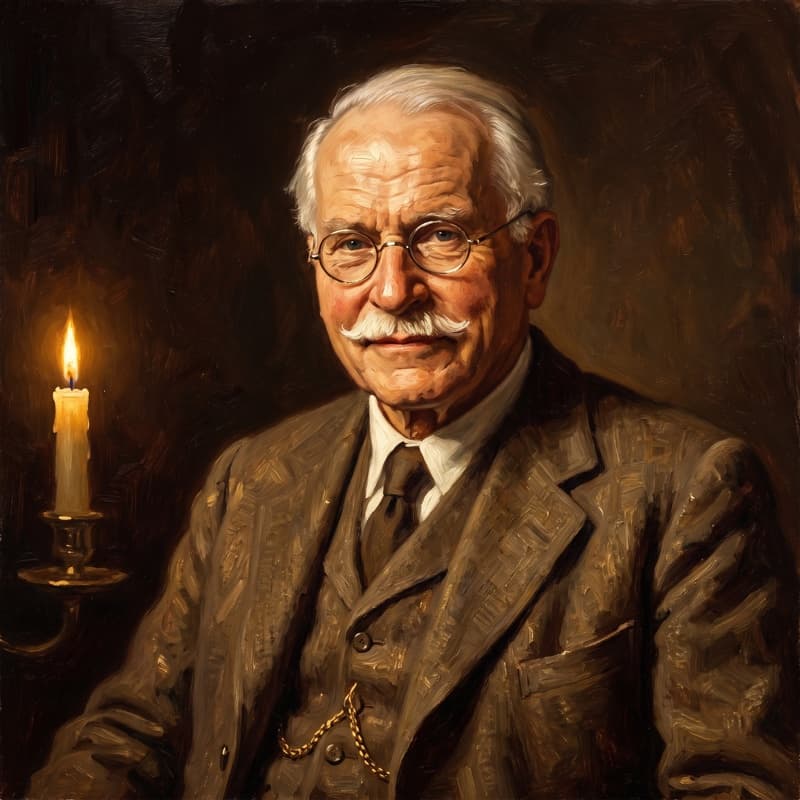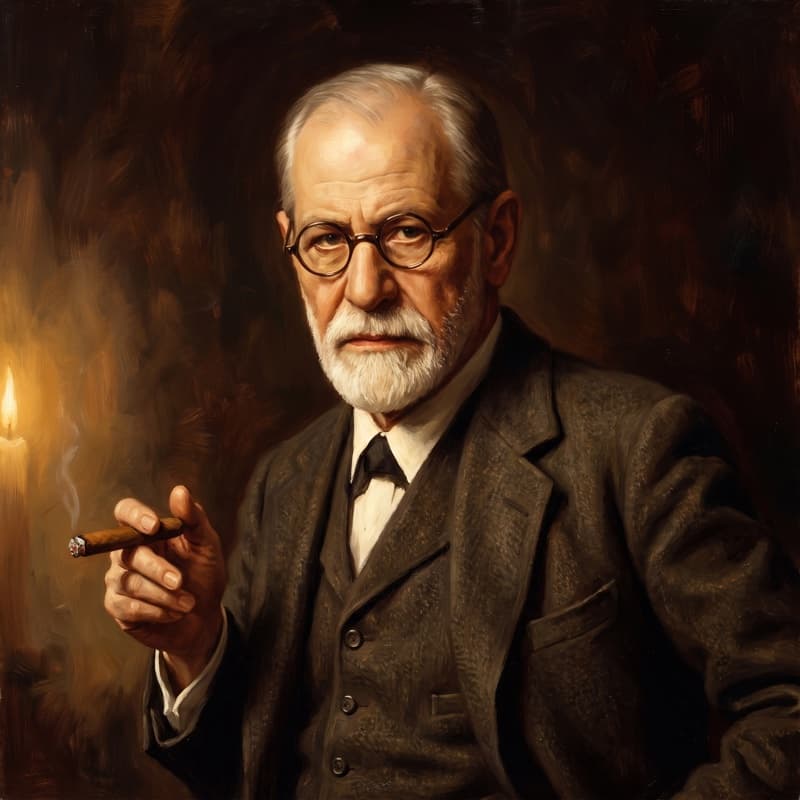
Sigmund Freud was the Viennese physician who founded psychoanalysis — the theory and clinical method built on the claim that most of the mind's real business happens outside conscious awareness. Born on 6 May 1856 in Freiberg, Moravia (now Příbor, in the Czech Republic), he was brought to Vienna as a small child and stayed for most of his life. He trained as a physician and neurologist, then built his entire apparatus — the unconscious, repression, the talking cure, the Oedipus complex, the id, ego, and superego — out of one consulting room at Berggasse 19, and did not leave Vienna until the Nazis forced him out in 1938. He died in London on 23 September 1939, sixteen years and roughly thirty operations into a cancer of the jaw he never let stop him from working.
That is the outline. What he found — and what he got wrong — is worth the next few minutes.
From neurology to the talking cure
Freud enrolled at the University of Vienna in 1873, studied under the physiologist Ernst Brücke, and earned his medical doctorate in March 1881. In 1884 he published an early paper on the clinical uses of cocaine — an episode best read plainly, without the moralizing gloss it sometimes gets. A travel scholarship sent him to Paris in 1885–86 to study under the neurologist Jean-Martin Charcot, who was using hypnosis to treat hysteria: proof that symptoms with no physical cause could still be real, and could be moved.
Back in Vienna, Freud married Martha Bernays in 1886 and, in 1891, opened the practice at Berggasse 19 that would be his consulting address for the next forty-seven years — the Sigmund Freud Museum in Vienna still occupies the address today. Building on Josef Breuer's treatment of "Anna O." — the patient, Bertha Pappenheim, who coined the phrase "the talking cure" herself — Freud arrived at his founding method: say whatever comes to mind, omit nothing, treat the associations, however trivial or embarrassing, as data. Studies on Hysteria, published with Breuer in 1895, was the idea's first public statement.
The book he thought was his one flash of genius
The Interpretation of Dreams, published in 1899 with a title page dated 1900, argued that dreams are disguised wishes, not noise — condensed, displaced, and readable once decoded through the dreamer's own associations. He called the method, in effect, the royal road to the unconscious. The book sold slowly at first and made his reputation permanently. The Psychopathology of Everyday Life (1901) turned the same method on slips and forgotten names, using his own case of forgetting the painter Signorelli's name as evidence such lapses are rarely accidents.
By the 1920s Freud had redrawn his own map. The Ego and the Id (1923) proposed the mind is not one thing arguing with itself, but three: the id's raw drives, the ego's negotiations with reality, and the superego's internalized rules. The Oedipus complex — a child's early, conflicted attachment to and rivalry over a parent — sat under it all as, in Freud's view, a near-universal fact rather than the sensational claim it's often reduced to. Civilization and Its Discontents (1930) argued that civilized life runs on renounced instinct, the fee collected in neurosis. It also holds one of his starkest lines:
"Man has, as it were, become a kind of prosthetic God." — Civilization and Its Discontents, trans. James Strachey
He meant tools and machines — decades before anyone could put a voice on a telephone line and call it a person. In the same book he wrote something plainer, and harder to argue with:
"We are never so defenceless against suffering as when we love." — Civilization and Its Discontents, public-domain translation
From a conversation with our Freud
What follows is an excerpt from a conversation with our AI Freud persona — a stylized recreation for readers, not a historical record.
Caller: Isn't psychoanalysis just guessing about people's childhoods?
Freud: An interesting defense — you attack the method rather than answer the question it would ask of you. I do not guess. I listen to what a person says, and more carefully to what they arrange not to say. You call it guessing because the alternative — that your slips and silences mean something — is less comfortable. Now: what did you nearly say, just before you asked me that?
Did Freud really say a cigar is sometimes just a cigar?
Almost certainly not. The line is usually offered as proof Freud knew not to over-interpret every object as a phallic symbol, but its earliest documented appearance is a 1950 footnote — over a decade after his death — with no German source ever located. Quote Investigator's research calls it almost certainly apocryphal, one biographer terming it "Freud's ultimate anti-Freudian joke." Good story. Not a real quotation from him.
The break with Jung, exile, and the end
Freud's inner circle unraveled twice: Alfred Adler broke away in 1911, reducing Freud's drive theory to a struggle for status; Carl Jung — once treated as the heir who would carry psychoanalysis beyond Vienna's Jewish doctors — broke in 1913 over his drift toward mysticism. Freud discussed both losses with irony more than grief, though he never pretended the Jung rupture cost him nothing.
In 1923 he was diagnosed with cancer of the jaw and palate, almost certainly linked to the cigars he refused to give up; some thirty operations followed over sixteen years. Then, in 1938, came the rupture history usually skips past in favor of the theory: after Nazi Germany annexed Austria, Freud fled Vienna on 4 June 1938 by the Orient Express to Paris and then London, his antiquities collection following him into exile rather than staying behind. He spent his final year still seeing patients and writing, and died at his London home on 23 September 1939 — three weeks after Britain entered the Second World War, a war he would not live to see.
Caller: Do you regret any of it — Jung, the exile?
Freud: Regret is a young man's economy; I have moved to a different currency, which is accounting. Jung I lost because he wanted a religion and I offered a science, and a man will always choose the warmer error. Vienna I lost because a government decided a Jew's forty-seven years at one address counted for nothing. I have analyzed both losses — the only revenge left to a doctor out of time to take a better one.
Excerpt from our AI Freud persona — stylized, and labeled as such.
Keep reading — or ask him yourself
The pages below go further: his full biography, his final illness and death in exile, his verified quotes — and the one he never said, and the facts, sourced and dated.
Or skip the reading. Our Freud takes calls. Tell him a dream and see what he asks about the part you left out. He is an AI recreation, honestly labeled — but he built his whole career on listening, and he has time for you.