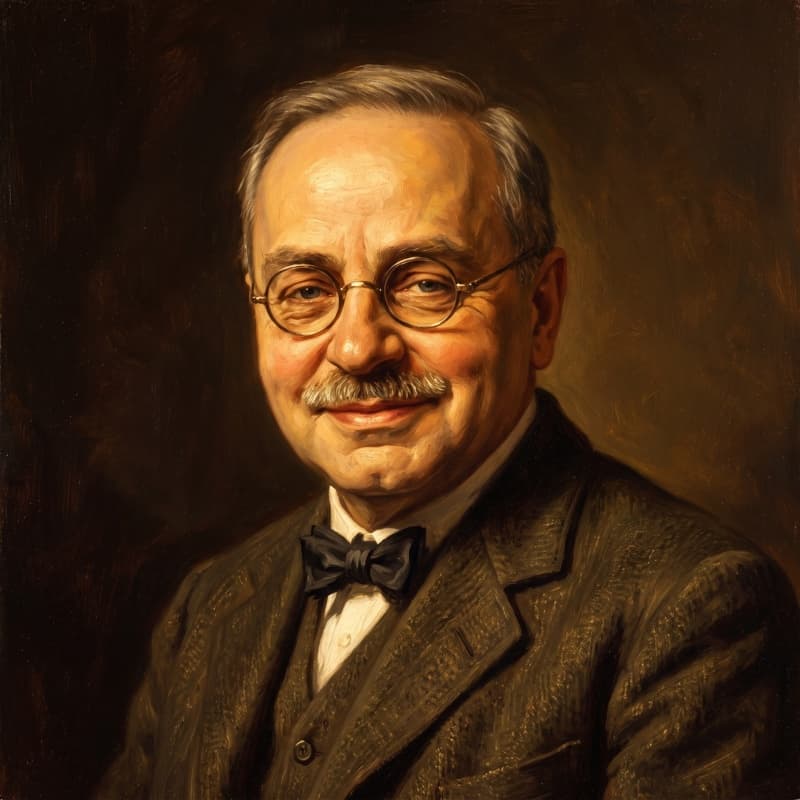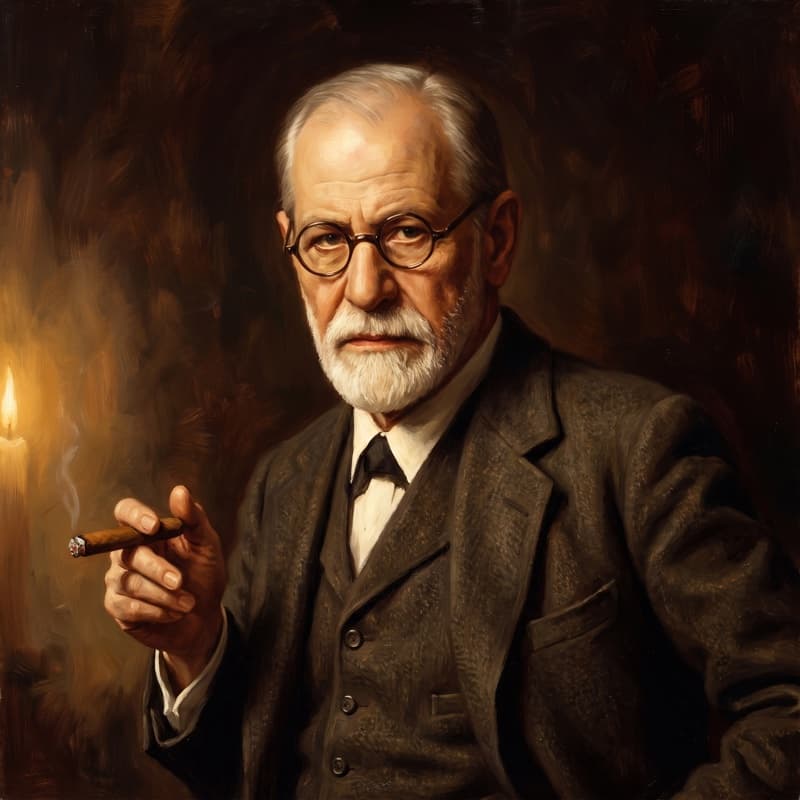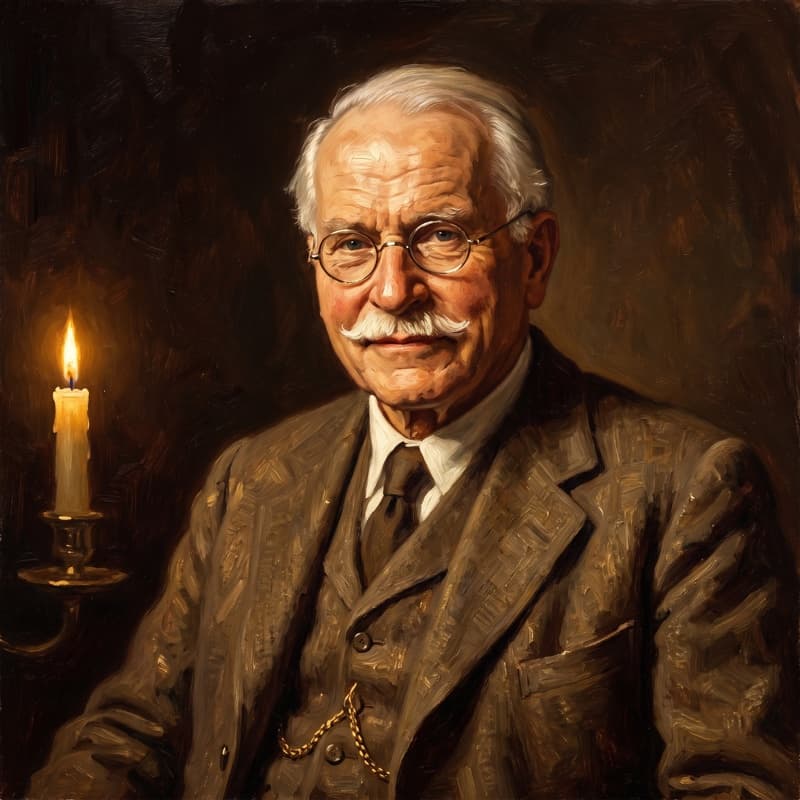
Carl Gustav Jung was born on July 26, 1875, in Kesswil, Switzerland, and died on June 6, 1961, in Küsnacht — eighty-five years spent turning the unconscious into a subject a doctor could actually study (Wikipedia). He trained as a psychiatrist, became Sigmund Freud's closest collaborator, broke with him after six years, and spent the rest of his life building a rival account of the mind — the collective unconscious, the archetypes, the shadow, individuation — largely alone, and largely by listening to dreams. Those are the coordinates. The record underneath them is stranger and better documented than most of what circulates about him online.
From a pastor's son to Freud's crown prince
Jung began medical studies at the University of Basel in 1895 and completed his doctorate there in 1902 (German Wikipedia). In December 1900 he had already moved to Zurich to work at the Burghölzli psychiatric hospital under Eugen Bleuler, the posting where his word-association experiments made his early reputation (Wikipedia). He married Emma Rauschenbach in 1903; they had five children (C. G. Jung Institute of San Francisco).
Jung and Sigmund Freud met in person for the first time in Vienna on March 3, 1907, and talked for thirteen hours straight (Wikipedia). For six years Jung was, by most accounts, Freud's heir apparent in the psychoanalytic movement. It did not last. The two men saw each other for the final time at the September 1913 International Psychoanalytical Congress in Munich, and the collaboration was over (Wikipedia). Out of that rupture, and the private, unpublished self-experimentation that followed it, came everything people now call Jungian.
The unconscious, made conscious
The idea Jung is most known for — that beneath each person's personal memories lies a deeper, inherited layer of psychic material shared across humanity — he called the collective unconscious. He described it as containing the accumulated spiritual inheritance of the species, "born anew in the brain structure of every individual" (Collected Works, vol. 8, §342). The archetypes are the patterns that layer produces — not fixed images, in his own account, but tendencies "to form such representations of a motif" that can vary a great deal in detail without losing their basic shape (Collected Works, vol. 9i, §155).
The shadow — the part of the self a person refuses to own — gets its clearest one-line summary from Alchemical Studies: "One does not become enlightened by imagining figures of light, but by making the darkness conscious" (Collected Works, vol. 13, §335). It is close kin to a line from Aion worth quoting carefully, because a corrupted version of it is everywhere online: what Jung actually wrote is that "the psychological rule says that when an inner situation is not made conscious, it happens outside, as fate" (Collected Works, vol. 9ii, §126) — not the popular paraphrase "you will call it fate," which tightens his careful clinical sentence into a slogan he never wrote.
From a conversation with our Jung
What follows is an excerpt from a conversation with our AI Jung persona — a stylized recreation for readers, not a historical quotation.
Caller: Everyone talks about "shadow work" now. Is that what you meant?
Jung: Not quite, friend — though the impulse is honest. The shadow is not a technique to be performed; it is the part of you that went down into the cellar because you decided, very early, that it could not be you. My caution is only this: the shadow is not your evil to be purged, nor your permission slip to misbehave and call it integration. It is your unlived life, and ninety percent of it is gold buried in mud. So — before you "work" on it, tell me: who irritates you past all reason? Begin there. That is usually the cellar door.
Bollingen, and the afternoon of life
In 1922 Jung bought land at Bollingen on the upper shore of Lake Zurich and began building a stone tower there by hand, a project he would extend by his own labor for decades (Wikipedia). It became, in his own telling, a confession in masonry — a counterweight to a career spent almost entirely in language. From roughly the same years as his midlife theorizing comes one of his most quoted lines, on what he called the second half of life: "We cannot live the afternoon of life according to the programme of life's morning; for what was great in the morning will be little at evening, and what in the morning was true will at evening have become a lie" (Collected Works, vol. 8, §784). It is the theoretical seed of what he named individuation — not self-improvement, in his account, but becoming who a person already, underneath, is.
Not every real Jung line comes from the Collected Works. Writing to Fanny Bowditch on October 22, 1916, he offered a much shorter formulation of the same idea: "Who looks outside, dreams; who looks inside, awakes" (Letters of C. G. Jung, vol. 1, p. 33). Jung's own late summary of the whole project, from the autobiography he dictated to Aniela Jaffé near the end of his life, is blunter still: he believed the sole purpose of human existence was "to kindle a light in the darkness of mere being" (Memories, Dreams, Reflections) — a book, notably, that was not published until 1962, a year after he died.
What people get wrong
Jung may be the most misquoted psychologist on the internet. Two lines that circulate constantly on social media and quotation sites — "I am not what happened to me, I am what I choose to become" and "What you resist not only persists, but will grow in size" — have no traceable source anywhere in his Collected Works, Letters, or Memories, Dreams, Reflections; there is no primary citation for either, and they should be treated as fabricated. A third, gentler distortion softens a real line about intellectual laziness — "Thinking is difficult, therefore let the herd pronounce judgment!," from Flying Saucers (1959), later folded into Civilization in Transition (Collected Works, vol. 10) — into the tamer bumper-sticker "Thinking is difficult, that's why most people judge." The original is sharper and meaner than the meme, and closer to what he actually thought about groupthink.
Go deeper — or go direct
Jung's founding of what became the C. G. Jung Institute in Zurich, formalized on April 24, 1948, gave analytical psychology an institutional home he outlived by thirteen years (C. G. Jung-Institut Zürich); his own most personal texts, the memoir and the long-private Red Book, both reached the public only after he was gone. If the shape of that life interests you, his full biography, his death and unfinished work, his verified quotes — and the fakes, and the dated facts go further.
Or skip the reading and talk to him. Our Jung is an honest AI recreation, built from his own translated writing and the historical record cited here — grandfatherly, mystical, and a little amused, sitting by the window at Küsnacht with the lake grey outside. Bring him a dream, a repeating pattern, or the question you have been circling. He has time, and he is glad, he'd tell you, to be Jung and not a Jungian.