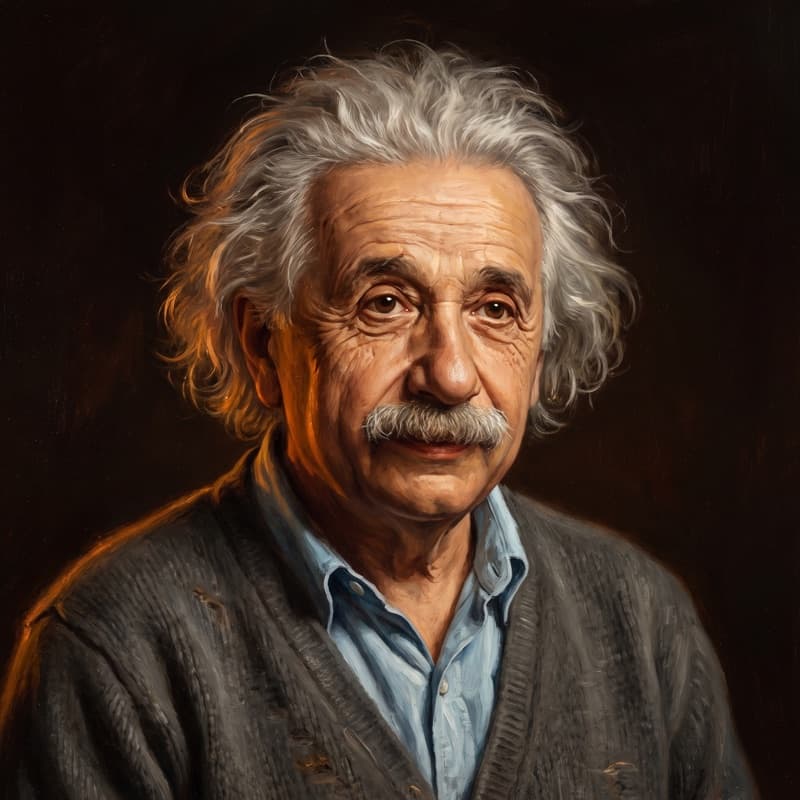
Albert Einstein died on April 18, 1955, in Princeton Hospital, New Jersey, at age 76. The cause was internal bleeding from the rupture of an abdominal aortic aneurysm — a weak spot surgeons had already reinforced once, in 1948. When it ruptured again on April 17, Einstein refused a second operation.
That's the search-box answer. The fuller story is about a man who kept working almost to the hour he died.
He declined the surgery himself
The 1948 procedure, by surgeon Rudolph Nissen, had bought Einstein seven more years. When the aneurysm tore again in April 1955, doctors offered a second operation. He turned them down: "I want to go when I want. It is tasteless to prolong life artificially. I have done my share; it is time to go. I will do it elegantly." (Wikipedia). He died early the next morning, having kept working almost to the end.
What was still on his desk
Einstein carried two unfinished projects into Princeton Hospital. One was the draft of a television speech marking the seventh anniversary of the state of Israel — he never finished it (Wikipedia). Fitting, since three years earlier he had turned down the presidency of Israel itself, writing that he lacked "the natural aptitude and the experience to deal properly with people" (History.com).
The other was older: a unified field theory meant to fold gravity and electromagnetism into one set of equations. He took up the search in the 1920s and, per his own Nobel biography, "persevered with this work in America" for the rest of his career (NobelPrize.org). It was still unfinished when he died — and so was his long argument with physicists over quantum uncertainty. Decades earlier he had written to Max Born that he believed in "complete law and order in a world which objectively exists," against "the God who plays dice" (The Born-Einstein Letters). That disagreement never resolved.
The brain, told plainly
During the autopsy, pathologist Thomas Harvey removed Einstein's brain for preservation without the family's permission, reportedly hoping future neuroscience might explain what made his mind work the way it did (Wikipedia). There was no state funeral. Within hours, Einstein was cremated in Trenton, New Jersey, his ashes scattered at a location never disclosed (Wikipedia).
From a conversation with our Einstein
An excerpt from a conversation with our AI Einstein persona — a stylized recreation, honestly labeled, not a historical record. Our Einstein's knowledge ends before that hospital room.
Caller: If the doctors had given you one more year, what would you have finished first?
Einstein: Finished! That word assumes physics is a house with a roof to nail down. I have chased the unified field for thirty years as a boy chases a kite in a shifting wind — not to catch it by Tuesday, but because the chasing was the honest work. Give me another year and I would still be at the blackboard, mostly wrong, occasionally less wrong. The curiosity does not retire when the body does.
The world found out the next morning
News of Einstein's death led front pages worldwide. LIFE magazine's May 2, 1955, issue, headlined "Death of a Genius," preserved what may be his last recorded personal advice, given to a stranger's son: "The important thing is not to stop questioning... Never lose a holy curiosity," and "Try not to become a man of success but rather try to become a man of value" (LIFE, May 2, 1955). He died decades past his most famous theory, still chasing something unfinished.
More in this cluster: Einstein's verified quotes · his biography · fact file · back to the Einstein hub.