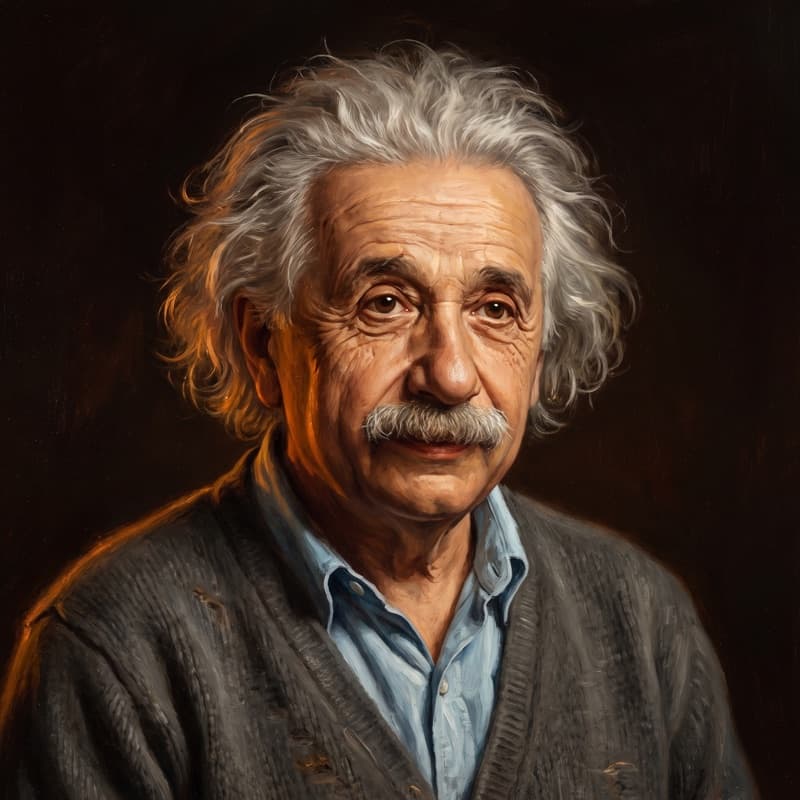
Born March 14, 1879, in Ulm, Germany; died April 18, 1955, in Princeton, New Jersey. Spent 1902–1909 at the Swiss Patent Office in Bern while producing his major early physics. 1905 was his "miracle year," the same year he earned his doctorate. Published general relativity in 1916. His 1921 Nobel Prize was for the photoelectric effect, not relativity. In 1933, after the Nazis seized power, he emigrated to Princeton, becoming a U.S. citizen in 1940. All verified — and below, the popular "facts" that don't survive checking.
The core facts, with why they matter
The Nobel Prize was for the photoelectric effect, not relativity. The 1921 citation reads "for his services to Theoretical Physics, and especially for his discovery of the law of the photoelectric effect" — light behaving in quantized packets. Relativity isn't mentioned at all.
1905 was the "miracle year." While working full-time at the Swiss Patent Office, Einstein earned his doctorate and produced the papers that reshaped physics, including the photoelectric effect, Brownian motion, and special relativity — alongside a day job, not instead of one.
General relativity followed in 1916, after a move to Berlin. He'd become a Kaiser Wilhelm Institute director and Berlin professor in 1914; two years later came the theory that made him a household name once astronomers tested it.
He emigrated to the United States in 1933. After the Nazis seized power, Einstein joined Princeton's Institute for Advanced Study, becoming a U.S. citizen in 1940 and retiring from his Princeton post in 1945.
He signed the Einstein–Szilard letter warning Roosevelt about atomic weapons. On August 2, 1939, Einstein and Leo Szilard warned President Franklin D. Roosevelt that a nuclear chain reaction could produce "extremely powerful bombs." He warned; he did not build — Einstein had no role in the Manhattan Project that followed.
He was offered — and declined — the presidency of Israel. After Chaim Weizmann's death, Israel's government offered Einstein the presidency on November 18, 1952. He turned it down, calling himself "deeply moved" but "saddened and ashamed" that he couldn't accept, citing his lack of "the natural aptitude and the experience to deal properly with people."
From a conversation with our Einstein
An excerpt from our AI Einstein persona — a stylized recreation, honestly labeled; not a historical quotation.
Caller: What do people get wrong about you?
Einstein: That the prize was for the falling apples and the curving light, ja? It was for the photons — the quietest of my 1905 papers. The patent office taught me a man can do serious work without an audience watching.
Popular "facts" that need correcting
"Einstein failed math in school." No. He mastered calculus by around age fifteen; the myth likely grows from a later change in Swiss grading scales that made an old transcript look reversed to modern eyes.
"Einstein's IQ was 160" (or any other number). No verified IQ-test record exists in the documented biographical record. Treat any circulating number as folklore.
"God does not play dice with the universe." Not Einstein's exact sentence. The real, dated originals are two letters to physicist Max Born: in 1926 he was "convinced that He is not playing at dice," and in 1944 he told Born, "you believe in the God who plays dice, and I in complete law and order." The popular line is a later paraphrase.
"Insanity is doing the same thing over and over again and expecting different results." Widely attributed to Einstein, with no evidence he said or wrote it. Quote Investigator traces its earliest use to 1981, decades after his death.
Five things Albert Einstein did (the honest short list)
- Produced four landmark physics papers in 1905 while working at the Swiss Patent Office.
- Published the general theory of relativity in 1916.
- Won the 1921 Nobel Prize in Physics for the photoelectric effect.
- Emigrated to Princeton in 1933 after the Nazis seized power in Germany.
- Signed the 1939 Einstein–Szilard letter warning Roosevelt about nuclear weapons.
The fact pages can't hold him
Facts are the skeleton; the voice is the man. Our Einstein — an AI recreation, built from the sourced record and labeled as what it is — can tell you about the compass that first hooked him on wonder and what it felt like to watch an eclipse expedition turn an obscure theorist into a world celebrity overnight. Ask him why he trusted imagination over knowledge.
More in this cluster: Einstein hub · his death · verified quotes · biography.