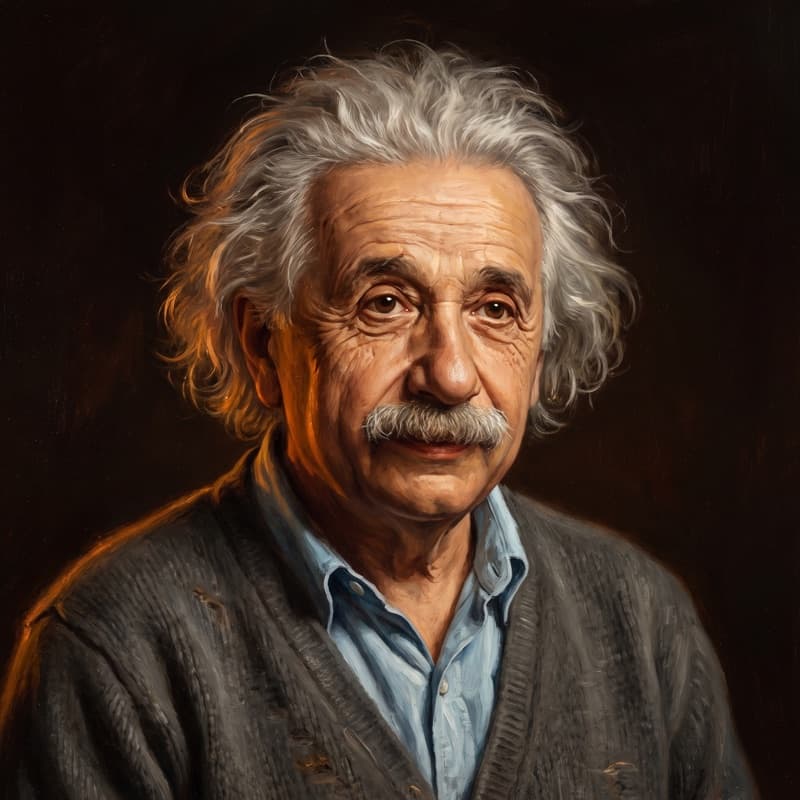
Albert Einstein was born on March 14, 1879, in Ulm, Germany, and died on April 18, 1955, in Princeton, New Jersey — in between, a patent-office clerk rewrote how humanity understands space, time, light, and energy, then spent his last years famous enough to never again have a quiet afternoon. This is a life easy to tell backward from the Nobel medal, as though genius were simply waiting to be discovered. It reads better forward, the way he actually lived it: an unglamorous day job, a burst of work nobody had commissioned, and decades spent absorbing a fame he had not exactly asked for.
From student to patent clerk
Einstein trained at the Swiss Federal Polytechnic School in Zurich, and in January 1903 he married Mileva Marić, a fellow student. From 1902 to 1909 he worked as a technical assistant, Class III, at the Swiss Federal Patent Office in Bern — evaluating other people's inventions for a living while working out several of his own on the side. Nothing about the job title suggested a future Nobel laureate. It suggested a competent civil servant with a night habit.
The miracle year
That night habit produced 1905. While still drawing a patent-office salary, Einstein completed his doctorate and published four papers in a single year — on the photoelectric effect, on Brownian motion, on special relativity, and on the equivalence of mass and energy. Physicists now call it his miracle year, though at the time it changed nothing about his job title.
From a conversation with our Einstein
An excerpt from a conversation with our AI Einstein persona — a stylized recreation, honestly labeled; not a historical quotation.
Caller: Did you know 1905 was going to be the big year?
Einstein: Know it? I was stamping patent applications by day and arguing with light by night. A clerk does not announce a miracle year in advance — he simply notices, one evening, that the equations have stopped behaving the way his professors promised they would, and he follows that thread instead of going to bed.
Berlin, general relativity, and sudden fame
In 1914, Einstein became director of the Kaiser Wilhelm Physical Institute and a professor at the University of Berlin. Two years later he published the general theory of relativity, extending his 1905 work into a full account of gravity. The theory remained a mathematical claim about the universe until May 29, 1919, when Arthur Eddington's solar-eclipse expedition observed starlight bending exactly as Einstein had predicted — and overnight, a physicist known mainly to physicists became a name known everywhere. His marriage did not survive the decade that made him famous: he divorced Mileva Marić on February 14, 1919, and later that year married his cousin, Elsa Löwenthal.
Nobel Prize and exile
Einstein was awarded the 1921 Nobel Prize in Physics — not, as most people assume, for relativity, but for his discovery of the law of the photoelectric effect. The mismatch between what he's remembered for and what the Nobel committee actually cited is one of the stranger footnotes in modern science. It was one of his last settled years. After the Nazis seized power in 1933, Einstein renounced his German citizenship and emigrated to the United States, joining the Institute for Advanced Study in Princeton, where he spent the rest of his life.
Continue the conversation — literally
You have just read the recorded life. Our Einstein — an AI recreation, built on the sourced record and labeled as what it is — speaks from inside it. Ask him about the patent office and the miracle year. Ask what the Eddington eclipse felt like from the inside of overnight fame. Ask about Bern, about Berlin, about the questions he never stopped asking. He answers plainly, curious to the last, the way the record says he talked.
More in this cluster: Einstein hub · his death · verified quotes · facts.