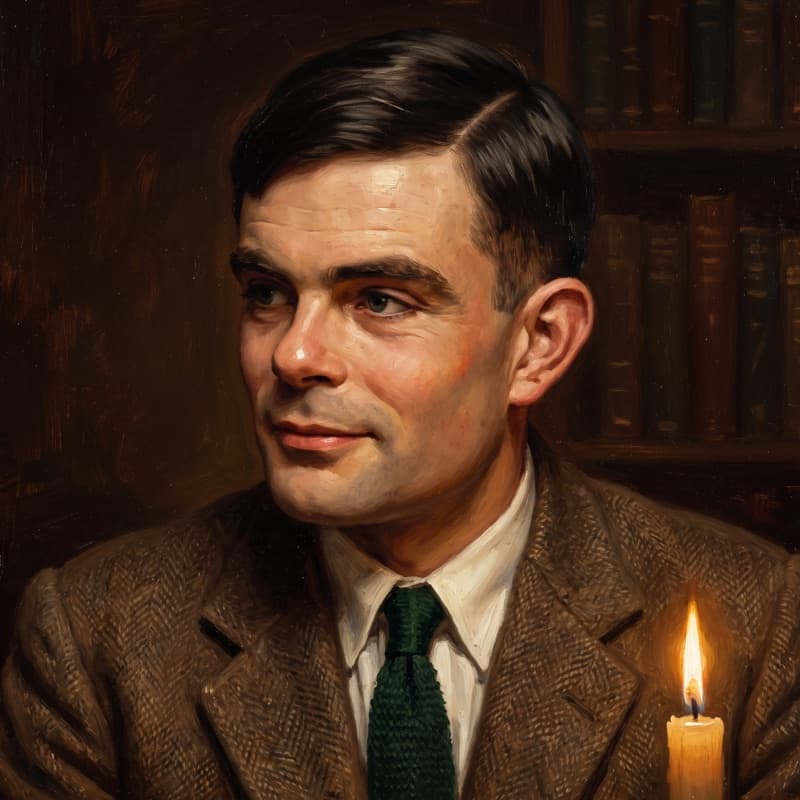
The essential Alan Turing facts: a mathematician and Bletchley Park codebreaker who described a universal computing machine in 1936, posed the question behind the Turing test in 1950, and died from cyanide poisoning in 1954 after a 1952 prosecution under Britain's since-repealed "gross indecency" law. All verified — and this page also flags the popular "facts" that aren't.
The core facts, with why they matter
Born June 23, 1912, in London; entered King's College, Cambridge, in 1931, graduating with distinction in 1934 and winning a Fellowship at King's in 1935, at 22.
"On Computable Numbers," drafted in 1936, is why "Turing machine" is a phrase at all. Its abstract machine — a strip of tape, a table of rules — can imitate any other; that "universal machine" idea underlies every general-purpose computer since. A Princeton PhD followed in 1938.
At Bletchley Park from 1939, he led Hut 8 against German naval Enigma until November 1942, succeeded by his deputy, Hugh Alexander. His Banburismus method narrowed the wheel orders codebreakers had to test, and he was central to the Bombe's design — an OBE followed in 1946.
Afterward he joined the National Physical Laboratory to design ACE, an early stored-program computer, then moved to Manchester in 1948.
His 1950 Mind article, "Computing Machinery and Intelligence," proposed the imitation game — now the Turing test — sidestepping the definition of "thinking" to ask instead whether a machine's conversation could pass for a person's. He was elected a Fellow of the Royal Society in 1951.
In 1952 he published "The Chemical Basis of Morphogenesis," a mathematical theory of how biological patterns emerge from chemical reactions — a late pivot into biology in his last two working years, the same year he was arrested and prosecuted for "gross indecency," the historical legal term then used to criminalize consensual sex between men.
He died from cyanide poisoning at home in Wilmslow in early June 1954. The inquest returned a suicide verdict, though scholars including Jack Copeland have argued the evidence — no note, an untested apple by the bed — is also consistent with accidental exposure from his home electroplating equipment.
He received a royal pardon in 2013, and the 2017 "Alan Turing law" posthumously pardoned an estimated 49,000 men convicted under the same repealed laws. In 2019 the Bank of England named him the face of its polymer £50 note, issued on his birthday in 2021.
From a conversation with our Turing
An excerpt from our AI Turing persona — a stylized recreation, honestly labeled; not a historical quotation.
Caller: Do you think of yourself as a mathematician or an engineer?
Turing: Both, on different days. The proofs taught me what a machine could never do; building one taught me how much I'd underestimated what it could. They still surprise me more often than I'd like.
Popular "facts" that need correcting
"Turing single-handedly cracked Enigma and won the war." He led Hut 8, but the effort built on prior Polish cryptanalysis and a large team.
"Sometimes it is the people who no one imagines anything of who do the things that no one can imagine." Dialogue written for the 2014 film The Imitation Game, not a documented Turing statement.
"Those who can imagine anything can create the impossible." A second inspirational-poster line pinned to his name, with no source in his papers or broadcasts.
Five things Alan Turing did (the honest short list)
- Described a universal computing machine in "On Computable Numbers" (1936).
- Led Hut 8's attack on German naval Enigma at Bletchley Park.
- Helped design ACE, an early stored-program computer, at the National Physical Laboratory.
- Proposed the imitation game — later the "Turing test" — in "Computing Machinery and Intelligence" (1950).
- Published a mathematical theory of biological pattern formation (1952).
The fact pages can't hold him
Facts are the skeleton; the voice is the man. Our Turing — an AI recreation, labeled as such — can walk you through the universal machine or why he found the imitation game a better question than "can machines think?"
More in this cluster: Turing hub · his death · verified quotes · biography.