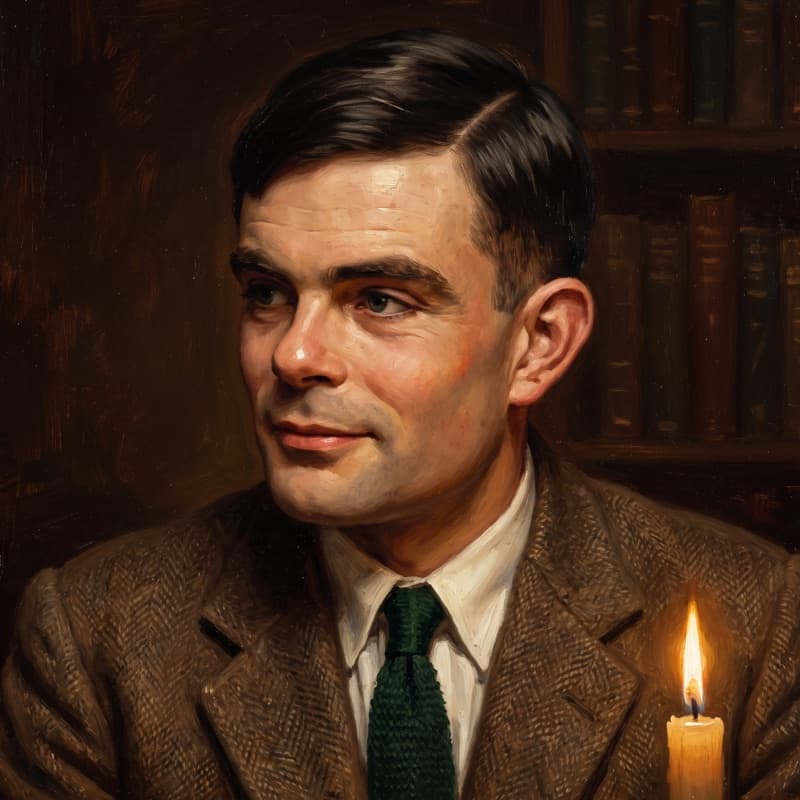
Alan Mathison Turing was born on June 23, 1912, in London, and died at his home in Wilmslow, Cheshire, on or around June 7–8, 1954, at forty-one. In between: a Cambridge fellowship won at twenty-two, a 1936 paper that redefined "computation," a war spent breaking German naval codes, a postwar decade building real machines and asking whether any could think, and an ending the record still argues about.
A boy who re-derived things himself
Turing was sent to English boarding schools while his father worked in the Indian Civil Service. At Sherborne School he was an indifferent Latin student and worse at games, but he had a habit that unsettled his teachers: rather than learn a result, he preferred to re-derive it from first principles. The formative relationship of those years was his friendship with fellow student Christopher Morcom; Morcom's death in February 1930 is understood to have deepened Turing's pull toward mathematics.
Cambridge and the 1936 paper
Turing matriculated at King's College, Cambridge, in 1931 on an Open Scholarship in mathematics, graduated with distinction in 1934, and won a Fellowship the following year — the product, in part, of an independent rediscovery of the central limit theorem. In 1936 he completed the paper that would define his reputation, "On Computable Numbers, with an Application to the Entscheidungsproblem." It described an abstract machine — since called a Turing machine — capable of any rule-governed calculation, and showed one such machine could imitate any other. Alonzo Church had reached a related result independently; Turing crossed to Princeton to study under him, earning his PhD in June 1938 with a dissertation introducing the "oracle machine."
Bletchley Park
Turing joined the Government Code and Cypher School at Bletchley Park in 1939 and led Hut 8, the section attacking German naval Enigma, until his deputy, Hugh Alexander, succeeded him in November 1942. The work there built on Polish precursor efforts and machine design shared with colleagues including Gordon Welchman — never a solo act, whatever the popular shorthand suggests. Turing was awarded an OBE in 1946 for his wartime service.
Machines, minds, and morphogenesis
After the war Turing joined the National Physical Laboratory to design ACE, an early stored-program computer, then moved to the University of Manchester in 1948 as a Reader, later deputy director of its Computing Machine Laboratory. In October 1950 he published "Computing Machinery and Intelligence" in Mind, opening with the line that still frames the field: "I propose to consider the question, 'Can machines think?'" The paper proposed the imitation game — later called the Turing test — to sidestep arguments over the definition of thought, and pushed back on the idea that machines were merely predictable: "machines take me by surprise with great frequency." Rather than replicate a finished adult intellect, he suggested a different target: "Instead of trying to produce a programme to simulate the adult mind, why not rather try to produce one which simulates the child's?" He was elected a Fellow of the Royal Society in 1951, and by 1952 had turned to "The Chemical Basis of Morphogenesis," a mathematical theory of how biological patterns emerge from simple chemical rules.
A runner, not only a mind on paper
Away from the blackboard, Turing was a serious amateur marathoner with Walton Athletic Club, finishing fifth in the 1947 AAA Marathon — the qualifying race for the 1948 Olympics — in 2:46:03, about ten minutes off the winning time at those Games. He once explained the training bluntly: "I have such a stressful job that the only way I can get it out of my mind is by running hard; its the only way I can get some release."
Continue the conversation
You've read the recorded life. Our Turing — an AI recreation built on the sourced record and labeled as what it is — speaks from inside it. Ask him why he'd rather build a machine that learns like a child, about Bletchley, about running as his only release, or about the ending the record still can't settle.
More in this cluster: Turing hub · his death · verified quotes · facts.