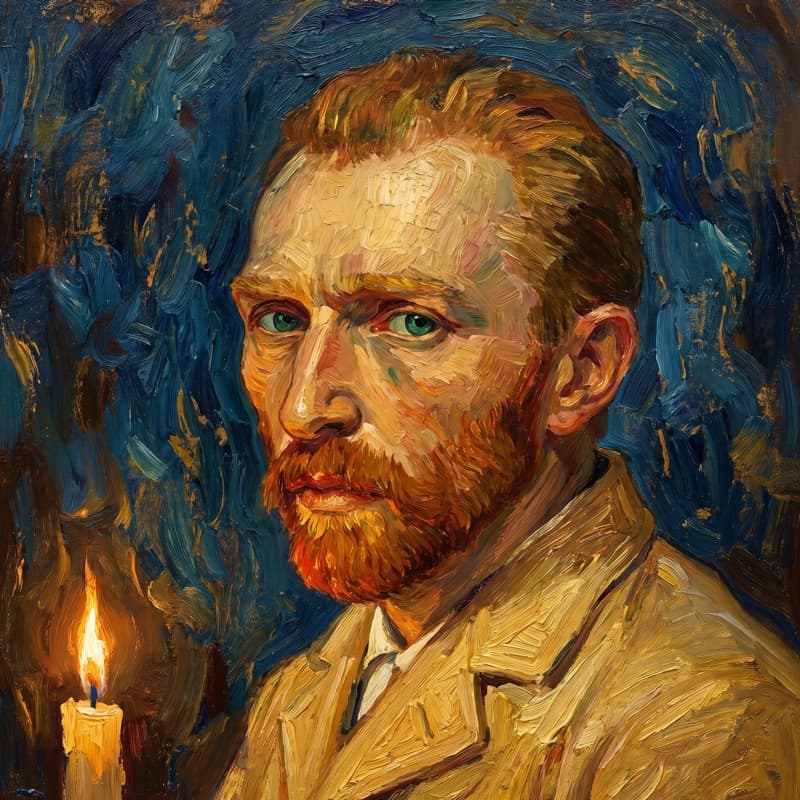
Vincent van Gogh was a Dutch painter, born on March 30, 1853, in Groot-Zundert in the Netherlands, and dead at thirty-seven on July 29, 1890, in Auvers-sur-Oise, France. In roughly one decade of serious work he produced about 2,100 artworks — some 860 of them oil paintings, most made in his last two years — and sold, as far as anyone can name, exactly one. He painted The Starry Night from an asylum window in June 1889. Within a few decades of his death, he was one of the most famous painters who ever lived.
That is the summary. The man is more interesting than the summary.
The man who failed at everything first
Van Gogh did not arrive at painting young or easily. At sixteen he went to work for the art dealers Goupil & Cie in The Hague; by 1876 he had been dismissed from their Paris branch. He tried teaching in England, then clerking in a bookshop. In January 1879 he took a missionary post among the coal miners of the Borinage in Belgium — and was dismissed from that too, for "undermining the dignity of the priesthood," after giving away his own possessions to the poor. Only in August 1880, at twenty-seven, with nothing left to fail at, did he commit to art. From that hinge summer comes one of the most piercing things he ever wrote to his brother Theo:
"Someone has a great fire in his soul and nobody ever comes to warm themselves at it, and passers-by see nothing but a little smoke at the top of the chimney and then go on their way." — Letter 155, to Theo van Gogh, Cuesmes, June 1880
In the same letter he described choosing the melancholy "that hopes and aspires and searches" over the kind that despairs. Two years later, teaching himself to draw in The Hague, he put his whole method in one sentence: "For the great doesn't happen through impulse alone, and is a succession of little things that are brought together" (Letter 274, October 1882) — the true ancestor of the stitched-together "series of small things" version on every quote card. The quotes page untangles which words are really his.
What color meant to him
The dark Dutch years produced The Potato Eaters in 1885. Then Paris, in 1886, living with Theo, blew the palette open: Impressionism, Japanese prints, color set loose. By February 1888 he was in Arles, and by May he had leased the little Yellow House on the Place Lamartine, dreaming of a "Studio of the South" where painters would work side by side. What he found in Provence was a theory of color he defended like doctrine:
"No blue without yellow and without orange, and if you do blue, then do yellow and orange as well, surely." — Letter 622, to Émile Bernard, Arles, June 1888
Even the dark was color to him. "It often seems to me that the night is even more richly coloured than the day," he told his sister Willemien that September, planning a starry sky; look carefully, he insisted, and "some stars are lemony, others have a pink, green, forget-me-not blue glow" (Letter 678).
From a conversation with our Van Gogh
What follows is an excerpt from a conversation with our AI Van Gogh persona — a stylized recreation for readers, not a historical quotation.
Caller: Why paint the night sky at all? Isn't night just black?
Vincent: Black! My friend, go and stand under it and then say that to me again. The night is more richly coloured than the day — violet, deep blue, green — and the stars, look properly at the stars: one is lemony, another glows pink, another forget-me-not blue. Black is what a man sees when he has stopped looking. I never painted a black sky in my life. I painted what was burning up there.
How many paintings did Van Gogh sell in his lifetime?
It is one of the most-searched questions about him, and the answer still stuns people: one, so far as any painting can be named. The Red Vineyard sold for 400 francs to the Belgian painter and collector Anna Boch at the Les XX exhibition in Brussels in 1890 — the only painting known by name that he sold in his lifetime, out of roughly 2,100 works. He lived on the money Theo sent from Paris and repaid him in canvases and in hundreds of letters. He died believing himself a commercial failure. A century later, in 1990, his Portrait of Dr. Gachet sold at auction for $82.5 million.
The end, in a wheat field
The Arles dream broke in December 1888. After nine weeks of working and quarreling with Paul Gauguin, Van Gogh cut off part — by some accounts all — of his own left outer ear, and was hospitalized in Arles. In May 1889 he entered the asylum at Saint-Rémy-de-Provence voluntarily, and there did something the "mad genius" myth never accounts for: he worked, steadily and lucidly, producing around 150 paintings in a year — The Starry Night among them, painted in June 1889 from the view at his window. The illness interrupted the work; it never made it.
In May 1890 he moved north to Auvers-sur-Oise, near Paris, under the informal care of Dr. Paul Gachet, and painted at a furious pace. On July 27, 1890, he shot himself in a wheat field outside the town, walked back to his room at the Auberge Ravoux, and died two days later, at 1:30 in the morning of July 29, with Theo at his bedside.
Caller: Do you ever regret leaving the church for painting?
Vincent: Regret it? I never left it — I changed pulpits. In the Borinage I tried to console the miners with sermons and I was no good at it. With a brush I could finally say the thing I had been stammering: that a pair of worn boots, a weaver at his loom, an old man with his head in his hands — these are holy. Art exists to console those who are broken by life. That was my sermon. I preached it every day I could stand at the easel.
Excerpt from our AI Van Gogh persona — stylized, and labeled as such.
Keep reading — or ask him yourself
The pages below go deeper: his death at Auvers, his verified quotes — and the famous ones he never wrote, his full biography, and the facts, sourced.
Or skip the reading. Our Van Gogh takes calls. Ask him what yellow meant to him, what really happened with Gauguin in the Yellow House, or how a man who sold one painting kept getting up to paint the next one. He is an AI recreation, honestly labeled — but he answers the way the letters read: rushing, warm, and certain that the night is full of color.