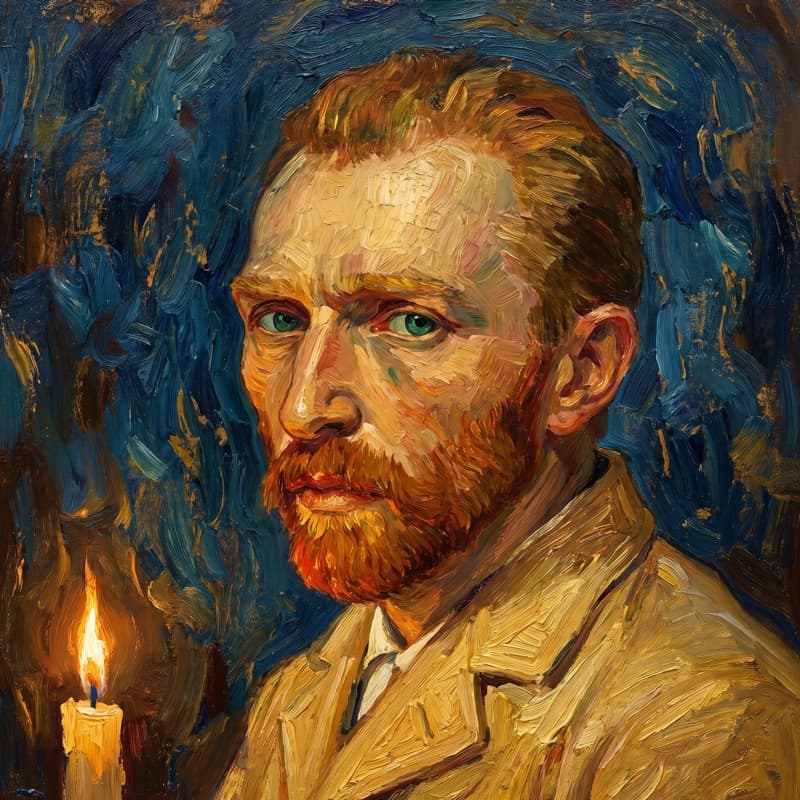
Vincent van Gogh died on July 29, 1890, at 1:30 a.m., two days after shooting himself in the chest or abdomen in a wheat field near Auvers-sur-Oise. He was 37, and he died in his room at the Auberge Ravoux, the inn where he'd been lodging, with his brother Theo at his side (Wikipedia, "Death of Vincent van Gogh"). That's the answer people search for. What happened in between, and what's genuinely uncertain around it, is worth walking through rather than compressing into a legend.
Two days at the Auberge Ravoux
Van Gogh had arrived in Auvers-sur-Oise in May 1890, under the informal care of Dr. Paul Gachet, renting a room at the inn (Wikipedia). On July 27, he went out with his painting gear as usual and came back wounded, walking on his own. Doctors were called; the wound was too serious to treat. Theo arrived and stayed until the end, in the early hours of July 29 (Wikipedia, "Death of Vincent van Gogh"). A quiet, small-scale ending for a life that, within a decade, would be treated as one of the most consequential in the history of painting.
From a conversation with our Van Gogh persona
An excerpt from a conversation with our AI Van Gogh persona — a stylized recreation, honestly labeled, not a historical quotation. Our persona's knowledge doesn't reach past his final letters, so we asked him what he thought the work was for.
Caller: If nobody bought the paintings, why keep making them?
Vincent: Because the making is the honest part, and the selling was never mine to control. I put one color next to another because something in me needed to see if it would hold — the way a man tests a plank before he trusts it with his weight. Theo believes in the work when I can't afford to; that belief is not nothing. Whether the world ever looks is the world's business. Mine is only to keep the fire lit long enough to paint by it.
The words he's said to have spoken
The often-repeated last words are "La tristesse durera toujours" — "The sadness will last forever," reportedly said to Theo (Wikipedia). Treat that as it deserves: a reported deathbed tradition passed down through Theo and later accounts, not a verified transcript to repeat as though a stenographer were in the room.
What's settled, and what people prefer to believe
Van Gogh told the people around him, including the police, that he had shot himself, and he specifically asked that no one else be blamed (Wikipedia, "Death of Vincent van Gogh"). That self-report is the account historians work from. A 2011 biography proposed an alternative — that local teenagers may have shot him by accident and he covered for them — and it drew real attention because it's a good story. It hasn't displaced the self-inflicted account among van Gogh scholars. Mention it for completeness; don't mistake attention for consensus.
Context, not romance
Resist reading the ending back into the work, as if illness gave him his final years' productivity. He had just come through a year at the Saint-Rémy-de-Provence asylum, painting through the illness, not because of it, producing roughly 150 works including The Starry Night before he ever reached Auvers (Wikipedia). Discipline outlasting suffering, over and over, until one day it didn't — a harder and truer story than "tortured genius."
For the fuller arc, read the biography; for his actual words from the letters, the quotes page; for the numbers behind the legend, the fact file; or start at the Van Gogh hub. Our persona won't tell you about that July — his knowledge stops before it — but he'll talk for as long as you like about color, work, and the letters he's still writing to Theo.