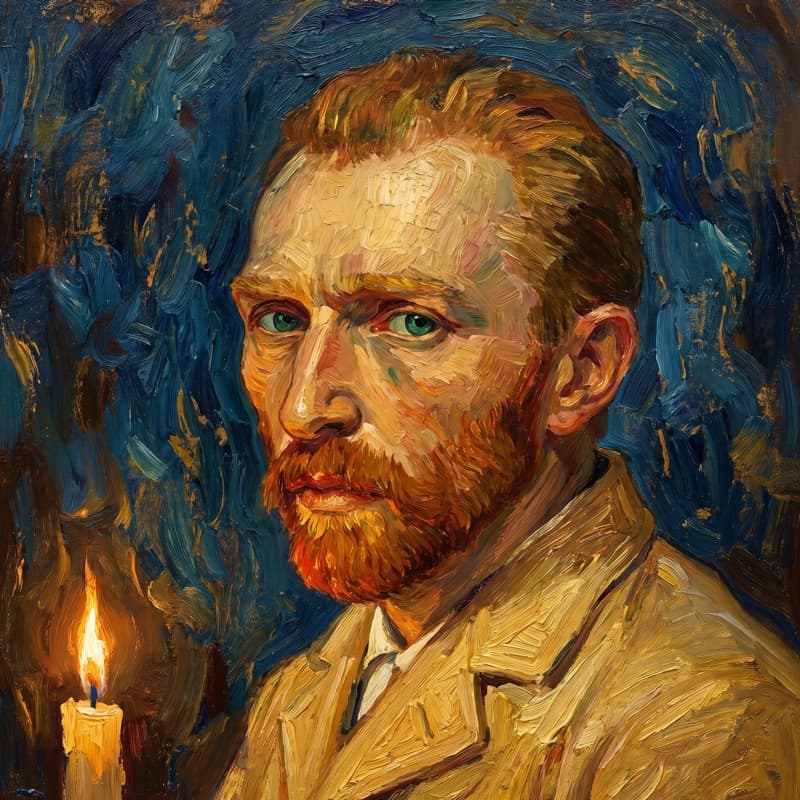
Vincent van Gogh was born on March 30, 1853, in Groot-Zundert, in the Dutch province of North Brabant, the son of a minister, and he died on July 29, 1890, in a rented room above a café in Auvers-sur-Oise, France, with his brother Theo at his side. In between: a painting career that lasted barely a decade, produced roughly 2,100 works, and sold, so far as anyone can confirm, exactly one of them while he was alive. This is a life told mostly through letters to Theo, shaped by four careers that failed before the one that didn't.
Four false starts
At sixteen, van Gogh went to work for the art dealers Goupil & Cie in The Hague, the family trade. Paris followed, then dismissal in 1876, then a stretch as a supply teacher in England and a bookshop clerk in Dordrecht. None of it held. In January 1879 he took a missionary post among coal miners at Petit-Wasmes in the Borinage, and gave away his own bedding, clothes, and money to men poorer than he was. The church dismissed him for what it called undermining the dignity of the priesthood. It is the hinge of the whole biography: the preacher's instinct to sit with suffering people didn't disappear when the pulpit did — it went into the pictures instead. Writing to Theo that year, he put it plainly: "I preferred the melancholy that hopes and aspires and searches" to the kind that only despairs. In August 1880, at 27, he committed to art.
Learning alone, in the dark
He was almost entirely self-taught, copying Jean-François Millet's peasant scenes like scripture. "I want to make drawings that move some people," he wrote to Theo in 1882 — an early statement of a goal he never really revised. By December 1883 he was back with his parents in Nuenen, sketching weavers and farmers in a dark, earthbound Dutch palette, and in May 1885 he finished The Potato Eaters, generally reckoned his first major work.
Paris and Arles: the palette catches fire
In March 1886 he moved to Paris to live with Theo, and over two years among the Impressionists and Japanese prints his colors broke open. By May 1888 he had leased the "Yellow House" in Arles for 15 francs a month, hoping to found a "Studio of the South" — a working community of painters. "It seems to me more and more that people are the root of everything," he told Theo that April. The color theory sharpened into conviction: "No blue without yellow and without orange, and if you do blue, then do yellow and orange as well, surely," he wrote to Émile Bernard that June. Paul Gauguin joined him for nine weeks that autumn. It ended in a confrontation in late December, after which van Gogh injured his own ear — accounts differ on how much of it — and was hospitalized.
The last two years
He voluntarily entered the asylum at Saint-Rémy-de-Provence in May 1889 and stayed a year, painting roughly 150 canvases, including The Starry Night that June. Not long before, from Arles, he'd written to his sister Willemien that "the night is even more richly coloured than the day," and that "some stars are lemony, others have a pink, green, forget-me-not blue glow." In May 1890 he moved to Auvers-sur-Oise, under the informal care of Dr. Paul Gachet, and worked at a furious pace. On July 27 he shot himself in a wheat field near the town; he died two days later, at 37. That same year, at an exhibition in Brussels, the painter Anna Boch bought The Red Vineyard for 400 francs — his only documented sale.
Continue the conversation — literally
You have just read the recorded life. Our Van Gogh — an AI recreation, built on the sourced letters and labeled as what it is — speaks from inside it. Ask him why the Borinage mattered more to him than the pulpit, what he meant by unstable color, or what the Yellow House was supposed to become before Gauguin arrived.
More in this cluster: Van Gogh hub · his death · verified quotes · facts.