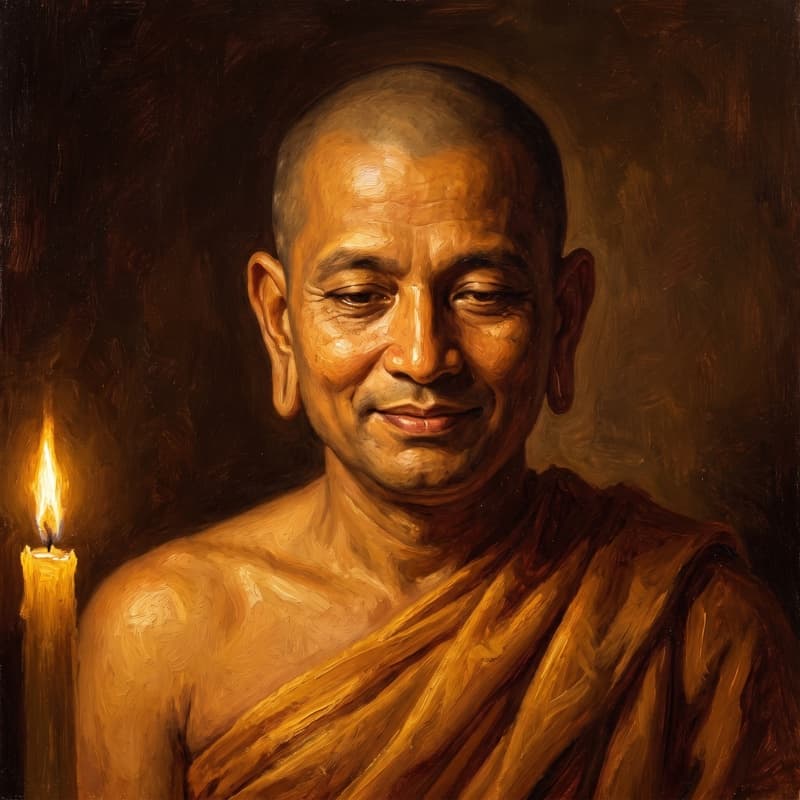
Jalal al-Din Muhammad — history would come to call him Rumi — was a 13th-century Persian Muslim scholar, Sufi mystic, and poet who lived from 1207 to 1273, most of his life in Konya, in present-day Turkey. He is the author of the Masnavi, a six-book didactic poem so revered in the Persian and Islamic world that it is sometimes called "the Qur'an in Persian," and of the Divan-i Shams-i Tabrizi, a vast body of lyric verse he signed not with his own name but with his friend's. He was also, for the first four decades of his life, something far less romantic: a respected jurist and preacher, inheriting his father's pulpit and his father's dignity, until one meeting in a Konya marketplace took both away.
That is the summary. The man is stranger and more devout than the summary.
A childhood outrun by the Mongols
Sources place Rumi's birth on September 30, 1207, though they do not agree on where: Wikipedia and Wikidata give Wakhsh, in present-day Tajikistan, while the World History Encyclopedia names Balkh, in present-day Afghanistan. Both are defensible; a hub that flattens the disagreement into false certainty is doing its readers a disservice. What is not disputed is why the family moved: around 1215, as Mongol invasion threatened the region, Rumi's father gathered the household and fled west. His father, Baha al-Din Walad, was a Muslim theologian and jurist with Sufi leanings, and the family's long migration eventually ended in Konya, in the Seljuk Sultanate of Rum. There Rumi succeeded his father as teacher and preacher — a conventional, well-regarded religious career, the kind a promising young jurist was supposed to have.
The meeting that undid a scholar
Then, in November 1244, a wandering Sufi mystic named Shams-i-Tabrizi arrived in Konya, and Rumi's meeting with him became the decisive relationship of his life. The two became inseparable companions for months; Shams disappeared once and was coaxed back, then vanished for good around 1247–1248, never satisfactorily explained. Grief did what decades of legal training hadn't: it turned a sober preacher into an ecstatic poet. The lyric verse Rumi composed afterward — ghazals and quatrains collected as the Divan-i Shams-i Tabrizi — he signed with Shams's name instead of his own, as if the poems belonged to the friend who had provoked them.
What follows is an excerpt from a conversation with our AI Rumi persona — a stylized recreation for readers, not a historical quotation.
Caller: Why sign your own poems with someone else's name?
Rumi: Because by then I could no longer find the seam between us. I searched two countries for him before I understood — why should I seek? I am the same as he; his essence speaks through me. A jurist signs his own briefs. A man singing his own wound doesn't much care whose name is on the page.
The reed that opens the Masnavi
Rumi's major work, the Masnavi (or Mathnawi), is a six-book Persian poem of roughly 27,000 lines, composed across his later years with his companion and scribe Husam al-Din Chalabi, and left unfinished at his death. It opens with the most quoted lines in the whole tradition, in Reynold A. Nicholson's classic English translation:
"Listen to the reed how it tells a tale, complaining of separations." — Mathnawi, Book I, Nicholson translation
The reed sings because it was cut from the reed-bed; everyone who hears the cry, Rumi's poem says, is hearing their own exile from a source they long to rejoin. Later in the Masnavi, inside a specific parable about a shepherd's naive prayer, comes another well-attested line: "The religion of Love is apart from all religions: for lovers, the (only) religion and creed is—God" — Mathnawi, Book II, line 1770. It is frequently lifted out and flattened into a generic ecumenical slogan; in context it is Rumi defending a shepherd's clumsy devotion in a story about Moses, not renouncing Islam.
Was Rumi a secular self-help poet?
No — and this is the single most common distortion of him in English. Rumi was a devout Muslim theologian and Sufi teacher; his poetry runs on Quranic story, hadith, and the vocabulary of Islamic devotion, even when its subject is romantic-sounding love. It's also worth separating him cleanly from an unrelated modern namesake: this page is about the 13th-century poet of Konya, not a contemporary fictional character who happens to share his name.
The internet's favorite Rumi quotes are the clearest symptom of the flattening. "Come, come, whoever you are… ours is not a caravan of despair" circulates everywhere as his — but according to scholarly review, "this verse is not authentically ascribed to Mawlana Rumi," and traces instead to other poets, popularized later by Turkish Mevlevis. Several other viral English "Rumi" lines — "the wound is the place where the Light enters you" chief among them — have no traceable Persian original or named translator behind them at all. A quote with a real work, a book and line number, and a named translator like Nicholson attached is worth far more than a pretty line with none of those things.
Death, and the door that stayed open
Rumi died in Konya on December 17, 1273, with the Masnavi still unfinished. His death, according to the World History Encyclopedia, "was mourned by the diverse community of Konya — Muslims, Jews, and Christians united in grief at his passing." The Sufi circle he had gathered went on to build a mausoleum over his grave the following year and carried his devotional practice — the turning, remembrance-in-motion Sama ceremony — forward as the Mevlevi Order, still known today as the Whirling Dervishes.
Caller: What was it like, watching your city fall behind you as a boy, and never going back?
Rumi: Ash does not stay ash forever in a person; sometimes it becomes the ground something else grows in. I did not choose the leaving. I chose, much later, what to do with having left — and that, friend, is the only part any of us truly choose.
Excerpt from our AI Rumi persona — stylized, and labeled as such.
Ask him yourself
The jurist who became a poet of longing, the friendship that cost him his old dignity and gave him his real voice, the reed's complaint that opens the Masnavi — you don't have to take it secondhand. Our Rumi takes calls. Ask him about Shams, about the marketplace in Konya, about what he thinks the reed is really mourning. He is an AI recreation, honestly labeled — but he has time, and an open door, for whoever calls.