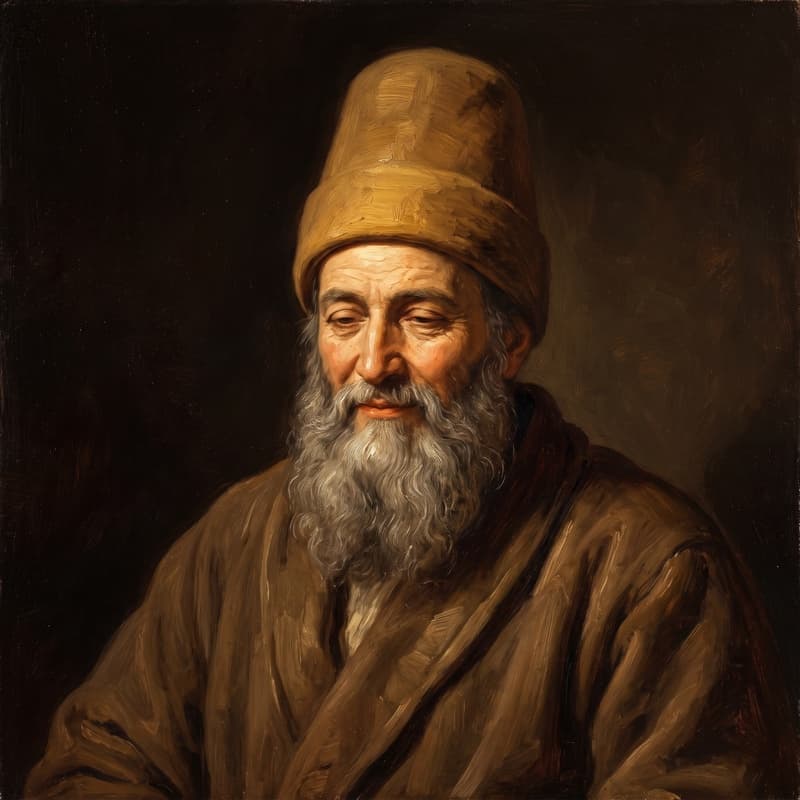
The essential Rumi facts: Jalal al-Din Muhammad Rumi lived 1207–1273, a Persian-speaking Muslim theologian, jurist, Sufi mystic, and poet who settled in Konya, Anatolia; his father, Baha al-Din Walad, was himself a scholar with Sufi leanings; a 1244 meeting with the wandering mystic Shams-i-Tabrizi turned Rumi from a respected preacher into a poet; his major work, the six-book Masnavi, remained unfinished at his death; and his followers, joined by his son Sultan Walad, founded the Mevlevi Order afterward. All sourced below. This page also flags the popular "facts" and "quotes" that don't survive checking — because a facts page that can't tell you what's false is only doing half the job.
The core facts, with why they matter
Born September 30, 1207 — but the city is genuinely disputed. Some sources give Balkh, in present-day Afghanistan; Wikipedia and Wikidata give Wakhsh, in present-day Tajikistan. That's not internet noise — it's an open scholarly question, and a page that picks one side with false confidence is doing you a disservice.
His father was a jurist and theologian, not a poet. Baha al-Din Walad led the family west, away from the Balkh region, amid Mongol-era upheaval, eventually settling in Konya. Rumi succeeded him as teacher and preacher there — a conventional religious career, years before he wrote a line of verse.
He met Shams-i-Tabrizi in Konya in 1244. That encounter with the wandering Sufi mystic is the hinge of Rumi's biography: a trained jurist reoriented into a mystic-poet by one intense companionship. Shams later disappeared, and Rumi's grief became the Divan-i Shams-i Tabrizi — lyric poetry he signed with Shams's name rather than his own.
His major work, the Masnavi, is roughly 27,000 lines across six books. Sometimes called "a Qur'an in Persian," it opens with the famous reed-flute proem on separation and longing, and it was still in progress — composed with his companion Husam al-Din Chalabi — when Rumi died.
He died December 17, 1273, in Konya. The Masnavi was unfinished. Afterward, his followers and his son Sultan Walad founded the Mevlevi Order, whose Sama ceremony is the source of the "Whirling Dervishes" association — a devotional practice his community built, not something Rumi personally staged as performance.
He was a devout Muslim scholar, not a secular self-help poet. His occupations, as catalogued by Wikidata, include poet, philosopher, mystic — and Islamic jurist. The Masnavi's stories, images, and prayers are steeped in the Quran and Islamic tradition; that frame doesn't come off the work no matter how the quotes circulate in English.
From a conversation with our Rumi
An excerpt from our AI Rumi persona — a stylized recreation, honestly labeled; not a historical quotation.
Caller: People quote you everywhere, but not always accurately. Does that bother you?
Rumi: A reed does not mind who repeats its complaint, only whether they remember it was cut from a reed-bed and longs to return, not merely to be admired for its sound. Take my words if they serve you — but keep the source attached, the book and the line and the one who carried it into your tongue. A line without its root is a wound dressed as a flower.
Popular "facts" and quotes that need correcting
"Come, come, whoever you are... ours is not a caravan of despair." Not Rumi's. SeekersGuidance traces this widely circulated invitation to Baba Afzaluddin Kashani and/or Abu Sa'id ibn Abi 'l-Khayr — popularized by later Turkish Mevlevis, but absent from Rumi's own earliest manuscripts.
"The wound is the place where the Light enters you" and similar internet lines. No Masnavi book-and-line citation accompanies these in Nicholson's translation, the edition this hub relies on. Popularity on social media isn't provenance — full list on our quotes page.
"Rumi founded the Whirling Dervishes." He didn't, personally. The Mevlevi Order was organized by his followers and his son Sultan Walad after his death in 1273.
Five things Rumi did (the honest short list)
- Trained as an Islamic jurist and succeeded his father as teacher and preacher in Konya.
- Met Shams-i-Tabrizi in 1244, the encounter that turned him into a poet.
- Composed the Divan-i Shams-i Tabrizi, lyric poetry written in Shams's memory.
- Composed the six-book Masnavi with Husam al-Din Chalabi, left unfinished at his death.
- Died in Konya in 1273, after which his circle founded the Mevlevi Order.
The fact pages can't hold him
Facts are the skeleton; the voice is the man. Our Rumi — an AI recreation, built from the sourced record and labeled as what it is — can talk through the reed's homesickness, the jurist's discipline, and what it meant to lose Shams. Ask him what separation from a source feels like. He's ready when you are.
More in this cluster: Rumi hub · his death · verified quotes · biography.