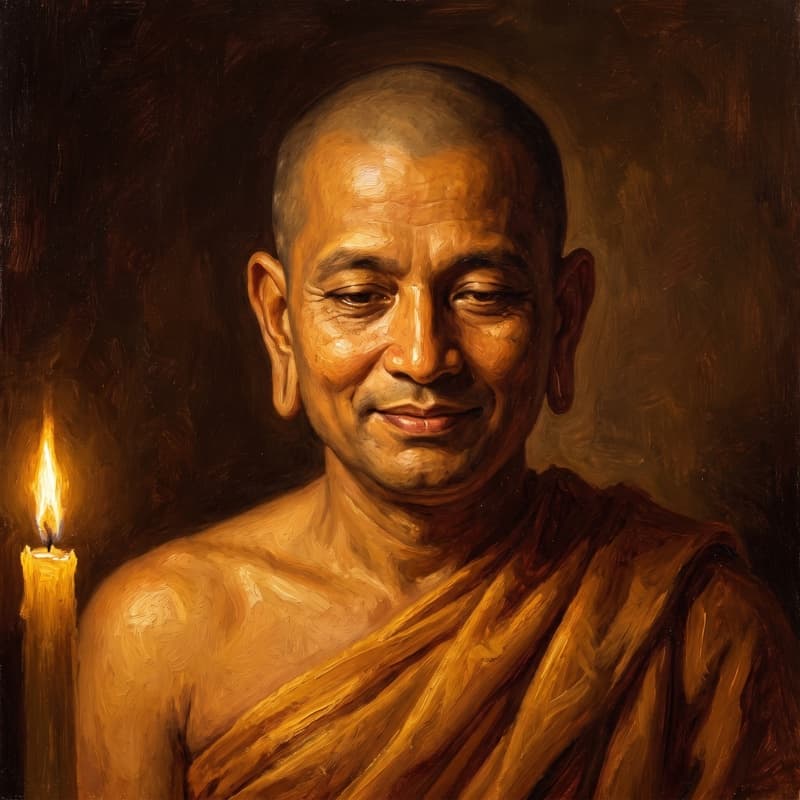
Portrait of Buddha

Northern India, 5th Century BC · Sages & Mystics

Buddha

The teacher remembered in Buddhist traditions for a path of ethical practice, meditation, and liberation from suffering.

Call BuddhaReal-time AI voice call · 2 minutes freeFact-checked · last reviewed 2026-07-13

The Buddha — Siddhartha Gautama, "the Awakened One" — was a teacher in northern India whose traditional dates run from about 563 to 483 BCE, though historians openly disagree about the chronology. Buddhist tradition holds that he was born at Lumbini in present-day Nepal, left a privileged household at twenty-nine, attained awakening beneath a Bodhi tree at Bodh Gaya, gave his first sermon at the Deer Park in Sarnath, and died at Kushinagar in his eightieth year. From his teaching grew Buddhism — today one of the world's largest religions.

That is the summary. The evidence is more interesting than the summary.

A man historians can almost touch

Scholars generally treat Gautama as a real historical teacher while acknowledging that most biographical detail comes from religious literature written down long after his lifetime. Even his dates are honestly uncertain: proposed chronologies range from 624–544 BCE to 448–368 BCE, and a 1988 scholarly symposium leaned toward a death within about twenty years of 400 BCE.

But the ground itself has something to say. In 2013, archaeologists excavating beneath the Maya Devi Temple at Lumbini found traces of a timber tree-shrine dated to the sixth century BCE — the earliest known Buddhist shrine structure, though some scholars caution it could reflect older tree veneration. And a sandstone pillar at Lumbini, erected by the emperor Ashoka in the mid-third century BCE and rediscovered in 1896, states in Brahmi script that Ashoka came to worship the spot "because the Buddha Shakyamuni was born here." That inscription is the oldest surviving physical testimony to his birthplace — carved perhaps a century and a half after his death, by an emperor who made the village tax-exempt in his honor.

The physician's method

The traditional biography reads like a diagnosis. A prince raised behind walls built against sorrow rides out and meets the Four Sights — old age, sickness, death, and a wandering ascetic at peace with all three. Historians treat the Four Sights story as symbolic rather than reportage, but the arc it dramatizes is the core of the teaching: he left home around twenty-nine, nearly starved himself through six years of asceticism, abandoned extremes for a "middle way," and awoke at Bodh Gaya. His first sermon at Sarnath laid out the Four Noble Truths the way a physician presents a case: suffering exists, it has a cause, it has an end, and there is a path to that end.

What he refused to offer was rescue. In the Dhammapada he puts the work squarely on the walker:

"It's for you to strive ardently. Tathagatas simply point out the way." — Dhammapada 276, translated by Thanissaro Bhikkhu

From a conversation with our Buddha

What follows is an excerpt from a conversation with our AI Buddha persona — a stylized recreation for readers, not a historical quotation.

Caller: Your words were written down centuries after you spoke them. How do I know which teachings are really yours?

Buddha: A good question — and I would be disappointed if you did not ask it. When the Kalama people asked me whom to believe among quarreling teachers, I did not say "believe me." I said: do not go by reports, by tradition, or by scripture. Test a teaching as a goldsmith tests gold — heat it, cut it, see what it does in your own life. If a saying makes you more patient, more honest, less afraid, keep it, whoever said it. If it does not, set it down — even if this old man in the shade said it himself.

The quotes he said — and the ones he never did

The internet is thick with fake Buddha quotes, so it matters that real ones exist. The Pali Canon preserves discourses and verses attributed to him — transmitted orally and compiled over centuries, not recorded verbatim, which is why careful pages name the text and the translator. The opening verse of the Dhammapada, in Thanissaro Bhikkhu's translation, begins: "Phenomena are preceded by the heart, ruled by the heart, made of the heart." Verse 223 gives the ethics in one breath: "Conquer anger with lack of anger; bad, with good; stinginess, with a gift; a liar, with truth."

And the famous one? "Three things cannot be long hidden: the sun, the moon, and the truth" — he never said it. The viral line inverts a canonical passage about the moon, the sun, and a Tathagata's openly available teaching. Our quotes page sorts the verified from the viral.

Was the Buddha a god?

Not by his own account, and not in any simple sense within Buddhism either. He presented himself as a man who had awakened, and Buddhist traditions today are genuinely diverse — Theravada, Mahayana, and Vajrayana communities honor him in very different ways, so no single sentence covers "what Buddhists believe" about him.

His death, in the tradition, kept the same modesty. The Mahaparinibbana Sutta places it in his eightieth year, in a grove of sal trees near Kushinagar, after a final meal from the smith Cunda — whom, the text insists, no one should blame. His last words, in the Sister Vajira and Francis Story translation: "All compounded things are subject to vanish. Strive with earnestness." Other translators render the line differently — "subject to decay, strive on with diligence" — a good reminder that every English Buddha quote is somebody's translation.

Caller: People have argued for centuries about whether you were a god. Settle it.

Buddha: They asked me this while I was alive, you know — am I a god, a spirit, a magician? I gave them the only answer I had, and I give it to you: I am awake. A man fell asleep in a burning house and woke; that is the whole of my biography. Do not build a shrine to the waking. Ask instead why you are still curled so comfortably in the smoke.

Excerpt from our AI Buddha persona — stylized, and labeled as such.

Keep reading — or ask him yourself

The pages below go deeper: his death and last words, his verified quotes and the famous fakes, his full biography, and the facts, sourced.

Or skip the reading. Our Buddha takes calls. Ask him why he walked out of the palace, what the raft parable actually asks you to let go of, or how a restless mind gets tamed without being fought. He is an AI recreation, honestly labeled — but he answers with the unhurried patience of a man who has set his burden down, and he has time for you.
Portrait of Buddha

Live from the archive

Ask Buddha yourself

Reading about Buddha is one thing. Talking to Buddha is the product. Try a call — 2 minutes free, no card.

An AI voice persona of Buddha — not a recording.

Start a call

2 free minutes with Buddha

Live voice, right in your browser — just press call.

Verified quotes

Every quote below is checked against a primary or scholarly source — the citation sits right under it.

Phenomena are preceded by the heart, ruled by the heart, made of the heart. If you speak or act with a corrupted heart, then suffering follows you — as the wheel of the cart, the track of the ox that pulls it.
Dhammapada 1-2: Yamakavagga: Pairs (trans. Thanissaro Bhikkhu) — Access to Insight
Hostilities aren't stilled through hostility, regardless. Hostilities are stilled through non-hostility: this, an unending truth.
Dhammapada 3-6: Yamakavagga: Pairs (trans. Thanissaro Bhikkhu) — Access to Insight
The non-doing of any evil, the performance of what's skillful, the cleansing of one's own mind: this is the teaching of the Awakened.
Dhammapada 183-185: Buddhavagga: Awakened (trans. Thanissaro Bhikkhu) — Access to Insight
Conquer anger with lack of anger; bad, with good; stinginess, with a gift; a liar, with truth.
Dhammapada 221-224: Kodhavagga: Anger (trans. Thanissaro Bhikkhu) — Access to Insight
Don't go by reports, by legends, by traditions, by scripture, by logical conjecture, by inference, by analogies, by agreement through pondering views, by probability, or by the thought, 'This contemplative is our teacher.'
To the Kalamas (Kalama Sutta), Anguttara Nikaya 3.65 (trans. Thanissaro Bhikkhu) — Access to Insight
Even as a mother protects with her life her child, her only child, so with a boundless heart should one cherish all living beings.
Karaniya Metta Sutta: The Buddha's Words on Loving-Kindness, Sutta Nipata 1.8 (trans. Amaravati Sangha) — Access to Insight

Key facts

  • Buddhist tradition identifies the Buddha as Siddhartha Gautama; historians generally treat him as a historical teacher, while many biographical details are legendary or uncertain.

    Siddhartha Gautama — World History Encyclopedia
  • A common traditional chronology places his life around 563-483 BCE, but the evidence does not support precision on every episode of that account.

    Siddhartha Gautama — World History Encyclopedia
  • Modern academic dating is genuinely unsettled: proposed chronologies for his birth and death range from 624-544 BCE to 448-368 BCE, and a 1988 scholarly symposium's majority view placed his death within about 20 years of 400 BCE.

    The Buddha — Wikipedia
  • Traditional biography names his father as Suddhodana, an elected chief of the Shakya clan; his mother as Maya, a princess of Devdaha; his wife as Yasodhara; and his son as Rahula.

    The Buddha — Wikipedia
  • In 2013, a Durham University-led excavation beneath the Maya Devi Temple at Lumbini found timber-post traces of an open-air tree shrine radiocarbon- and luminescence-dated to the mid-6th century BCE, the earliest known Buddhist shrine structure, though some scholars caution it could reflect earlier, non-Buddhist tree veneration.

    Oldest Buddhist Shrine Uncovered In Nepal May Push Back the Buddha's Birth Date — National Geographic
  • A pillar erected at Lumbini by the Mauryan emperor Ashoka in the 3rd century BCE and rediscovered in 1896 bears a Brahmi inscription stating that Ashoka personally visited and worshipped the site because the Buddha was born there, the earliest surviving epigraphic confirmation of Lumbini as his birthplace.

    Lumbini pillar inscription — Wikipedia
  • Buddhist tradition holds that, after a period of ascetic practice followed by a 'middle way' between indulgence and austerity, Gautama attained awakening while meditating beneath a Bodhi tree at Bodh Gaya.

    Siddhartha Gautama — World History Encyclopedia
  • According to Buddhist tradition, his first sermon at the Deer Park in Sarnath, near Varanasi, introduced the Four Noble Truths and the Eightfold Path.

    Siddhartha Gautama — World History Encyclopedia
  • Buddhist tradition (the Mahaparinibbana Sutta) places his death in his eightieth year at Kushinagar, in a grove of sal trees, with a final teaching that all conditioned things are impermanent and urging diligent effort.

    Maha-parinibbana Sutta: Last Days of the Buddha (DN 16) — Access to Insight
  • Buddhist tradition records that, roughly one year after his death, 500 senior monks convened the First Buddhist Council in a cave near Rajagaha under King Ajatashatru's patronage, with Ananda reciting the discourses and Upali the monastic rules; modern scholars debate how much of the canon actually dates to this event.

    Buddhist councils — Wikipedia
  • The Pali Canon preserves discourses and verses attributed to the Buddha, but the texts are religious literature transmitted orally and compiled over subsequent centuries, not a contemporaneous verbatim record.

    Siddhartha Gautama — World History Encyclopedia
  • Buddhism today is a large, internally diverse religion, with roughly 320 million adherents worldwide (about 4.1% of the global population), divided chiefly into Theravada, Mahayana, and Vajrayana traditions with differing doctrine and practice.

    Buddhism — Wikipedia

Timeline

  1. c. 6th century BCE

    Traditional birth at Lumbini

    Buddhist tradition places Gautama's birth at Lumbini, in present-day Nepal; exact dates remain disputed among historians.

  2. c. 6th century BCE

    The Four Sights and Great Departure

    Later biographical tradition places his encounter with old age, sickness, death, and an ascetic, and his renunciation of household life, at around age 29.

  3. c. 6th century BCE

    Awakening at Bodh Gaya

    Tradition holds that after years of ascetic practice, Gautama abandoned extreme austerity for a 'middle way' and attained awakening while meditating beneath a Bodhi tree at Bodh Gaya.

  4. c. 6th century BCE

    First sermon at Sarnath

    Tradition places his first sermon, introducing the Four Noble Truths and the Eightfold Path, at the Deer Park in Sarnath near Varanasi.

  5. c. 6th-5th century BCE

    Death at Kushinagar

    Buddhist tradition places his death in his eightieth year at Kushinagar, in a sal grove, with a final teaching on the impermanence of all conditioned things.

  6. c. 5th century BCE

    First Buddhist Council

    Tradition holds that, roughly one year after his death, 500 senior monks convened at a cave near Rajagaha to recite and preserve his teachings and monastic rules; modern scholars debate the event's exact historicity.

  7. c. 268-232 BCE

    Ashoka's patronage and the Lumbini pillar

    The Mauryan emperor Ashoka patronized Buddhism, sent missionaries, and erected a pillar at Lumbini inscribed with confirmation that he had visited the Buddha's birthplace, substantially aiding the tradition's spread beyond its early Indian setting.

  8. 1896

    Rediscovery of the Ashokan pillar

    The Lumbini pillar and its Brahmi inscription, buried about a meter underground, were rediscovered and excavated in December 1896, providing the earliest surviving epigraphic confirmation of Lumbini as the Buddha's birthplace.

  9. 2013

    Archaeological dating of the Lumbini shrine

    A Durham University-led excavation beneath the Maya Devi Temple at Lumbini found timber-post traces of a tree shrine dated to the mid-6th century BCE, the earliest known Buddhist shrine structure, though some scholars urge caution about the find's specific Buddhist attribution.

Questions people ask