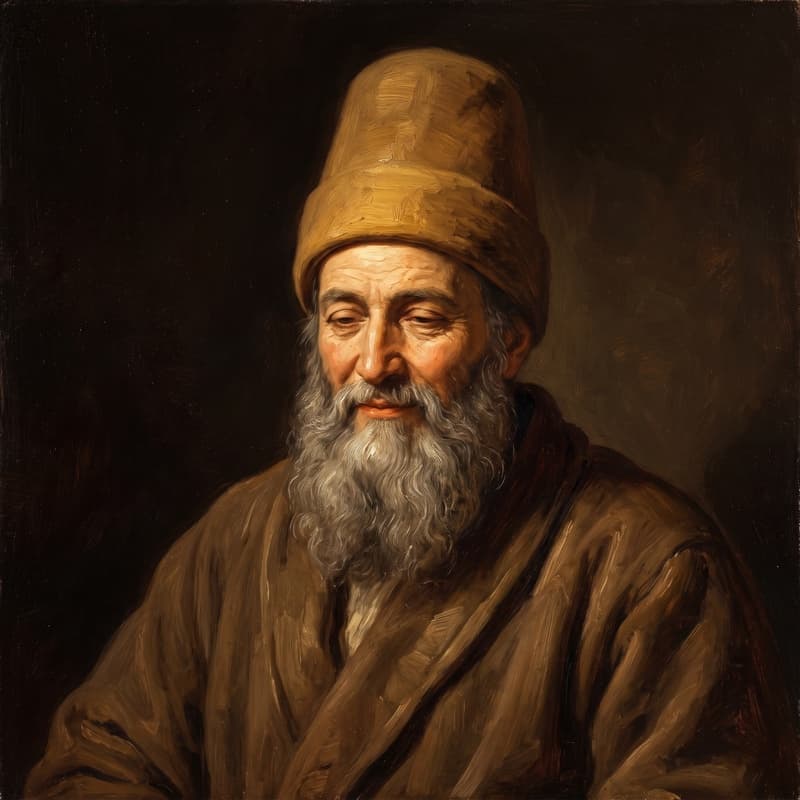
Jalal al-Din Muhammad Rumi was born September 30, 1207, and died December 17, 1273, in Konya, in what is now Turkey (Wikipedia; Wikidata) — a Persian-speaking Muslim jurist, theologian, and Sufi mystic whose late-life turn toward poetry produced the Masnavi and the Divan-i Shams-i Tabrizi (World History Encyclopedia). This biography states only what the cited sources support, and flags the points where scholars still disagree.
A childhood on the move
Sources agree Rumi was born in 1207 but not exactly where: Wikipedia and Wikidata give Wakhsh, in present-day Tajikistan, while the World History Encyclopedia gives Balkh, in present-day Afghanistan (Wikipedia; Wikidata; World History Encyclopedia). That is a genuine open question in the record, not a detail this hub will flatten into false certainty. What is not disputed is the direction of travel: Rumi's father, Baha al-Din Walad, a Muslim theologian and jurist with Sufi leanings, led the family west out of the greater Khorasan region amid Mongol-era upheaval, eventually settling in Konya, then part of the Seljuk Sultanate of Rum (World History Encyclopedia).
A conventional career, before the pivot
Nothing in Rumi's early record points toward the poet he would become. He was trained in Islamic law and theology, and when Baha al-Din Walad died, Rumi succeeded him as teacher and preacher at the family's school in Konya — a respectable, settled religious career (World History Encyclopedia). Wikidata's own list of his occupations — poet, writer, literary scholar, philosopher, mystic, and Islamic jurist — reflects that order: jurist first (Wikidata).
Shams, and the turn to poetry
Everything changes with one meeting. On November 15, 1244, Rumi met the wandering Sufi mystic Shams-i-Tabrizi in Konya, and the companionship that followed reoriented him from settled jurist to ecstatic poet (Wikipedia). Shams disappeared from the record around December 5, 1248; what exactly happened to him afterward is not established with the same certainty as the meeting itself, and this hub keeps that distinction rather than asserting more than the sources do. The grief and transformation that followed produced the lyric poetry gathered as the Divan-i Shams-i Tabrizi — ghazals and quatrains Rumi often signed with Shams's name rather than his own (Wikipedia). Its opening register is audible in Nicholson's translation of a separate Divan poem: "I am silent. Speak thou, O soul of soul of soul" (Internet Archive).
The Masnavi years
In his later years, working with his companion and scribe Husam al-Din Chalabi, Rumi composed the Masnavi (Mathnawi-ye Ma'navi) — a six-book didactic Persian poem of roughly 27,000 lines that opens with the reed's proem: "Listen to the reed how it tells a tale, complaining of separations—" (Internet Archive). Within its parables sits the line "The religion of Love is apart from all religions: for lovers, the (only) religion and creed is—God," spoken inside a specific Moses-and-the-shepherd episode, not as a stand-alone slogan (Dar-al-Masnavi). The Masnavi remained unfinished when Rumi died.
What this biography does not claim
Rumi was not a secular self-help poet, and not every English line attributed to him online belongs to him. The popular verse "Come, come, whoever you are... ours is not a caravan of despair" is not authentically ascribed to Rumi at all; it traces instead to Baba Afzaluddin Kashani and/or Abu Sa'id ibn Abi 'l-Khayr (SeekersGuidance). Every genuine quotation here is a named translator's rendering of Persian verse, not Rumi's own English words.
Death and legacy
Rumi died in Konya on December 17, 1273 (Wikipedia; Wikidata). Afterward, his followers, joined by his son Sultan Walad, founded the Mevlevi Order — the Whirling Dervishes — built around the Sama ceremony of devotional remembrance (Wikipedia).
Related pages
Rumi hub · his death · verified quotes · fact file.
Where the documents stop, a conversation can continue — this site hosts an AI recreation of Rumi, built on the sourced record above and labeled as exactly that.