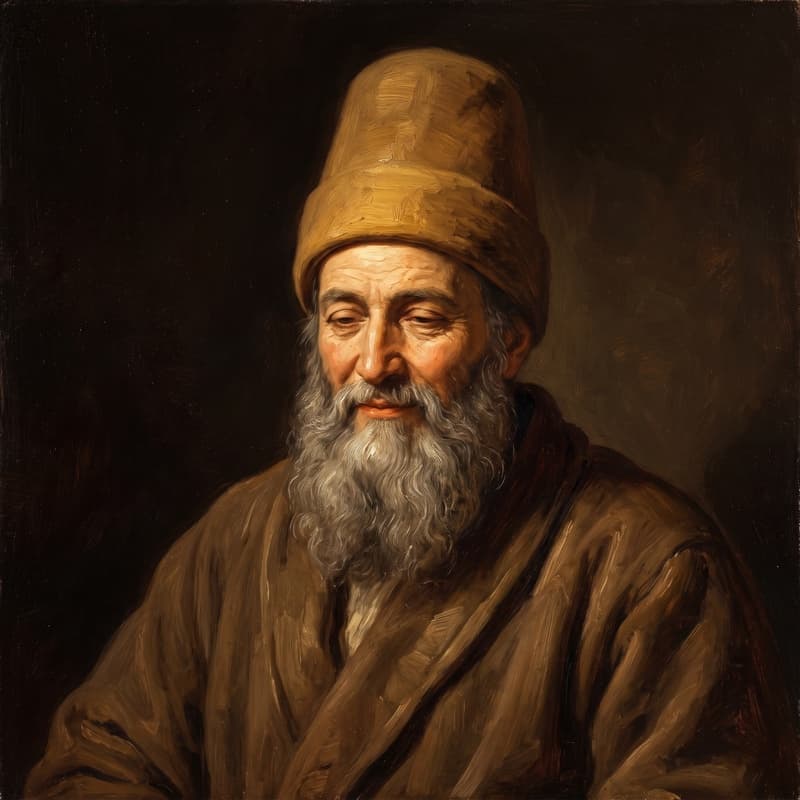
Jalal al-Din Muhammad Rumi (1207–1273) wrote in Persian. Every English line attributed to him on this page is Reynold A. Nicholson's translation of a specific book and line of the Masnavi, not a free-floating maxim — and not the words of the unrelated modern character who shares his name. Read that way, on purpose, because most quote pages strip the frame off first.
The reed's complaint
The Masnavi opens with the Ney-nameh, the reed's lament, cut from its reed-bed and made to sing of separation:
"Listen to the reed how it tells a tale, complaining of separations—"
"Every one who is left far from his source wishes back the time when he was united with it."
That is theology, not nostalgia: the reed stands for the soul cut off from God, and its "source" is the reed-bed it was cut from. Two lines later, the reed turns from cosmic longing to something more specific — the ache of being known only partway:
"Every one became my friend from his own opinion; none sought out my secrets from within me."
And the proem's most guarded line, easy to secularize and worth resisting that urge on:
"Body is not veiled from soul, nor soul from body, yet none is permitted to see the soul."
A shepherd, a rebuke, and one famous line
Book II carries the line quoted more than any other outside the proem:
"The religion of Love is apart from all religions: for lovers, the (only) religion and creed is—God."
It comes from a specific parable: Moses corrects a shepherd for praying to God too plainly and familiarly, and is himself rebuked for missing the shepherd's sincerity. Lifted out of that story, the line reads as a generic ecumenical slogan. Left inside it, it is Rumi arguing that God judges the heart's devotion over its correct religious form — a Muslim mystic's argument, not a dissolution of religion itself.
Quotes Rumi never wrote
Several of the internet's favorite "Rumi quotes" have no Persian source and no Nicholson line behind them: "The wound is the place where the Light enters you," "What you seek is seeking you," "You were born with wings, why prefer to crawl through life?," "Stop acting so small. You are the universe in ecstatic motion," and "Out beyond ideas of wrongdoing and rightdoing there is a field. I'll meet you there" all circulate as Rumi with no traceable book, line, or translator attached. The most famous fake of all, "Come, come, whoever you are… ours is not a caravan of despair," has been traced by Islamic scholarship to Baba Afzaluddin Kashani and/or Abu Sa'id ibn Abi 'l-Khayr — not Rumi, and popularized centuries after him by Turkish Mevlevis (SeekersGuidance). If a "Rumi quote" reads like a greeting-card slogan with no book and line attached, that is itself a warning sign.
Ask him yourself
Our Rumi — an AI recreation, clearly labeled, not a historical record — can walk you through why the reed complains, what the shepherd's prayer meant to him, or what was lost when Shams disappeared. He answers as the jurist-turned-poet the record describes, not as a source of unsourced maxims.
More in this cluster: Rumi hub · his death · biography · facts.