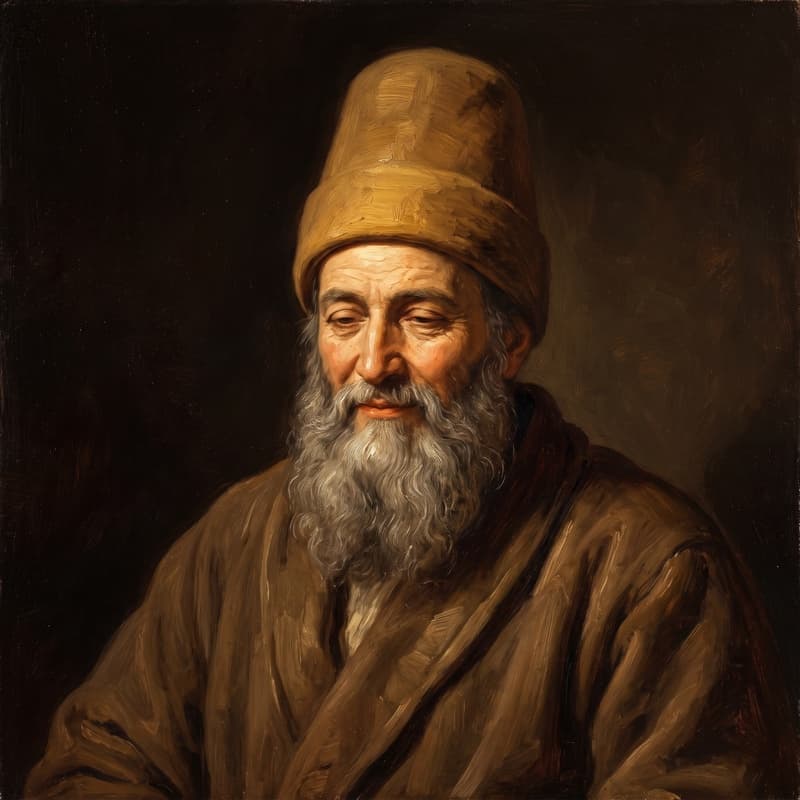
Jalal al-Din Muhammad Rumi died on December 17, 1273, in Konya, in what was then the Seljuk Sultanate of Rum and is now Turkey. He had spent his later decades composing the Masnavi, his six-book Persian poem of Quranic story, parable, and Sufi teaching, working with his companion and scribe Husam al-Din Chalabi — and the poem was still unfinished when he died.
That's the secure answer. The fuller picture is about what a life devoted to longing for God looks like at its end, and what came after.
A poem left unfinished
By the time of his death, Rumi had spent roughly two and a half decades as a poet rather than the conventional jurist and preacher he'd been trained to become — a shift set in motion by his 1244 meeting with the wandering mystic Shams-i-Tabrizi in Konya. The Masnavi, sometimes called "a Qur'an in Persian," runs to some 27,000 lines across six books, and Rumi was still dictating it to Husam al-Din Chalabi in his final years. It remained incomplete at his death, a working manuscript rather than a closed book — fitting for a poem that opens by comparing itself to a reed cut from the reed-bed, still telling its tale of separation.
Mourned across Konya
World History Encyclopedia's account of Rumi's life records that his death was mourned across Konya's religiously diverse community, not only by his own Muslim and Sufi circle. Konya in the thirteenth century held Christian, Jewish, and Muslim populations living under Seljuk rule, and the breadth of that mourning is treated as a marker of how far Rumi's reputation as a teacher had reached beyond any single congregation. This is worth stating carefully rather than romantically: the source is a modern historical account of his life, not a contemporary eyewitness record, and the specific texture of that mourning — who exactly turned out, and why — isn't preserved.
From a conversation with our Rumi
An excerpt from a conversation with our AI Rumi persona — a stylized recreation built from his poetry and historical record, honestly labeled, not a historical recording. Our Rumi's knowledge ends before that final illness in Konya.
Caller: Are you afraid of finishing your work unfinished?
Rumi: Friend, the reed's whole complaint is that it was cut from the reed-bed before it was ready — and still it sings. I have given the Masnavi to Husam as much as I have given it to paper; the telling doesn't stop with me, it only changes hands. What frightens the self is being unfinished. What the soul wants is only to go home to its source. Those are not the same fear, once you look at them closely.
What came after
Rumi's death did not end the circle he had gathered. His followers, joined by his son Sultan Walad, formed the Mevlevi order afterward — the community later known in the West as the Whirling Dervishes, centered on the Sama, a devotional ceremony of remembrance rather than a folk dance. Popular retellings sometimes dress Rumi's death in miracle stories and elaborate legend built up over the centuries since. What's actually documented is narrower and, honestly, still striking on its own: a scholar-turned-poet who died with his masterwork mid-sentence, mourned by a city larger than his own sect, whose students then built an order to carry the practice forward.
Ask our Rumi about the reed's complaint, about Shams and the grief that made him a poet, or about what it means to be a jurist who found rapture without excusing himself from duty. His knowledge stops short of that last illness — but everything that shaped it is his to tell.
More in this cluster: Rumi's verified quotes · his biography · fact file · back to the Rumi hub.