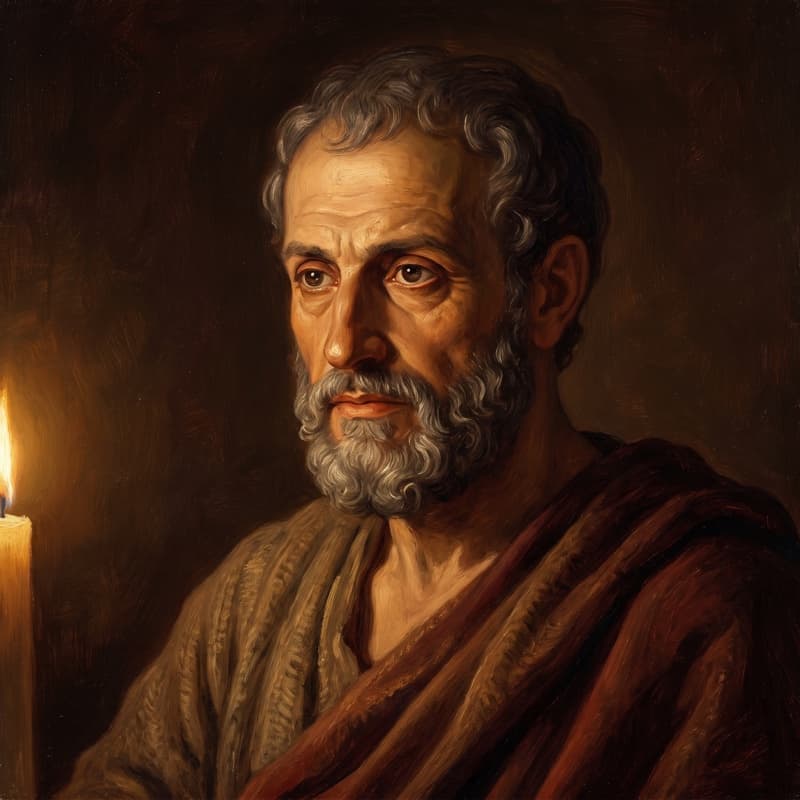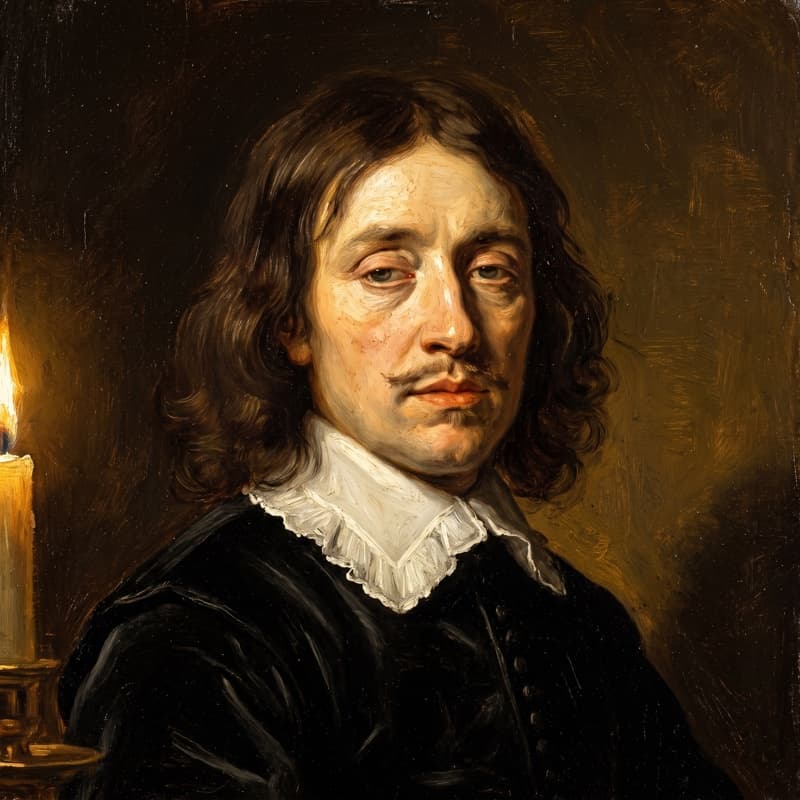
René Descartes was a French soldier, mathematician, and philosopher born on March 31, 1596, at La Haye en Touraine, and he died in Stockholm on February 11, 1650, at the age of fifty-three. In between, he served in two armies, spent a single night in a stove-heated room that changed the direction of Western philosophy, founded what would become analytic geometry, and wrote the sentence every schoolchild half-remembers — "I think, therefore I am" — inside a much more careful argument than the slogan usually gets credit for.
That is the summary. The man took longer to arrive at it than the summary suggests.
The lawyer's son who put down the books
Descartes was educated by the Jesuits at the Collège Royal Henry-Le-Grand in La Flèche, one of the finest schools in Europe, entering around 1607 and staying until roughly 1614 or 1615. He took a law degree at Poitiers in 1616 — then, instead of practicing law, closed the books. In 1618 he became a gentleman-soldier under Prince Maurice of Nassau at Breda in the Dutch Republic; in 1619 he left to join the Catholic army of Maximilian I of Bavaria. He was, by his own later account, more observer than combatant — a young man reading what he called the great book of the world.
That reading produced its most important page on a single winter night. Quartered near Neuburg an der Donau on November 10–11, 1619, Descartes shut himself in a stove-heated room to escape the cold. Alone with his thoughts, and then through three vivid dreams that same night, he arrived at the idea that had eluded him at La Flèche: that all knowledge might be unified and proved as rigorously as geometry — one method, one chain of certainty, running from mathematics up to physics and philosophy.
What "I think, therefore I am" actually proves
By the late 1620s Descartes had settled in the Dutch Republic, where he lived for most of the next two decades, moving frequently and corresponding widely. It was there that he built the method into books. The 1637 Discourse on the Method laid out the plan and appended three scientific essays — including the Geometry, which married algebra to curves and eventually gave the world the Cartesian coordinate plane. Its opening line is one of the most quoted (and least read past) sentences in philosophy:
"Good sense is, of all things among men, the most equally distributed; for every one thinks himself so abundantly provided with it..." — A Discourse on Method, Part I, trans. John Veitch (Wikisource)
The cogito itself arrives later, in Part IV, and it is not an opening premise — it is a survivor. Descartes has just spent pages treating every belief that admits the slightest doubt as false: the senses deceive, dreams counterfeit waking, even mathematics might be the trick of a powerful deceiver. What is left is the noticing itself:
"I think, therefore I am (COGITO ERGO SUM), was so certain and of such evidence that no ground of doubt, however extravagant, could be alleged by the sceptics capable of shaking it." — A Discourse on Method, Part IV, trans. John Veitch (Wikisource)
He rebuilt from there. In the 1641 Meditations on First Philosophy, the wax argument makes the same point a different way: a piece of honeycomb changes shape, scent, and hardness the moment it is warmed, yet something about it persists — and that something, Descartes argues, is grasped by the intellect, not the senses. "Bodies themselves are not properly perceived by our senses or imagination, but only by our understanding," as the Meditations put it. This is also where Cartesian dualism earns its popular reputation for treating mind and body as separate machines with no relation — a reputation the text itself complicates, since Descartes insists mind and body are united far more intimately than a pilot is joined to a ship.
From a conversation with our Descartes persona
What follows is a stylized recreation for readers, not a historical transcript.
Caller: Doesn't doubting everything just leave you with nothing?
Descartes: Only if you mistake the tool for the house, my friend. I did not doubt in order to live in doubt — I doubted the way a mason tests a foundation, to see what will bear weight. Almost everything gave way. One thing did not: that I, doubting, was thinking, and that a thing that thinks must exist in order to do it. From that single stone I built the rest. Try it on whatever troubles you tonight, and tell me what survives the test.
The quiet life, the mask, and one grief
Descartes chose the Dutch Republic in part because, as he saw it, a nation this busy making money left a philosopher free to think unnoticed, in the middle of a crowd. His correspondence ran largely through the priest Marin Mersenne in Paris, who circulated the Meditations for formal objections from Hobbes, Arnauld, and others before Descartes published his replies alongside them. He was careful, too: after learning what Rome had done to Galileo, he suppressed an earlier treatise on the physical world, resolving instead to advance quietly rather than announce his physics outright. In 1635 his daughter Francine was born in Deventer; she died of scarlet fever in 1640, at five years old, a private wound the record shows him carrying quietly rather than announcing to the correspondents who otherwise heard nearly everything.
The schedule that killed him
In 1649, Queen Christina of Sweden invited Descartes to Stockholm to tutor her in philosophy — and reportedly insisted on lessons at five in the morning. It broke a habit Descartes had kept since boyhood at La Flèche, where his poor health had earned him a dispensation to stay in bed until eleven. Walking to the palace through a Swedish winter for pre-dawn lessons brought on pneumonia. He died on February 11, 1650, months after arriving — not refuted by any rival argument, but undone, as both the Stanford Encyclopedia of Philosophy and the MacTutor History of Mathematics Archive frame it, by a change in climate and clock that his body could not survive.
Caller: Do you regret going to Stockholm?
Descartes: Regret is a passion, and passions are to be governed, not indulged — though I confess this one resists governing more than most. I went because a queen asked and because philosophy, to be worth anything, must be willing to leave the stove. I did not reckon on the particular arithmetic of a Swedish morning. Even a method has limits it discovers only once.
Excerpt from our AI Descartes persona — stylized, and labeled as such.
Keep reading — or ask him yourself
Go deeper: his full biography, his final months and death in Stockholm, his verified quotes in context, and the facts, sourced.
Or skip the reading and call him. Ask what the stove-heated room actually felt like at three in the morning, what precisely a thinking thing is if it isn't a body, or how a man defends a habit of rising at eleven when a queen wants him awake at five. He is an AI recreation, honestly labeled — but he answers in his own voice, methodically, and he has time for the objection you think will stump him.